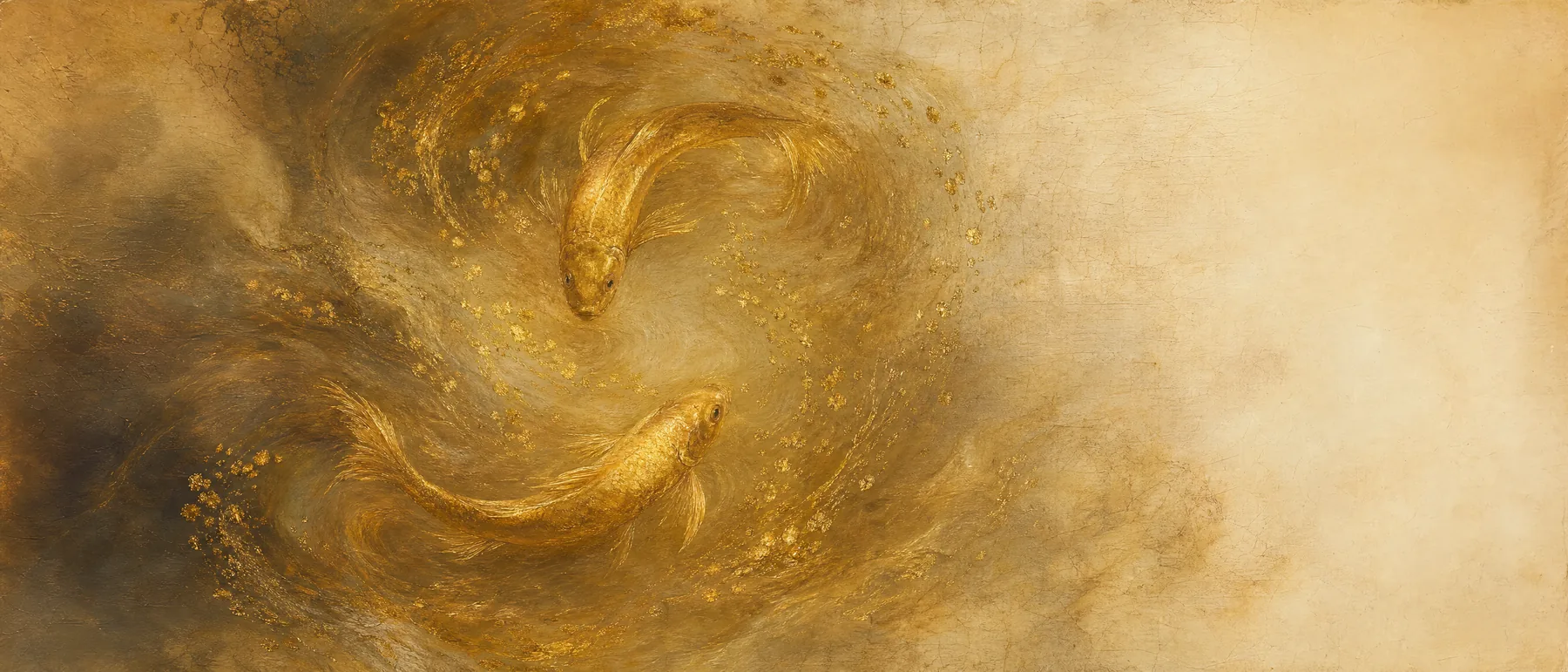
Adar — the Hebrew month of Pisces
Adar is the month the sages teach us to meet with increased joy — but the joy of Adar is the kind that hides something, the laughter of a fish swimming where no eye can follow.
You learned to laugh early, and you learned it under pressure. Somewhere in your childhood there was a room that could not hold sadness — a family that changed the subject, a parent who reached for the joke before the tears could land, or simply a temperament in you that refused to sit still inside grief. By your teens you had become the lightest person in the heaviest room, the one who could read the air going wrong and turn it before anyone noticed. People born under אֲדָר tend to carry this gift the way others carry a second skin: so naturally that even they forget it is doing work. Your joy is not naïveté. It is a craft, and like all real crafts it has a price most people never see.
This is the central contradiction of the Adar nature. You are openly joyful and deeply hidden at the same time — and the two are not opposites in you, they are the same motion. The brightness is real, but it is also a surface, and underneath it most of you swims somewhere no one is watching. Friends would describe you as warm, funny, easy. Few of them could tell you what frightens you. You prefer it that way, and that preference is exactly the thing worth examining.
Born Under the Fish
The mazal of Adar is דָּגִים — Pisces, the Fish. It is the last sign of the zodiac and the last month of the Hebrew year as counted from Nisan, the place where the cycle completes itself before beginning again. The fish is an unusual emblem because it lives entirely out of sight. It moves through a medium we cannot enter, leaves no tracks, and is gone before you have finished looking. The tradition draws a sharp lesson from this: fish are immune to the evil eye precisely because they cannot be watched. What cannot be seen cannot be envied, cursed, or fixed in place.
You understand this instinctively. Your power has always lived in the parts of you that stay submerged. The danger is that the same depth that protects you can also drown the part of you that wants to be known. A fish out of water is the most exposed creature alive — which is why visibility, for you, feels less like an opportunity than a threat.
The Inheritance of Naphtali
The tribe of Adar is Naphtali, and the name carries the month's whole disposition. When Naphtali is born, Rachel's handmaid names him from her own struggle, but Jacob's later blessing turns him into something nimble and free — a deer let loose, giving good words. The Chassidic tradition hears in the name the phrase sweet to me: a soul that knows how to make the bitter palatable, to deliver hard truth wrapped in lightness so it can be received. That is your social genius and your evasion in a single trait. You can say the difficult thing — but you will almost always say it as a joke, and the joke gives you somewhere to retreat if it lands badly. Naphtali runs swift and speaks sweet. The growth is in learning when to stop running and let the sweet word stand on its own, unhedged.
Kuf, and the Faculty of Laughter
In the סֵפֶר יְצִירָה — the Sefer Yetzirah — each month is assigned a Hebrew letter and a corresponding sense. To Adar belongs the letter ק, Kuf, and the faculty of laughter. This is striking, because laughter is the one sense that is not a sense at all in the ordinary list of seeing, hearing, smelling — it is a response, a release, a sign that something hidden has suddenly been understood. Adar's laughter is not the laughter of mockery; it is the laughter of trust. It is the sound a soul makes when it has decided, against the evidence, that the concealment is not abandonment — that the good is present even when it cannot be seen.
This is why Adar holds Purim, the festival of the fourteenth and fifteenth, the only book in the canon that never once names God. The Megillah is a story of pure hiddenness — coincidences that, read closely, are not coincidences at all. Salvation arrived in disguise. The masks of Purim protect the wearer, but they also keep the wearer from being known, and that is your exact soul test: whether you can be seen without dissolving. The name אֲדָר is read as אַדִּיר, mighty — the mazal of this month is strong. Your inner work is to turn concealment into revelation by choice: to let the name show, where the Megillah would have hidden it.
Work, Love, and the Cost of the Mask
In work, your instincts run toward the places where reading the room is the whole job — where timing, subtext, and the management of feeling are the craft itself. You tend to thrive as:
- Entertainer or comedian — turning the heavy room light is your native gift
- Filmmaker — building whole worlds behind a screen, present but unseen
- Festival or event producer — orchestrating joy for others while staying backstage
- Marketer — fluent in subtext and the art of the well-timed reveal
- Spiritual teacher or therapist — holding what people cannot say out loud
Your strengths are joy deployed as strategy, an almost liquid adaptability, hidden reserves of depth, and an ear for what is being meant beneath what is being said. The growth edges are the mirror image of all of it. Direct confrontation feels like leaving the water; you will charm, deflect, and disappear before you will simply state the grievance. Structure resists you — you prefer to flow around obstacles rather than build against them. Decisiveness comes hard, because committing to one channel means giving up the freedom to slip away. And visibility, the deepest one, asks you to be present without performing.
In love this is the whole story. The people closest to you are often the ones who sense, without being able to name it, that there is more of you they are not being shown. The mask was never lying — it was protection, learned honestly in a room that could not hold your sadness. But intimacy is the one place where the fish has to surface. The work of Adar is not to stop being joyful. It is to let someone watch you when the joke is over, and to discover that you do not dissolve when you are seen.
Adar in the Classical Sources: A Deeper Map
In Hebrew the sign is מַזָּל דָּגִים — mazal Dagim, the Fishes — and the month is חוֹדֶשׁ אֲדָר, chodesh Adar. Adar holds a unique credential: it is the one month whose mazal the Talmud explicitly certifies as healthy — in the Sages' own Aramaic, bari mazlei. The sources on this month are unusually rich, because its festival is itself a story about how mazal works and where it breaks.
Sefer Yetzirah: Letter, Tribe, and Faculty
The fifth chapter of the סֵפֶר יְצִירָה assigns Adar the letter ק (Kuf), the tribe of Naftali, and the faculty of laughter. Kuf is the only letter that descends below the writing line — the Sages read it as the letter of holiness (kedushah) willing to reach into low places, which is the Purim story's exact method: redemption worked entirely from inside a pagan court, under an assumed name. Naftali is blessed as "a hind let loose, who gives words of beauty" — swiftness and sweet speech, the tribe of the well-timed word. And laughter, the month's faculty, is the tradition's deepest instrument: the laugh that erupts when a story reverses — v'nahafoch hu, "and it was turned upside down" — the sound of a person discovering that the plot was never what it appeared. Classical astrology gives Dagim to צֶדֶק (Tzedek, Jupiter), the planet of expansion whose Hebrew name is "righteousness" — luck, the sources would say, correctly spelled.
The Talmud: The Healthy Mazal and the Broken Lottery
Ta'anit 29a–b gives Adar its famous rulings: "When Adar enters, we increase joy," and — the Talmud's plainest astrological advice — an Israelite with a lawsuit should bring it in Adar, "whose mazal is healthy" (בָּרִיא מַזָּלֵיהּ). Megillah 13b then tells the story of the man who trusted that logic too far: Haman cast lots month by month, and rejoiced when the lot fell on Adar — the month Moshe died. What his astrology missed, the Talmud notes, is that the seventh of Adar is also the day Moshe was born. The month's own Talmudic file is a matched pair: mazal is real enough to schedule a court date by, and blind enough to miss a birthday that reverses an empire. Even Esther's hiddenness is written into the canon: "Where is Esther in the Torah? — 'And I will surely hide My face.'"
The Maharal: The God Who Hides in the Story
The Maharal of Prague wrote a full commentary on the Megillah — Ohr Chadash, "New Light" — and its central question is Adar's: where is God in a book that never mentions Him? The Maharal's answer built the month's theology: Purim is the festival of hester panim, the hidden face — providence working through what looks exactly like coincidence, politics, and luck. Precisely because nothing in the Megillah breaks nature, everything in it reveals what runs beneath nature. The miracle of Nisan splits the sea; the miracle of Adar looks like a lucky break — and is, the Maharal argues, the deeper of the two, because it shows the hand inside the glove of the ordinary. The fish of Dagim swim unseen below the surface; that is where this month says the truth lives.
The Bnei Yissaschar: The Month's Avodah
The Bnei Yissaschar's Adar essays linger on the fish. Fish, the Talmud teaches, are shielded from the evil eye — "the eye has no power over what is covered by water" — and Adar's souls inherit that shelter: what grows unseen cannot be envied, and what cannot be envied grows in peace. He reads the month's joy-command as an avodah rather than a mood: marbin b'simchah, one increases joy, deliberately, as a practice — because joy in this tradition is not the result of good fortune but a method for drawing it down. The lottery-word itself became the festival's name — Purim, "the lots" — the tradition's standing joke: the holiday is named for the superstition it defeated.
Above the Stars
Adar is the month where ein mazal l'Yisrael (Shabbat 156a) stops being a doctrine and becomes a plot: Haman read the stars correctly and lost anyway, because the calculation that mattered was happening above the chart. The Talmud can call this month's mazal healthy and still tell that story — influence is real; the last word belongs elsewhere. The full teaching is at Ein Mazal L'Yisrael: Why the Jewish Zodiac Is Not Fate; the complete wheel is at the twelve Jewish zodiac signs.
What zodiac sign is the Hebrew month of Adar?
Adar corresponds to Pisces — in Hebrew, Dagim (דָּגִים), the Fish. It is the final sign of the zodiac, and the tradition teaches that fish, living unseen beneath the water, are immune to the evil eye.
Which tribe is associated with Adar?
Adar is linked to the tribe of Naphtali. Jacob's blessing calls Naphtali a deer let loose that gives good words — a nimble, free-spirited soul who delivers hard truths in a sweet and palatable way.
What is the personality of someone born in Adar?
People born in Adar tend to be joyful, adaptable, and quietly hidden — the lightest person in a heavy room. Their warmth is a genuine craft, but it often conceals real depth, and their growth lies in being seen without retreating behind humor.
When does Adar fall in the Gregorian calendar?
Adar falls roughly in February and March, during winter. It is the month of Purim (the 14th and 15th of Adar), and in a Jewish leap year an extra month, Adar I, is added before it.
What does mazal Dagim (מזל דגים) mean?
Mazal Dagim (מַזָּל דָּגִים) is the Hebrew name for Pisces, the Fishes — the sign of Adar (חודש אדר). Fish live unseen beneath the surface and, the Talmud teaches, are shielded from the evil eye (Berakhot 20a) — the month's emblem of blessing that grows hidden, in the festival of the hidden face.
Is Adar really the month with the best mazal?
The Talmud says so explicitly: Ta'anit 29b calls Adar the month 'whose mazal is healthy' (בריא מזליה) and advises scheduling a lawsuit in it. Yet Megillah 13b tells of Haman, who read Adar's stars correctly and lost anyway — the tradition's reminder (Shabbat 156a) that influence is real but the last word is above the chart.
What is the spiritual meaning of Adar?
The spiritual meaning of Adar is joy as a spiritual weapon. "When Adar enters, joy increases," the Talmud rules — and Purim, its holiday, celebrates a rescue in which God's name is never once mentioned. Adar teaches that laughter can overturn a decree that solemnity cannot.
Born in Adar? Read the chart you were born under.
Your Hebrew month is one thread. The full reading weaves in your day, your hour, and the letters of your name.
Begin Your ReadingThe Hebrew month before Adar, and the soul it carries.
The Hebrew month after Adar, and the soul it carries.
The full map of the mazalot — every Hebrew month, sign, and tribe in one place.