Elul — the Hebrew month of Virgo
Elul is the last month of the Hebrew year — Virgo's month, ruled by precision and the long, quiet labor of teshuvah. Those born under it carry a discerning, self-correcting soul that finds it easier to forgive everyone but itself.
You learned early that being good was safer than being seen. Somewhere in childhood you took on the role of the one who fixes things — who anticipates the need before it is spoken, who quietly heads off the mistake so it never has a chance to happen. By your teens you were already doing teshuvah for sins you had not committed, auditing a conscience that had done nothing wrong. This is the inheritance of Elul (אֱלוּל), the last month of the Hebrew year, the threshold before judgment, the month whose entire character is review. You do not relax into a year; you reconcile its ledger.
There is a particular loneliness built into your design, and it comes from a generosity turned inward as severity. You are exacting with yourself and gentle with everyone else — holding others to a standard far below the one you hold yourself to, and then wondering, in the dark, why you feel unaccompanied. The discernment that makes you indispensable is the same faculty that will not let you off the hook. You notice the flaw in your own work that no one else would ever find, and you cannot un-notice it. The cost is not that you fail; it is that you rarely arrive at the feeling of having done enough.
Betulah: the virgin and the renewable soul
The mazal of Elul is Virgo — Betulah (בְּתוּלָה), the Virgin. In the popular imagination this sign collapses into mere fussiness, but the older meaning is far stranger and more hopeful. The virgin is the soul that can be made new — purity not as a fragile state to be defended but as a condition that can be restored. This is why Elul, of all months, wears this symbol. The work of these weeks is the recovery of innocence after the fact: the conviction that a person who has erred can become, by honest return, genuinely whole again. You embody that belief on behalf of others almost reflexively. You extend it to yourself last, if at all.
Gad: the warrior who organizes the camp
Elul belongs to the tribe of Gad, and the connection is exact rather than decorative. Gad is the tribe of camps and companies — the warrior-organizer, the one whose strength is not raw force but arrangement: who marches where, who guards which flank, how the line holds. Jacob's blessing speaks of Gad in terms of troops and the turning of a raid back upon itself. Where another reads strategy as glory, you read it as responsibility. The Gad temperament is the gift for making a chaotic situation hold its shape under pressure — the logistician of the soul. It is no accident that this falls in the month of accounting, when the year itself must be marshaled, counted, and set in order before it can be handed over.
Yod, the sense of action, and the labor of return
In the Sefer Yetzirah, Elul is governed by the letter Yod (י) — the smallest letter, a single suspended point, the seed-stroke from which every other letter is drawn. And the faculty assigned to the month is action (the sense of ma'aseh). Read these together and the entire spiritual instruction of your month appears: the smallest letter, paired with the faculty of doing. The point of Elul is not the grand resolution but the completed deed — the good intention finally finished, translated from feeling into something that exists in the world before the judgment of Rosh Hashanah falls. Your rectification is precisely here. You are rich in intention and exacting in standard; the work is closing the distance to the act, doing the imperfect thing rather than perfecting the undone one.
Elul is read in tradition as an acrostic of Ani le-dodi ve-dodi li — I am to my beloved, and my beloved is to me. It is a verse of return, of a love that closes its own circuit. And here is your soul-test, plainly: whether you can extend to yourself the teshuvah you extend so freely to everyone around you. The whole logic of the month — that return is possible, that wholeness can be rebuilt — applies to you first. You have spent your life trying to skip that line, waving others ahead of you in the queue for mercy.
How it lives in work and in love
At work you are the person organizations are quietly built upon. Give you a sprawling, half-broken process and you will return it ordered, documented, and accountable to itself. Your precision, your critical eye, and your follow-through make you the rarest kind of colleague: one whose word means the thing is actually done. The roles that fit are the ones that turn that gift into structure:
- Project manager or Operations lead / COO
- Editor or quality assurance specialist
- Auditor or systems analyst
Your edges are the shadow of those same strengths. Self-acceptance does not come naturally to a temperament built for finding flaws; the bigger picture can vanish behind the defect you have fixed your eye on; and risk — the willingness to ship the imperfect, to be seen mid-mistake — tightens your chest. In love, you are devoted, anticipatory, almost telepathically attentive to what another person needs. What you withhold is the same softness from yourself, and intimate partners often sense it as a wall they cannot name: you let them in everywhere except the room where you keep your own failures. The growth is not to become less exacting. It is to turn that exquisite, forgiving attention around — to grant yourself the renewal that, by your own deepest belief, every soul is owed.
Elul in the Classical Sources: A Deeper Map
In Hebrew the sign is מַזָּל בְּתוּלָה — mazal Betulah, the Maiden — and the month is חוֹדֶשׁ אֱלוּל, chodesh Elul. The sources treat Elul less as a month than as a corridor: the thirty days of preparation before the Days of Awe, when the accounting is still private and the verdict is still open. Its classical texts are all about that open door.
Sefer Yetzirah: Letter, Tribe, and Faculty
The fifth chapter of the סֵפֶר יְצִירָה assigns Elul the letter י (Yud), the tribe of Gad, and the faculty of action. Yud is the smallest letter in the alphabet — a single point, the seed from which every other letter begins — and the sources read Elul's work at exactly that scale: not grand resolutions but the one small deed, the point of change from which a different year can be drawn. Gad's name is itself a word for fortune: when he was born Leah exclaimed בָּא גָד — "luck has come!" — the only tribe in Israel named for mazal. And yet Gad's blessing made him a rear-guard warrior, the tribe that secured the camp through discipline, not chance: luck, converted into action. That conversion is Elul's faculty. Classical astrology gives Betulah to כּוֹכָב (Kochav, Mercury) — the auditor of the planets — for the month of the soul's audit.
The Tradition: The Beloved and the Field
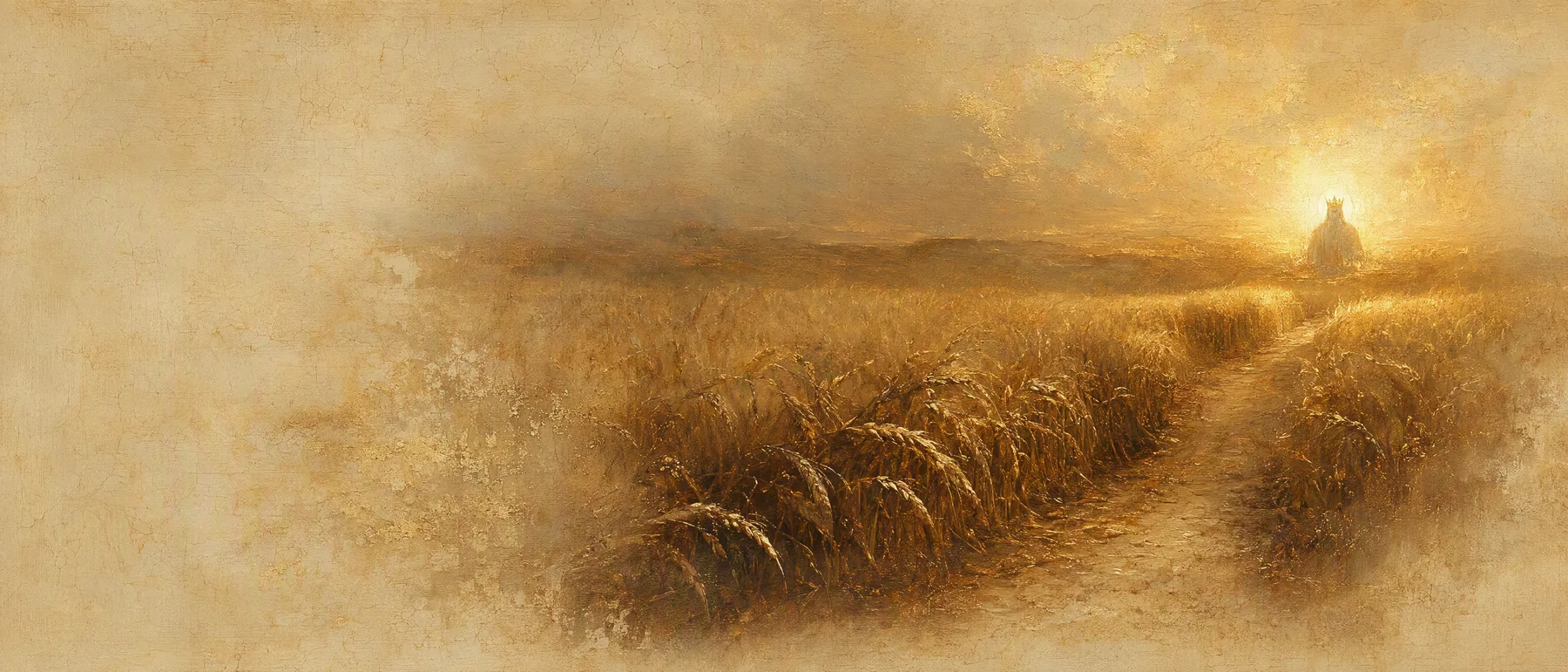
The classical acronym of the month — cited by the Abudraham, the Bnei Yissaschar, and virtually every source since — reads אֱלוּל as the initials of אֲנִי לְדוֹדִי וְדוֹדִי לִי: "I am my beloved's, and my beloved is mine." The month of judgment is named, astonishingly, with a love verse — repentance framed as return to a relationship rather than surrender to a court. The Chassidic masters sharpened it into the tradition's most famous image: in Elul, "the King is in the field" — the sovereign who is unapproachable in the palace walks out among the farmers, and anyone may speak to him. The Maiden of the month's sign carries the same grammar: unspent potential, a year not yet written.
The Maharal: Return as Coming Home to the Root
In Netivot Olam, his map of the soul's paths, the Maharal of Prague devotes a full treatise to Elul's work: Netiv HaTeshuvah, the Path of Return. His central claim dissolves the month's terror: teshuvah works, the Maharal argues, because a person's sins are additions — accretions around an essence that never sinned. Return is not self-demolition but excavation: the removal of what was never you, until the original point — the Yud, the seed-self — stands clear again. That is why teshuvah can undo the past, something no natural process can do: it operates on the level of essence, and essence stands outside time. Elul's maiden is his image made calendar: the self, restored to before.
The Bnei Yissaschar: The Month's Avodah
The Bnei Yissaschar's Elul essays are a manual of the month's customs and their inner logic: the shofar blown daily from the month's first day — not yet the commanded blast of Rosh Hashanah, but a rehearsal meant to wake the sleeper early; the added Psalm "The Lord is my light and my salvation"; the checking of tefillin and mezuzot — the year's equipment audited like accounts. He keeps returning to the acronym traditions of the month's name, each one a facet of the same work: love (Ani l'dodi), rescue of the accidental sinner (the cities of refuge), and gifts to the poor — because for a month whose faculty is action, even love must land as a deed.
Above the Stars
Elul is the month that operationalizes ein mazal l'Yisrael (Shabbat 156a). The entire premise of a month of teshuvah is that the coming year's verdict is not yet written — no chart, however precise, survives contact with a person who has genuinely changed. The tribe named "luck" became the tribe of disciplined action; that is the month's whole teaching in one family. Read the principle in full at Ein Mazal L'Yisrael: Why the Jewish Zodiac Is Not Fate, and the whole cycle at the twelve Jewish zodiac signs.
What zodiac sign is the Hebrew month of Elul?
Elul corresponds to Virgo — in Hebrew, Betulah (בְּתוּלָה), the Virgin. The virgin symbolizes the soul's capacity for renewal, which is why Elul is the month of teshuvah and preparation for Rosh Hashanah.
Which tribe is associated with Elul?
Elul is linked to the tribe of Gad, the tribe of camps and companies — the warrior-organizer. Gad represents the strength of arrangement and order, fitting for the month in which the year is reckoned and set right.
What is the personality of someone born in Elul?
People born in Elul tend to be methodical, discerning, and organizational — precise, self-correcting, and exacting with themselves while gentle with others. Their core work is learning to extend to themselves the forgiveness they readily give everyone else.
When does Elul fall in the Gregorian calendar?
Elul falls roughly in August–September, during summer. It is the final month of the Hebrew year, leading directly into Rosh Hashanah at the start of Tishrei.
What does mazal Betulah (מזל בתולה) mean?
Mazal Betulah (מַזָּל בְּתוּלָה) is the Hebrew name for Virgo, the Maiden — the sign of Elul (חודש אלול). The sources read the Maiden as the year's unspent potential: the self restored to before, in the month whose name is the acronym of 'I am my beloved's and my beloved is mine' (Song of Songs 6:3).
Which classical sources discuss the month of Elul?
Sefer Yetzirah (ch. 5) assigns Elul the letter Yud, the tribe of Gad, and the faculty of action; the Abudraham and the Bnei Yissaschar preserve its acronym from Song of Songs 6:3; the Maharal's Netiv HaTeshuvah (Netivot Olam) is the month's philosophy of return; and the Chassidic masters gave it the image of 'the King in the field.'
What is the spiritual meaning of Elul?
The spiritual meaning of Elul is return. Its letters are read as Ani l'dodi v'dodi li — "I am my beloved's and my beloved is mine" — and the tradition says the King is in the field: closeness is unusually available, but you must walk out to meet it. It is the month of honest inventory before the days of judgment.
Born in Elul? Read the chart you were born under.
Your Hebrew month is one thread. The full reading weaves in your day, your hour, and the letters of your name.
Begin Your ReadingRosh Hashanah 2026, the Days of Awe, and what you carry into the year being weighed.
The Hebrew month before Elul, and the soul it carries.
The Hebrew month after Elul, and the soul it carries.
The full map of the mazalot — every Hebrew month, sign, and tribe in one place.