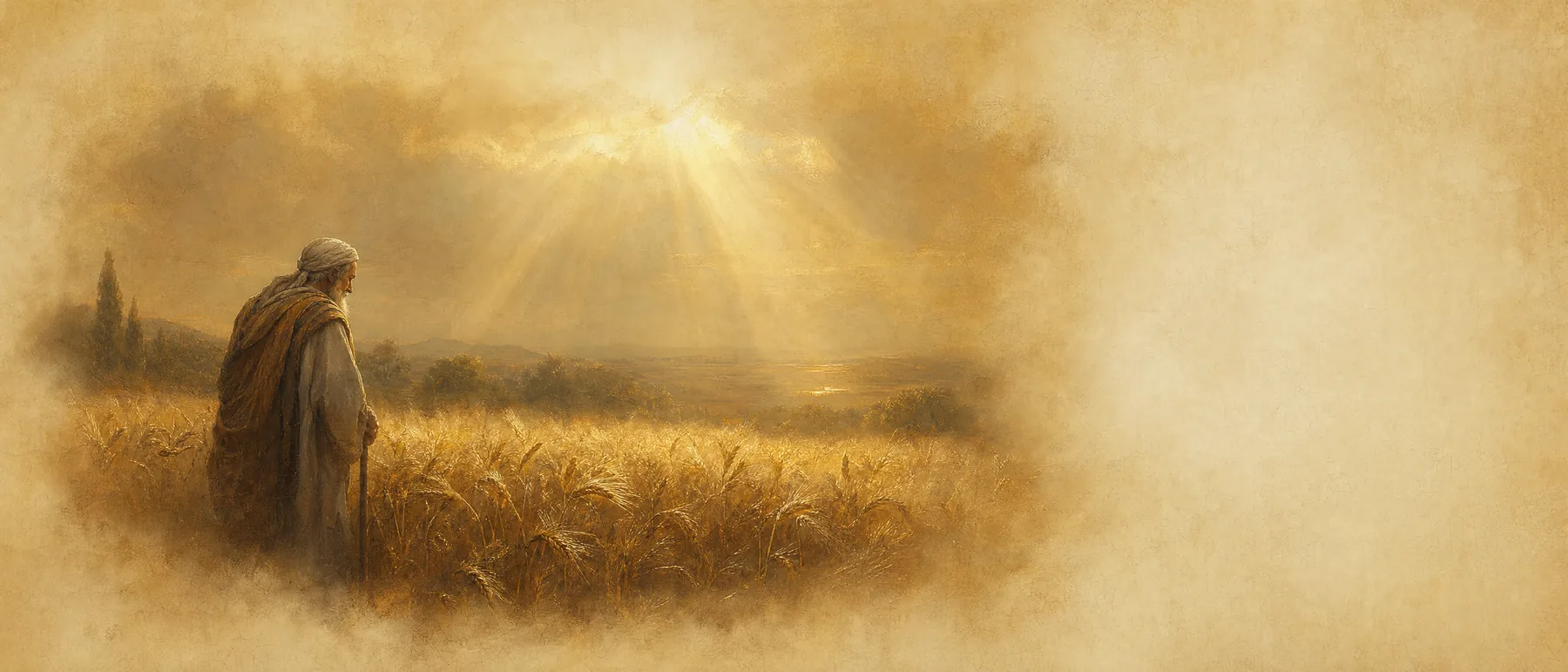
Iyar — the Hebrew month of Taurus
Iyar is the Hebrew month of spring's patient work — Taurus the ox, the tribe of Issachar, and the slow daily count of the Omer. Born here, you carry the temperament of someone who heals on a schedule and rebuilds without asking for help.
You learned early that the world does not stop turning so that you can mend. Somewhere in childhood you watched the adults around you carry their aches quietly — managing pain the way one manages a chore, on time, without complaint — and you decided that this was simply what strength looked like. So you became reliable before you became rested. People born in אִיָּר (Iyar) tend to move through the world this way: steady, deliberate, almost stubbornly composed, treating recovery as one more task to be completed efficiently and then filed away. The cost is hidden in plain sight. You crave solid ground beneath you, yet you only feel fully alive when something is mid-repair — a project, a relationship, a version of yourself under renovation. The stillness you say you want would, if it ever arrived, leave you restless within a week.
This is the central tension of the Iyar nature, and it is worth naming honestly rather than dressing it up as a virtue. Your patience is real, but it is also a hiding place. You will treat your own healing as a problem with a finish line — something to push through by spring, to resolve before summer — and you may spend decades trying to complete it before you understand that it was never a project at all. אִיָּר is read as an acronym for אֲנִי ה' רֹפְאֶךָ — Ani Hashem rofecha, "I am God your Healer." The month does not promise that you will be done. It tells you that the work of mending is a way of moving through the world, not a deadline you missed.
The Ox in the Field: Taurus as Shor
The מַזָּל (mazal) of Iyar is Taurus — in Hebrew, שׁוֹר (Shor), the ox. This is not the bull of the arena, snorting and charging; it is the working ox, harnessed to the plow, leaning its whole weight into a furrow it cannot see the end of. The symbol is exact for you. An ox is not fast and does not pretend to be. Its gift is torque — sustained pull, the kind that breaks hard ground precisely because it never lets up. You produce results the way an ox does: not in a single dramatic gesture but through the unglamorous repetition of effort that bores other people and steadies you. The shadow side is just as bovine. Try to turn an ox quickly and it plants its feet. When plans shift mid-stride, you do not pivot so much as resist, and the same weight that makes you immovable in adversity can make you immovable when the field itself has changed.
Issachar: The Scholars Who Knew the Times
The tribe of Iyar is Issachar, and the Sages cast them as the ox-like scholars of Israel — the men, as the verse says, "who had understanding of the times, to know what Israel ought to do." While Zebulun went out to trade and brought back wealth, Issachar bent over the text. They were not the warriors or the merchants; they were the ones who held the calendar, who fixed the new moons and the leap years, who knew when. There is something quietly radical in that division of labor: Issachar's contribution was patience made into expertise. You belong to this lineage. Your authority, when you have it, rarely comes from speed or charisma. It comes from having stayed with something long enough to actually understand it — from being the person in the room who has read the whole thing, twice, and remembers the part everyone else skimmed.
Vav, the Sense of Thought, and the Daily Count
According to Sefer Yetzirah, the Hebrew letter set into Iyar is ו (Vav), and the faculty it governs is thought — הִרְהוּר, the inner turning-over that precedes action. Vav is shaped as a simple vertical stroke, a hook, the conjunction that means "and": it connects, it continues, it joins this to the next. That is the grammar of your introspection. You do not think in conclusions; you think in linkages, one consideration hooked to the one before it, building slowly toward understanding rather than leaping to it. This is why Iyar is the month of סְפִירַת הָעֹמֶר (Sefirat ha-Omer), the daily counting between Pesach and Shavuot. Each evening adds one. No day can be borrowed from tomorrow or recovered from yesterday — the count refines character one increment at a time, which is the only pace at which lasting change has ever actually happened. Your rectification is to let thought lead to healing rather than to mere management: to turn the long interior deliberation toward mending what is broken in the body and the spirit, instead of toward perpetually auditing it.
Where the Ox Pulls Best: Work and Love
In work, your temperament is suited to anything that rewards endurance over flash. You go deep where others go wide, and you are trusted precisely because you finish. The natural fits cluster around healing, study, and the long horizon:
- Physician, nurse, or healer — the rofecha vocation lived out literally
- Researcher and academic — Issachar's seat, the long read
- Engineer — tolerance for tedium turned into reliability
- Therapist — the patience to sit with someone mid-repair
- Long-term investor — the discipline to wait out the count
Your strengths are stamina, deep focus, dependability, and a hard-won practical wisdom that knows the difference between busy and effective. The growth edges sit exactly where the ox plants its feet. You struggle to turn quickly when circumstances demand it, you deliberate past the point where a decision was needed, and — this one quietly costs you — you almost never advertise what you've done, so steadier colleagues take the credit your endurance earned. In love, you are the steady one, the partner who stays, and that is no small thing. But the same instinct that hides your own pain on a schedule can make you hard to actually reach. The people closest to you do not need you to be fully mended before you let them in. They need you to count the day you are on, out loud, with them beside you.
Iyar in the Classical Sources: A Deeper Map
The Hebrew name of the sign is מַזָּל שׁוֹר — mazal Shor, the Ox — and the month is חוֹדֶשׁ אִיָּר, chodesh Iyar. Scripture itself calls this month by an older name: Ziv, "radiance" — "in the month of Ziv, which is the second month" — the month when Solomon began building the Temple. A month named for light, signed by the animal that pulls the plow: that pairing, glow above and labor below, is the whole file on Iyar.
Sefer Yetzirah: Letter, Tribe, and Faculty
The fifth chapter of the סֵפֶר יְצִירָה gives Iyar the letter ו (Vav), the tribe of Yissachar, and the faculty of thought. Vav is the connector — as a prefix it means "and," the hook that joins one thing to the next — and Iyar is the calendar's great connector, the only month every one of whose days falls inside the Counting of the Omer, the forty-nine-day chain linking Pesach to Sinai. Yissachar is the Torah's scholar-tribe, the one Scripture praises as "knowers of understanding of the times" — the tribe that kept the calendar itself. And the faculty of thought makes Iyar the month of inner work: nothing dramatic happens in Iyar; everything cumulative does. Classical astrology adds that Shor is ruled by נֹגַהּ (Nogah, Venus) — the planet of beauty and attachment — the glow inside the ox.
The Torah: The Month of Healing and Second Chances
The tradition reads the month's name as an acronym: אִיָּר stands for אֲנִי יְהוָה רֹפְאֶךָ — "I am the Lord your healer" — the promise given at Marah in the first days of this month, when Israel's bitter water was made sweet. Iyar is when the manna began to fall, when the daily miracle replaced the one-time spectacle. And it holds the Torah's most remarkable institution of repair: Pesach Sheni, the "second Passover" of 14 Iyar, granted when a group of Israelites who had missed the offering came to Moshe and refused to accept exclusion — "why should we lose out?" The Torah's answer was a makeup date. Iyar is the only month with a festival whose entire content is the second chance.
The Maharal: The Refinement Between Freedom and Torah
In Tiferet Yisrael, his book on the giving of the Torah, the Maharal of Prague asks the question Iyar answers: if the Torah is the purpose of the Exodus, why was it not given the day after? His answer is that freedom and readiness are not the same event. Israel left Egypt as raw material — free but unformed — and the counted weeks in between are the slow refinement by which matter becomes fit for form. Iyar, the only month lived entirely inside that count, is the Maharal's month of becoming: the stretch where nothing is granted and everything is built, one deliberate day at a time. The ox pulling the plow through the field is exactly the right sign for it.
The Bnei Yissaschar: The Month's Avodah
The Bnei Yissaschar's essays on Iyar circle the same two poles the sources above keep touching: healing and counting. He treats Iyar as the month of refuah — when the manna, "bread of the mighty," healed whoever ate it — and reads the Omer count as the soul's own accounting, seven weeks of taking inventory of one's traits, one middah at a time. For a month whose faculty is thought, the avodah is precise: not to think more, but to think in order — to give the inner life the same daily discipline the count gives the calendar.
Above the Stars
The Talmud's ruling in Shabbat 156a — ein mazal l'Yisrael, the constellation is not a verdict — lands differently in Iyar than anywhere else, because Iyar's own festival already proved it: the men of Pesach Sheni were told, in effect, that even a missed appointment with God can be rescheduled. A month of second chances cannot also be a month of fixed fate. The full teaching is in Ein Mazal L'Yisrael: Why the Jewish Zodiac Is Not Fate; the whole system is mapped at the twelve Jewish zodiac signs.
What zodiac sign is the Hebrew month of Iyar?
Iyar corresponds to Taurus, called Shor (שׁוֹר) in Hebrew, whose symbol is the ox. It reflects steady, deliberate, hardworking strength rather than speed or flash.
Which tribe of Israel is associated with Iyar?
Iyar is linked to the tribe of Issachar, traditionally described as ox-like Torah scholars who 'understood the times' — the keepers of the calendar and patient masters of study.
What is the personality of someone born in Iyar?
People born in Iyar tend to be persistent, scholarly, methodical, and reliable, with deep focus and endurance. Iyar is read as an acronym for 'Ani Hashem rofecha' (I am your Healer), making introspection and healing central themes, alongside a stubborn resistance to changing plans.
When does the month of Iyar fall in the Gregorian calendar?
Iyar falls in spring, roughly from April to May. It is the month of Sefirat ha-Omer, the daily counting between Pesach and Shavuot.
What does mazal Shor (מזל שור) mean in Hebrew?
Mazal Shor (מַזָּל שׁוֹר) is the Hebrew name for Taurus, the Ox — the sign of the month of Iyar (חודש אייר). The ox is the Torah's animal of patient labor: strength yoked to a long furrow, which is Iyar's essence as the only month lived entirely inside the Counting of the Omer.
Which classical sources discuss the month of Iyar?
Sefer Yetzirah (ch. 5) gives Iyar the letter Vav, the tribe of Yissachar, and the faculty of thought; Scripture calls it Ziv, the month of radiance (I Kings 6:1); the tradition reads its name as the acronym of 'I am the Lord your healer' (Exodus 15:26); the Maharal's Tiferet Yisrael explains its Omer-count as the refinement between freedom and Torah; and the Bnei Yissaschar devotes his Iyar essays to healing and the soul's accounting.
What is the spiritual meaning of Iyar?
The spiritual meaning of Iyar is healing through discipline. Every one of its days is counted in the Omer, and its name is traditionally read as an acronym of Ani Hashem Rof'echa — "I am the Lord your Healer" (Exodus 15:26). Nothing dramatic happens in Iyar; that is the point. It is the month of unglamorous, daily self-repair.
Born in Iyar? Read the chart you were born under.
Your Hebrew month is one thread. The full reading weaves in your day, your hour, and the letters of your name.
Begin Your ReadingThe Hebrew month before Iyar, and the soul it carries.
The Hebrew month after Iyar, and the soul it carries.
The full map of the mazalot — every Hebrew month, sign, and tribe in one place.