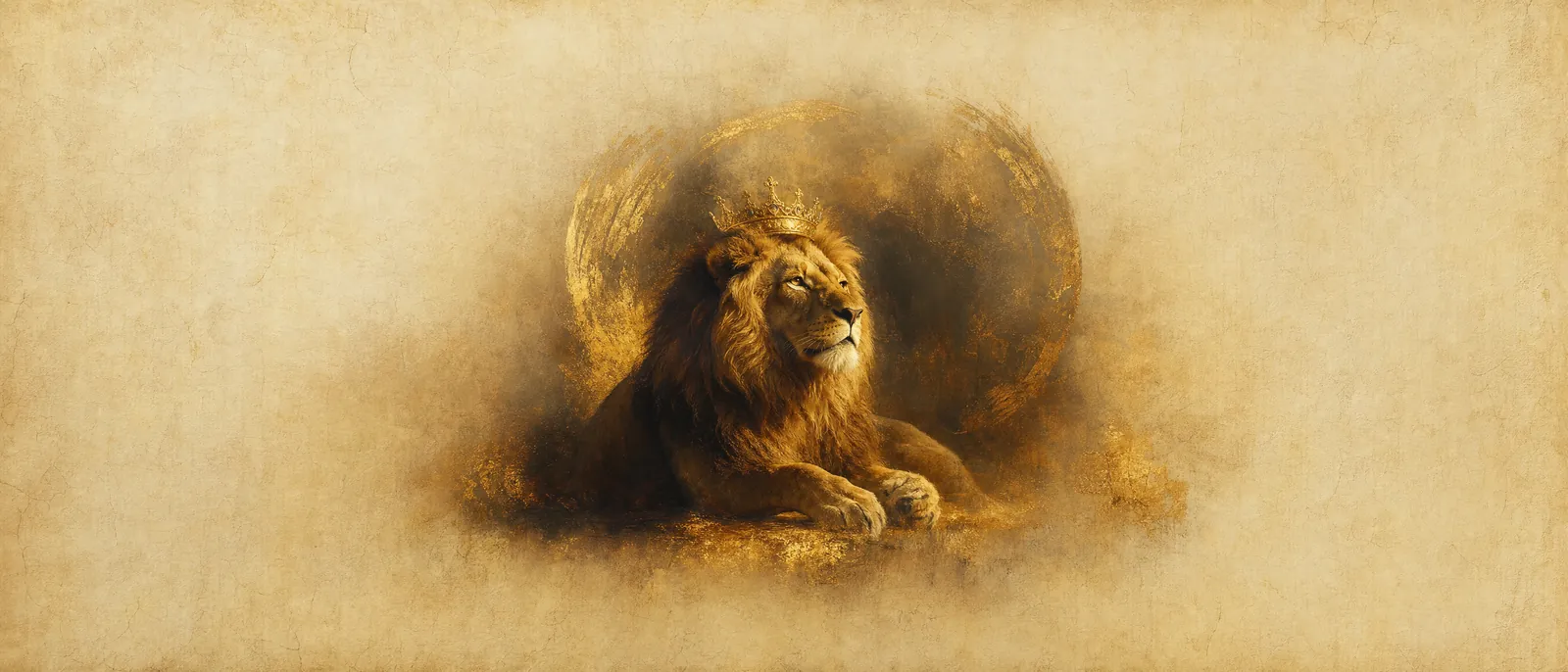
Aryeh — the crowned strength
Aryeh means lion — not the lion on the prowl but the lion at rest, crouched and unchallenged, the royal seal of Yehudah. It is a name that hands you a crown you never asked for and asks what you'll do with it.
The Animal That Never Leaves
The lion enters the Torah in a father's dying blessing. Yaakov, gathering his sons, reaches Yehudah and calls him gur aryeh — a lion's cub. From that moment the animal is fastened to the kingly tribe and never comes loose. It becomes the royal seal of the house that will produce David and the monarchy, the face embroidered on the Ark's curtain, the shorthand for majesty in Jewish imagination for three thousand years.
So a person named Aryeh carries something older than himself. The name does not describe a temperament so much as an inheritance — a lineage of authority that predates any choice he makes. This is the first thing to understand about the name: it is not a compliment. It is an assignment.
Royalty at Rest
Read the verse closely and the lion is not roaring. It is crouched, settled, lying down 'like a lion, and like a lioness — who dares rouse him?' The power in the image is stillness, not aggression. This is royalty at rest rather than royalty on the prowl, strength so established it no longer needs to prove itself.
People who wear this name tend to embody exactly that paradox. They carry visible authority they did not seek — others defer to them, look to them, assume they are in charge before they have said a word. The temptation is to mistake this for a privilege. The name insists it is a weight. The lion at rest is not lazy; he is responsible for the field, and everyone knows it.
Majesty, Applied to Mornings
The Mishnah gives the lion its most demanding job. When Yehudah ben Teima teaches how to serve, the very first instruction is to 'be strong as a lion' — and the strength is assigned not to battle or debate but to getting out of bed in the morning. Majesty, applied to the least glamorous act there is.
That is the working shape of the name Aryeh. The crown is real, but it is worn in ordinary hours — in showing up, in rising early, in bearing the small unromantic duties that no one applauds. The cost of the name is the same as Yehudah's: authority that must be spent as service rather than hoarded as status. Those who miss this become imperious. Those who understand it become the person a room leans on without noticing it is leaning.
The gift, when it lands right, is quiet gravity — a steadiness others borrow. The failure mode is a lion who confuses being looked to with being owed. The name spends its whole life negotiating that line.
Aryeh in the Classical Sources
In the sources, the word is אריה, aryeh — the lion. It is one of the most heavily freighted words in Tanakh, and its gematria, 216, opens a door we will return to: the number of the tradition's own word for disciplined strength. Here is where the sources anchor the name.
GENESIS 49:9 — 'GUR ARYEH YEHUDAH'
Yaakov's blessing to Yehudah is the birthplace of the name's meaning: 'Gur aryeh Yehudah' — a lion's cub is Yehudah. This single phrase welds the lion to the tribe that will carry the monarchy, and it does so with a striking image of repose. The lion crouches, settles, lies down — unchallenged not because it is fighting but because no one would dare.
This is the seed of the name's whole character. The authority in the verse is settled rather than seized, royal rather than restless. Aryeh inherits that posture: strength that has nothing to prove, and precisely for that reason, everything to protect.
PIRKEI AVOT 5:20 — 'STRONG AS A LION'
Yehudah ben Teima opens his teaching on divine service with four animals, and the lion comes first: be strong as a lion. What is remarkable is where the Mishnah aims that strength — not at conquest but at the day's very first act, rising in the morning to do what must be done.
The Mishnah thus translates lion-majesty into the smallest, least heroic unit of a life: getting up. For a person named Aryeh this is the entire instruction. The crown is not worn on a throne but in the alarm-clock hour, in the discipline of showing up when no one is watching. Grandeur, spent on the ordinary.
BERAKHOT 7b — SHEMA GARIM, THE LION-NAME
Berakhot 7b teaches the principle that a name shapes the one who bears it — shema garim, a name causes. The idea is not superstition but architecture: the word you are called becomes a lens through which you and others read your soul.
The tradition's own scholars have long worn this particular animal as a crown. The great Maharal of Prague was Yehudah Loew — 'Yehudah' the lion-tribe, 'Loew' the lion again — the name doubled, a man twice sealed with the royal beast. To be an Aryeh is to stand in that lineage: the lion-name carried by those who bore knowledge as responsibility.
THE LETTERS AND THE NUMBER
The gematria of אריה is 216 — and this is the name's hidden hinge. Two hundred sixteen is exactly the value of gevurah (גבורה), the tradition's word for disciplined might, the restrained strength that knows when to hold back. The lion and the word for controlled power count out to the same number.
That equivalence is the whole teaching in miniature. The lion of the name is not raw force; it is gevurah — strength under discipline, power that has learned restraint. The name promises the animal, but the number insists the animal be governed. Majesty and self-control, arriving at the same total.
The Talmud's principle shema garim — "the name causes" (Berakhot 7b) — is the tradition's claim that a name gently inclines its bearer. In this library, Aryeh's nearest companions are Yehudah and Ariel; the full index is at Hebrew names.
What does the name Aryeh mean?
Aryeh (אריה) means 'lion.' In the Torah it is the blessing-animal of Yehudah — 'gur aryeh Yehudah,' a lion's cub is Judah (Genesis 49:9) — and it becomes the royal seal of the kingly tribe. The name carries the sense of settled, unchallenged authority rather than mere ferocity.
What is the gematria of Aryeh?
The gematria of אריה is 216. Remarkably, this is the exact value of gevurah (גבורה), the tradition's word for disciplined strength — so the lion and the word for restrained might count out to the very same number.
Where does the word Aryeh appear in the Tanakh?
The word aryeh appears throughout Tanakh, but its defining moment is Genesis 49:9, where Yaakov blesses Yehudah as 'gur aryeh' — a lion's cub. This fastens the lion to the tribe of monarchy, making it the royal image behind David's line.
What does the name Aryeh say about personality?
People named Aryeh tend to carry visible authority they never requested — others defer to them instinctively. The name's work, drawn from Yehudah, is to treat that crown as responsibility rather than status, spending strength as service.
What do the sources say about Aryeh?
Genesis 49:9 makes the lion Yehudah's blessing; Pirkei Avot 5:20 assigns lion-strength to the day's first act, rising in the morning; and Berakhot 7b teaches that a name shapes its bearer — the lion-name long worn by scholars like the Maharal, Yehudah Loew.
Why is the lion linked to getting out of bed?
Pirkei Avot 5:20 opens its teaching on divine service by telling us to 'be strong as a lion' — and applies that majesty not to battle but to rising in the morning. For an Aryeh, the crown is worn in the ordinary hours: grandeur spent on discipline rather than display.