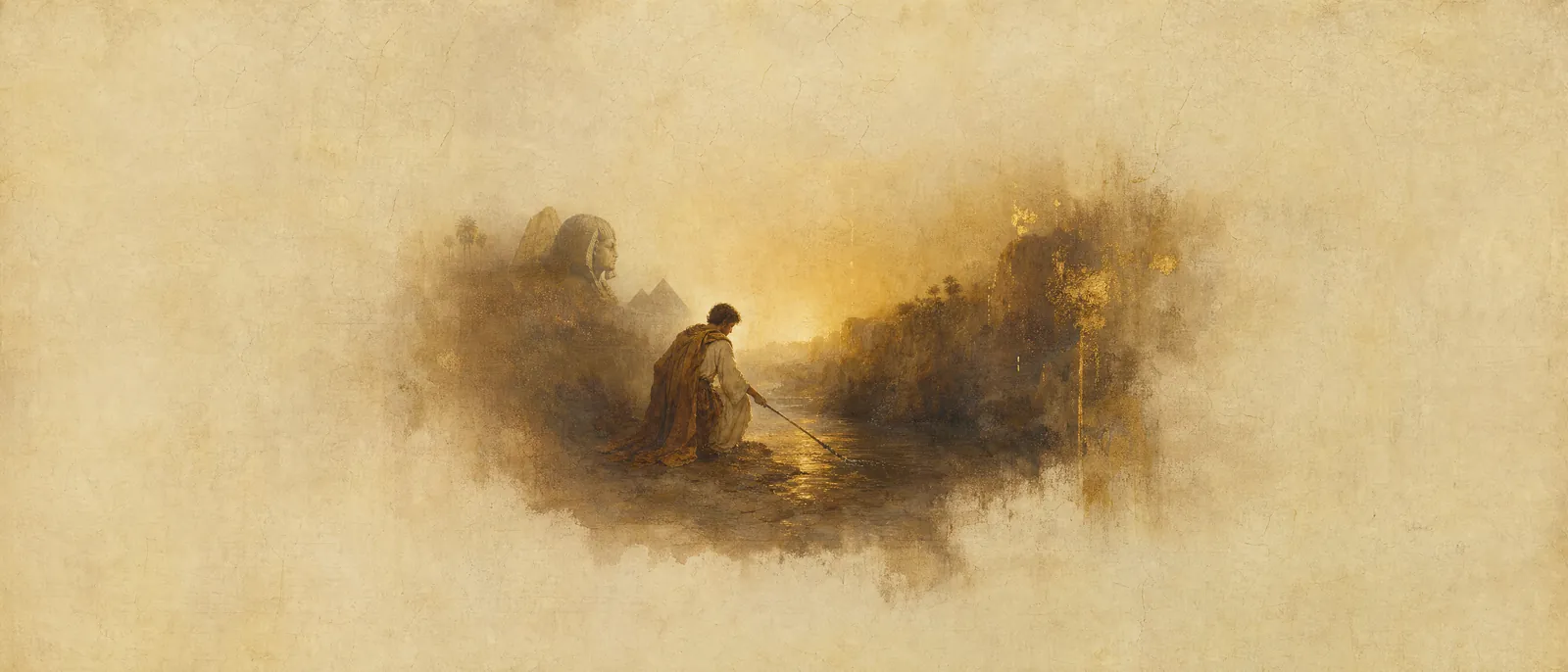
Moshe — the reluctant leader
The greatest leader in the Torah spent his first conversation with Hashem trying to talk his way out of the job. Moshe is a name built around an argument — between the call and the one who is called.
The name that points back to the moment of rescue
Pharaoh's daughter names the child she pulls from the Nile: "She called his name Moshe, and said, because I drew him out of the water" (Exodus 2:10). The Hebrew root mashah means to draw out, to pull from. It is worth noticing the strangeness — the name is given by the woman who rescued him, and it commemorates her act, not his. Moshe is named for being saved before he ever saves anyone.
Scholars also point to an Egyptian element — the suffix mose, "born of," as in Thutmose or Ramose — which would fit a child raised in the palace. The Torah, characteristically, reaches past the foreign sound to a Hebrew meaning. Either way, the name carries a residue of being acted upon. Moshe is rescued, then named, then — much later — asked to do the rescuing himself.
The argument at the bush
When Hashem calls to him from the burning bush, Moshe does not say yes. He negotiates. "Who am I, that I should go to Pharaoh?" (Exodus 3:11). Then: they won't believe me. Then: I am not a man of words, I am heavy of mouth and heavy of tongue. And finally, when the excuses run out, the plain refusal — "send by the hand of whomever You will send" (Exodus 4:13). Send someone else.
This is one of the most honest exchanges in scripture. The man who will become the standard against which all prophets are measured begins by trying to decline. And the text does not treat his reluctance as weakness to be overcome — it treats it as the texture of the man Hashem actually wanted. The reluctance is not a flaw in the candidate. It is part of why he is the candidate.
What the reluctance is for
People drawn to confidence make poor servants of a mission, because they confuse the mission with themselves. Moshe never did. He led a nation for forty years and the Torah calls him the humblest man on the face of the earth (Numbers 12:3). The humility and the argument at the bush are the same trait viewed from two angles: a man who never believed the role was his by right, and therefore never mistook himself for the source of it.
That is the architecture under this name. The reluctance keeps the leader pointed away from his own ego and toward the thing he is carrying. It is what stops the rescuer from needing to be worshipped.
It also has a cost. Moshe's burdens broke through more than once — the rock he struck in anger (Numbers 20), the despair when he tells Hashem the people are too heavy and asks to be killed rather than carry them alone (Numbers 11:14–15). The man who didn't want the job carried it past the point where carrying it was good for him.
The lived pattern
People with this name often feel called to roles they did not seek — and resent the call even as they answer it. They are the ones who end up running the committee, organizing the family, holding the team together, while privately insisting they never wanted any of it. And they're telling the truth. They didn't.
The temptation is to read that resentment as a sign you've taken the wrong job. Sometimes it is. But for a Moshe, the reluctance is frequently the qualification itself — proof that you're doing the work for the work and not for the standing it gives you. The people who lunge at leadership are rarely the ones you want holding it.
The work, then, is learning to answer without pretending you wanted to be asked. To lead from the heavy-tongued, who-am-I place rather than waiting to feel ready — because the readiness, for this name, never arrives, and waiting for it just means the burning bush keeps burning while you make excuses.
A number drawn out
The gematria of משה is 345. We won't dress it in arithmetic it doesn't carry. But it sits well with the name's shape: a value attached to a man who was first a thing drawn out of water — counted, named, accounted for — before he was ever a leader. The number is the receipt of a rescue.
Moshe in the Classical Sources
The name is מֹשֶׁה (Moshe), gematria 345 — and it carries a fact the commentators never stop turning over: the greatest name in the Torah was given by an Egyptian princess. The man who carried Israel out of Egypt answered his whole life to a name Egypt gave him.
Where the Tanakh Gives the Name
The naming verse is Pharaoh's daughter's: "and he became her son, and she called his name Moshe, and she said: for I drew him (meshitihu) from the water." The commentators note the grammar's quiet oddity — Moshe is an active form: not "the drawn one" but "the one who draws." The princess named her rescue; the name predicted his — a man whose career would be pulling a nation out of the water, then water out of a rock. The Torah keeps this name through every scene, even after God Himself speaks to him — the tradition reads it as a permanent monument to one woman's act of compassion across enemy lines.
The Sages on Moshe
The Talmud in Sotah paints his beginning: when he was born the house filled with light, and his sister Miriam stood watch by the river to see what would become of him. The Sages add that Moshe had many names — the Midrash counts ten, given by parents, siblings, and the princess — and of all of them, God chose to use only the one Batya gave: the name of the drawing-out. Rabbinic tradition also hears his name in the Torah's rhythm: from the beginning of Exodus to its end, the text is essentially the biography of this one name, the shepherd who argued with God face to face "as a man speaks to his friend."
The Letters and the Number
Mem–shin–heh: the gematria is 345, and the tradition's favorite equivalence is exact — הַשֵּׁם, HaShem, "the Name" (5+300+40), also totals 345. Moshe and "the Name" count out identically: the man the tradition calls Moshe Rabbeinu, who spoke with God mouth to mouth, carries God's own epithet in his arithmetic. Read backwards, his letters spell הַשֶּׁם as structure too — heh–shin–mem — the commentators' emblem for a life that was the Name's mirror, facing the people.
What a Name Does
The Talmud in Rosh Hashanah counts a changed name among the things that change a decree — and Moshe's story runs the rule in reverse: a name given in one world (Pharaoh's palace) became the instrument that overturned that world's decrees. The name Egypt gave drowned Egypt's army. His siblings' pages stand beside his — Miriam, who watched the basket, and Aharon, who ran to meet him — and the full index is at Hebrew names.
What does the name Moshe mean?
Moshe comes from the Hebrew root mashah, "to draw out," as Pharaoh's daughter explains when she names him: "because I drew him out of the water" (Exodus 2:10). Some scholars also connect it to the Egyptian element mose, "born of" — a fitting trace of his palace upbringing. Notably, the name commemorates his rescue, not his deeds.
What is the gematria of Moshe?
The name משה carries a gematria of 345. We hold to that value rather than building it into invented numerical claims — what matters is that the number belongs to a man first counted as a child drawn from the water, before he became a leader.
Who was Moshe in the Bible/Tanakh?
Moshe is the prophet and lawgiver who led Israel out of Egypt, received the Torah at Sinai, and guided the nation through forty years in the wilderness, across the books of Exodus through Deuteronomy. He is remembered both as the unmatched prophet and as the man who argued with Hashem at the burning bush, repeatedly asking to be sent home.
What does the name Moshe say about personality?
The name describes a soul built around reluctant leadership. People named Moshe often find themselves holding roles they never sought, answering the call while resenting it. The pattern's gift is humility that keeps the work pointed away from ego; its cost is burdens carried past what's healthy. The growth is in answering honestly without pretending you wanted to be asked.
Who named Moshe, and what does the name mean?
Pharaoh's daughter named him (Exodus 2:10): 'for I drew him (meshitihu) from the water.' The grammar is active — 'the one who draws' — a forecast of a career spent pulling a nation out of the water. Of his many names, God used only the one the Egyptian princess gave.
What is the gematria of Moshe?
Moshe (משה) totals 345 — exactly the value of HaShem (השם), 'the Name' (5+300+40). The man who spoke with God face to face carries God's own epithet in his arithmetic.