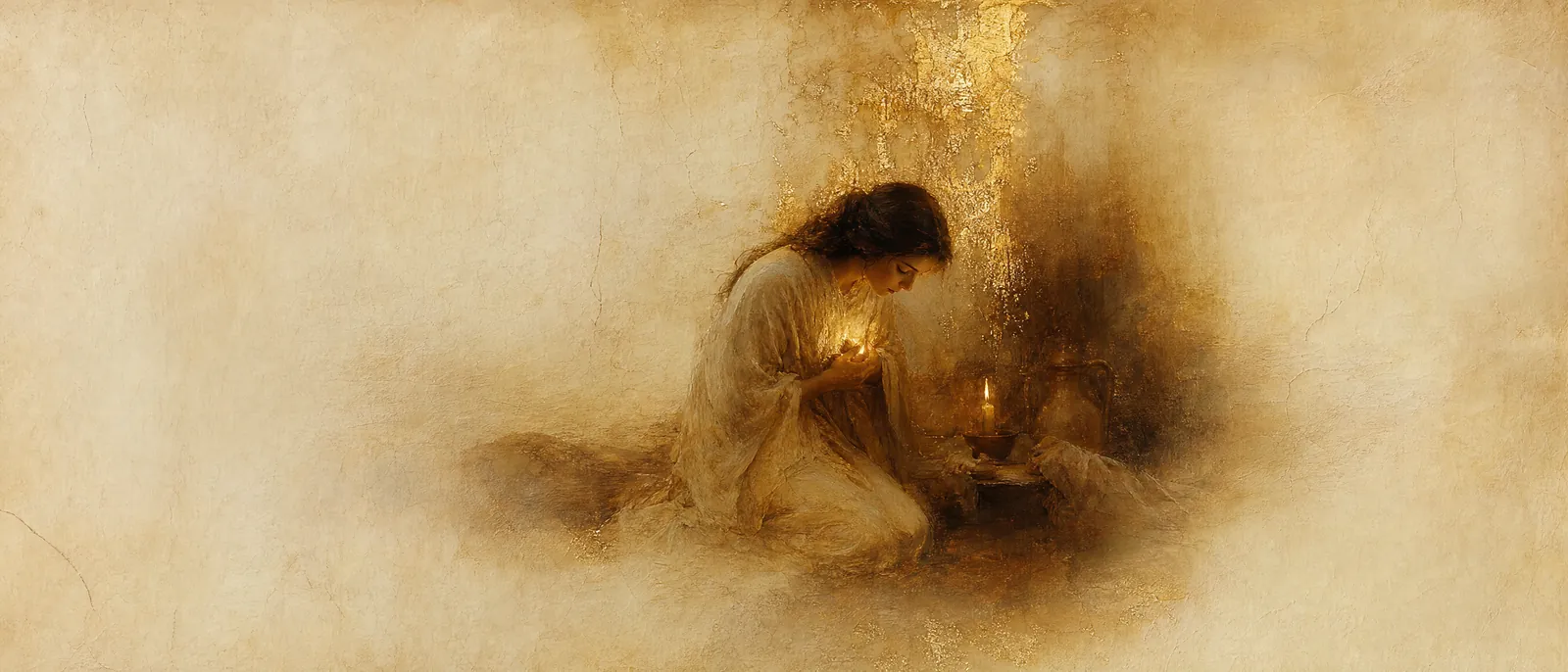
Rafael — the healer who arrives quietly
Rafael folds the healing-root refa into El — God's own name — and hands the result to a person. It is the shortest theology in the Torah made into a name: not one who cures, but one others recover around, often without knowing why.
A Name Built From a Prayer
Most names describe a person. Rafael describes an errand. The word breaks cleanly into two halves — refa, the root of healing, and El, one of the names of God — and the seam between them is the whole meaning: not that this person heals, but that healing passes through them from somewhere higher. The self is a conduit, not a source. That is a heavy thing to carry in three syllables.
In the tradition's anatomy of angels, Rafael is the one whose entire jurisdiction is repair. Not messaging, not judgment, not destruction — repair. The name names a specialization. And people who carry it often feel the pull of that narrowness: a sense that they are here to fix one kind of thing, and that the world keeps handing them exactly that thing to fix.
,
The Healer Who Doesn't Announce It
The archetype is the healer who arrives quietly. Not the physician with the loud diagnosis — the friend whose presence lowers the fever in a room. People with this name tend to be the ones others recover around, and often they cannot explain the mechanism, because there isn't one they can point to. They listen. They stay. They do not rush the repair. The healing is a byproduct of how they occupy space, not a technique they deploy.
This has a cost. When your value is felt rather than seen, you can go unthanked for the exact thing you do best. Rafael-people sometimes wonder whether they've done anything at all, because the person who healed near them credits their own resilience — as they should. The name asks its bearer to be at peace with invisible work. The repair is real even when no one, including the healer, can name where it came from.
The Tension: Everyone's Recovery, No One's Rest
Because others recover around them, Rafael-people are magnetically drawn to the wounded — and the wounded are drawn to them. That is a gift and a trap. The one whose jurisdiction is repair can forget that they, too, are a body that breaks. The angel of healing does not appear in the tradition asking to be healed; he only heals. A person is not an angel. The name's danger is a life spent as everyone's convalescence and never one's own.
The corrective is written into the sources themselves. Moshe's prayer for Miriam is five words and no more — El na refa na lah, 'God, please, heal her, please.' The Torah's shortest prayer teaches that healing does not require the healer to carry everything. It can be brief. It can be handed upward. The best Rafaels learn this: their job is to ask honestly and stay present, not to become the cure. The repair belongs to God; they are only its address.
Rafael in the Classical Sources
In the sources, רפאל is the healing-root refa with El — a name of God — folded in, and its gematria is 311. To read the name is to read the tradition's account of what healing actually is: a dedicated errand, a five-word prayer, and a divine promise compressed into a person.
BAVA METZIA 86b — HEALING AS A DEDICATED ERRAND
When three visitors come to Avraham's tent, the Talmud in Bava Metzia 86b refuses to let them be interchangeable. Each angel is assigned one task and one only: one to announce the birth of Yitzchak, one to overturn Sodom, and one — the tradition's Rafael — to heal Avraham after his circumcision. The reasoning is precise: a single angel does not perform two missions.
This is where the name gets its shape. Rafael is not a generalist. His entire jurisdiction is repair, and the Talmud's insistence on single errands means healing is dignified as a whole vocation, not a side task. People who carry this name often feel that same narrowing — that they are here for one kind of work, and that they do it best when they are not asked to do everything at once.
NUMBERS 12:13 — THE FIVE-WORD PRAYER
When Miriam is struck with illness, Moshe does not compose a speech. He says five words: El na refa na lah — 'God, please, heal her, please.' It is the shortest prayer in the Torah, and the healing-root refa sits at its center — the same root that opens the name Rafael.
The verse is the name in action. It teaches that healing-prayer works best when it is short and honest, stripped of everything but the plea itself. For a Rafael, this is the operating instruction: you are not required to fix; you are required to ask, briefly and without pretense, and to stay while the answer arrives.
EXODUS 15:26 — 'I AM THE LORD YOUR HEALER'
At the bitter waters of Marah, God makes a promise and signs it with a title: ani Hashem rofecha — 'I am the Lord your healer.' The healing-root stands in the divine name itself, claimed by God as an attribute, not delegated.
This is the theology the name Rafael compresses into a person. To bear the name is to be a small, human echo of that title — refa joined to El — a reminder that the healing was never the healer's own possession. The person is the address; the source is elsewhere. That humility is the name's deepest instruction.
THE LETTERS AND THE NUMBER
The gematria of רפאל is 311. The name is the healing-root refa with El — a name of God — folded in, so that the word cannot be spoken without invoking the source of the healing. The self does not appear in the letters at all; only the act and its origin do.
In the tradition's anatomy of angels, Rafael is the one whose entire jurisdiction is repair. The letters carry that specialization: this is not a name about power or announcement, but about a single dedicated function — mending what is broken and handing the credit upward.
The Talmud's principle shema garim — "the name causes" (Berakhot 7b) — is the tradition's claim that a name gently inclines its bearer. In this library, Rafael's nearest companions are Gavriel and Chaim; the full index is at Hebrew names.
What does the name Rafael mean?
Rafael (רפאל) means 'God heals.' It joins the healing-root refa to El, one of the names of God, so the meaning is not that the person heals but that healing passes through them from a higher source. The name describes a conduit for repair.
What is the gematria of Rafael?
The gematria of רפאל is 311. The name is the healing-root refa with El — a name of God — folded in: in the tradition's anatomy of angels, the one whose entire jurisdiction is repair.
Where does the name Rafael appear in the Tanakh?
The healing-root at the heart of the name appears in Moshe's prayer for Miriam in Numbers 12:13 — El na refa na lah — and in God's own title at Exodus 15:26, 'I am the Lord your healer.' The Talmud in Bava Metzia 86b names Rafael as the angel sent to heal Avraham.
What does the name Rafael say about personality?
Rafael is the healer who arrives quietly — the one others recover around, often without being able to say why. Such people do invisible work and can go unthanked for the very thing they do best, since their value is felt rather than seen.
What do the sources say about Rafael?
Bava Metzia 86b assigns Rafael a single errand — to heal — because an angel does not perform two missions. Numbers 12:13 shows the healing-root in a five-word prayer, and Exodus 15:26 places it in God's own name, teaching that the healing was never the healer's possession.
Why is the shortest prayer in the Torah tied to the name Rafael?
Moshe's plea for Miriam in Numbers 12:13 — El na refa na lah — is five words, the Torah's shortest prayer, and it carries the same root as Rafael. It teaches the name's operating instruction: heal by asking honestly and briefly, not by carrying everything yourself.