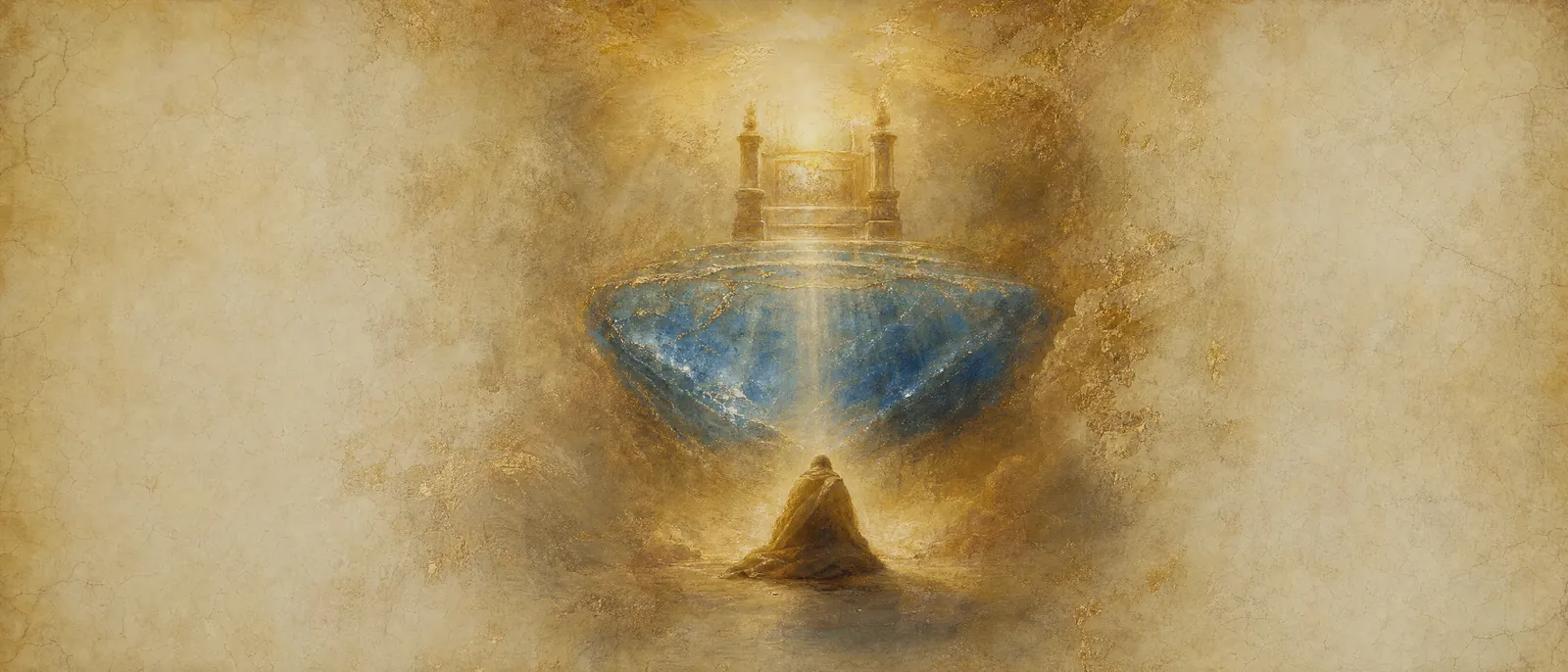
Sapir — the clarity under the feet of heaven
Sapir is the sapphire — the stone the elders saw beneath the feet of God at Sinai, the gem at the base of Ezekiel's chariot, the material the tradition reaches for when it needs to describe seeing as far as seeing goes. A modern Israeli name with an ancient floor under it.
A Name Made of Stone and Light
Sapir is a modern Israeli name, and it is worth saying so plainly: no woman or man named Sapir walks through the pages of the Tanakh. What walks through those pages is the stone itself — ספיר, the sapphire — and it appears at exactly the moments when the tradition is trying to describe the indescribable. That is the inheritance the name carries. Not a character, but a substance. The material of revelation.
When the elders climbed the mountain in Exodus, they saw 'beneath His feet, like a pavement of sapir, like the very heavens for clarity.' Not a figure, not a face — a floor. The ground of the vision was made of transparency. To be named Sapir is to be named after that floor: the thing that lets seeing happen, the clarity that is not the point of the picture but the condition for it.
The Clarity That Isn't Performed
People who carry this name tend toward a particular kind of transparency — one that feels structural rather than staged. It is the difference between someone who is trying to seem clear and someone through whom things simply become clear. Sapir does not perform openness; openness is the material she is built from. You can see through to the reasoning, the motive, the plain fact of what is going on.
This has a cost. A person made of glass gets read easily, and not everyone deserves the reading. The sapphire quality can leave someone feeling exposed, unable to hold a poker face when the situation demands one, uncomfortable with the ordinary human art of concealment. There is also a burden in being the clear one in a room full of opacity — the person to whom others come precisely because they will not be spun. Clarity is a service, and services drain.
The gift, though, is real and rare. Where others deal in impressions, Sapir deals in what is actually there. She is often the one who names the thing everyone was circling. This is not tact and it is not diplomacy — it is closer to a physical property. Light goes in and comes out true.
The Ground and the Throne
The most striking thing about the sapphire in the sources is where it sits: at the bottom of Sinai and at the top of the chariot. Same stone. In Exodus it is the pavement beneath the feet; in Ezekiel it is the likeness of the throne above the living creatures. The tradition placed its clearest material at both the floor and the ceiling of revelation — as if to say clarity is not a middle quality but a boundary one, the thing you hit at the very edge of what can be seen.
Those named Sapir often live at edges like that. They are drawn to the limit of what is knowable in a situation and unusually calm there, where others grow anxious. And they carry writing from the other side — the Sages taught the Tablets themselves were hewn of sapir, a stone transparent enough to be read from behind. It is a fitting emblem: a person who transmits something true without adding their own reflection to it.
Sapir in the Classical Sources
In the sources, the keyword is ספיר — sapir, the sapphire, whose gematria is 350. It is never a person and always a substance: the tradition reaches for this one stone whenever it approaches the outer edge of vision, at Sinai and in the merkavah alike. Read together, the passages describe clarity not as a mood but as a material.
EXODUS 24:10 — THE PAVEMENT BENEATH HIS FEET
At the covenant meal on the mountain, the elders 'saw the God of Israel, and beneath His feet like a pavement of sapir, like the very heavens for clarity.' The astonishing detail is that the vision is described from the floor up — what they could bear to see was the ground, and the ground was made of clarity itself.
This is the root of the name's architecture. Sapir is not the blaze at the top of the mountain; it is the transparent pavement that makes standing there possible. Clarity as foundation, not decoration — the surface you can stand on precisely because you can see all the way through it.
EZEKIEL 1:26 — THE THRONE OF SAPPHIRE
In the prophet's chariot vision, above the heads of the living creatures, 'was the likeness of a throne, like sapir stone.' The same gem that floored Sinai now crowns the merkavah. The tradition deliberately bookends revelation with a single material — the pavement below and the throne above are cut from the same clarity.
For a person named Sapir, this is the quiet claim of the name: that the same transparency serves at the bottom and the top, in humility and in authority. Whether beneath the feet or beneath the throne, the stone does the same work — it lets the true thing show.
YOMA 83b — THE SAPPHIRE NAME
The Talmud in Yoma records R. Meir's practice of reading a person's character out of their name, treating the name as a text about the soul. In that same tradition of name-as-revelation, the Sages taught that the Tablets themselves were hewn from sapir — a stone clear enough that the writing could be read from the far side.
This is the deepest note in the name. Sapir is the material that carries writing from the other side: transparent, yet inscribed. A person of this name often functions the same way — clear enough to be seen through, and yet bearing a message that came from somewhere beyond them.
THE LETTERS AND THE NUMBER
The gematria of ספיר is 350 — and it is a number Sapir shares exactly with Keren, the word for the radiance that shone from Moshe's face when he came down the mountain. The coincidence is almost too neat: the stone beneath the Throne and the shine on the messenger arrive at one and the same number.
Read together, the two words describe a single circuit of light. Keren is the light that comes off a face; sapir is the surface clear enough to let light through. One radiates, the other transmits — and at 350 they meet. To carry this name is to sit at that meeting point: not the source of the shine, but the clarity that lets it pass without distortion.
The Talmud's principle shema garim — "the name causes" (Berakhot 7b) — is the tradition's claim that a name gently inclines its bearer. In this library, Sapir's nearest companions are Keren and Adi; the full index is at Hebrew names.
What does the name Sapir mean?
Sapir (ספיר) means sapphire — specifically the stone the elders saw beneath the feet of God at Sinai in Exodus 24:10. It is a modern Israeli name whose meaning is rooted directly in the Torah's language of revelation, evoking transparency and clarity.
What is the gematria of Sapir?
The gematria of ספיר is 350. Notably, this is the same value as Keren, the radiance that shone from Moshe's face — linking the stone beneath the Throne to the shine on the messenger through a single number.
Where does the word Sapir appear in the Tanakh?
Sapir is not a person in the Tanakh but a stone that appears at pivotal moments: the sapphire pavement beneath God's feet at Sinai (Exodus 24:10) and the throne 'like sapir stone' in Ezekiel's chariot vision (Ezekiel 1:26). It is the tradition's material of revelation.
What does the name Sapir say about personality?
The name suggests a structural transparency — clarity that feels built-in rather than performed. People named Sapir often become the one others trust to name what is really happening, though that same openness can leave them feeling exposed and unable to conceal.
What do the sources say about Sapir?
Exodus 24:10 places sapphire beneath God's feet as the floor of revelation; Ezekiel 1:26 places it as the throne above the chariot. The Talmud (Yoma 83b), in its tradition of reading names, preserves the teaching that the Tablets themselves were hewn of sapir — a stone clear enough to carry writing from the other side.
Why is Sapir called the stone of revelation?
Because the tradition reaches for it at both edges of vision — the pavement at the base of Sinai and the throne at the top of the merkavah are made of the same sapphire. It is the material used to describe seeing as far as seeing goes, which is why the name carries a theme of clarity as a foundation, not a decoration.