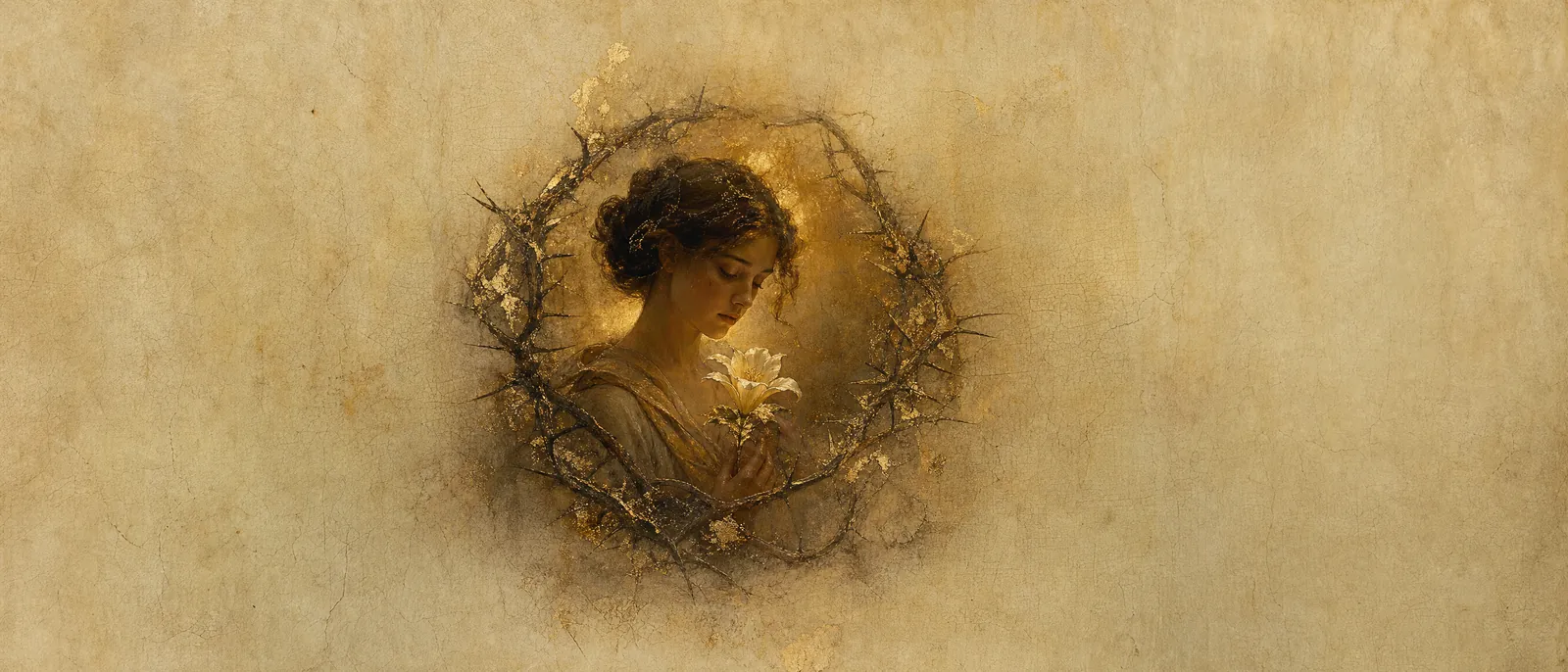
Shoshana — the bloom that keeps its color in hard company
Shoshana is the flower Song of Songs planted in the middle of thorns and dared to keep blooming. A modern Israeli name with a root that runs straight through the Tanakh, it names a soul built to hold its own color in company that offers it no discount.
The Flower That Doesn't Match Its Surroundings
Song of Songs draws the image in a single line: 'Like a shoshana among the thorns — so is my beloved among the daughters.' It is not a flower in a garden, tended and fenced. It is a flower where flowers are not supposed to grow, surrounded by exactly the thing that could tear it, and blooming anyway. That is the whole architecture of the name Shoshana. The beauty is real, but it is never protected by its setting.
This matters because most images of loveliness assume a friendly context — good soil, sun, safety. The shoshana assumes none of it. The verse does not remove the thorns; it simply places the bloom in the middle of them and lets both stand. Shoshana is the name for a person whose gentleness is not a product of easy circumstances. If anything, the environment seems designed to argue against it.
Blooming Where Nothing Subsidizes It
The Midrash sharpens the picture: the shoshana keeps its heart pointed upward no matter what grows around it. The thorns lean in; the flower does not lean back. This is the lived pattern of people who carry the name. They tend to hold their sweetness in rooms that do not reward it — workplaces that treat kindness as naivety, families that mistake softness for weakness, seasons that would make bitterness the reasonable response.
There is a cost to this, and it should be named honestly. Being the color in a colorless place makes you visible, and visibility among thorns means getting scratched. Shoshana can carry a quiet fatigue — the effort of staying warm when the surrounding temperature keeps dropping. The temptation is to become the thorns, to armor the softness away entirely. The name resists that. Its whole claim is that you can be surrounded and scratched and still refuse to become what surrounds you.
The archetype — the bloom that keeps its color in hard company — is not passive. It is a stance. The flower is not naive about the thorns; it simply declines to let them decide what it is.
The Queen Who Counts the Same
The tradition does something remarkable with this flower: it hands it to Esther. The hidden queen in the palace of Shushan, surrounded by a court full of danger, keeping her identity folded away until the exact moment it had to open — she is the shoshana among the thorns wearing a crown. The Purim hymn Shoshanat Yaakov, 'the lily of Jacob,' has been singing this connection for a thousand years.
So Shoshana holds two figures at once: the flower that blooms in hostile soil and the queen who survives a hostile court. Both keep their heart pointed upward. Both stay themselves in a setting engineered to erase them. This is the double inheritance of the name — beauty that is also strategy, softness that is also survival.
Shoshana in the Classical Sources
In the sources, Shoshana — שושנה — begins as a flower and becomes an emblem. The word means lily, or rose: the bloom among the thorns. Its gematria is 661, and that number carries a secret the liturgy has been singing for a millennium. Here is where the name is planted in the tradition.
SONG OF SONGS 2:2 — THE FLOWER AMONG THORNS
'Like a shoshana among the thorns — so is my beloved among the daughters.' This is the defining verse, and it is careful about what it does and does not promise. It does not say the thorns are removed. It does not say the flower is fenced off or kept safe. It says the flower is beautiful precisely where beauty has no protection.
Read as a description of a soul, the verse insists on two truths at once. The setting is genuinely hard — thorns are not a metaphor for mild inconvenience. And the bloom is genuinely itself — it does not blend, does not camouflage, does not become the thorns to survive among them. Shoshana names the person who lives inside both truths without resolving them into an easier one.
ESTHER 2:7 — THE HIDDEN QUEEN
Esther 2:7 introduces the orphan raised by Mordecai, the young woman taken into the palace of Shushan and told to hide her people. The tradition links her to the shoshana: the hidden queen among the palace thorns, keeping her true identity folded until the hour demanded it open. The court was beautiful and lethal at once — the perfect thorn-field.
The liturgical poem Shoshanat Yaakov, 'the lily of Jacob,' sings Purim's joy under this flower's name, binding Esther and the shoshana together in the annual telling. For Shoshana, this is the inheritance of composure under threat: the capacity to stay whole in a place that would rather you disappear, and to bloom on your own timing rather than the room's.
BERAKHOT 7b — A NAME AS A DAILY DISCIPLINE
Berakhot 7b teaches shema garim — that a name has influence, that what you are called shapes something in what you become. Applied to Shoshana, this turns the flower from a compliment into a practice. Color is not a fixed possession; it is a choice renewed each morning among the thorns.
This is the honest reading of the name. It does not promise that Shoshana will always feel gentle, always stay warm, always keep her heart pointed upward automatically. It says the name marks a discipline — the daily decision to remain the bloom rather than surrender to the surroundings. Some days the thorns win a little. The name simply keeps asking for the choice again.
THE LETTERS AND THE NUMBER
The gematria of Shoshana is 661 — and this is the number's quiet miracle: it is exactly the value of Esther, אסתר. The flower among the thorns and the queen hidden in the palace count out to the same total. Two images of the same soul-shape — beauty surviving in hostile company — arrive at one number.
The Purim hymn Shoshanat Yaakov has been singing this equivalence for a thousand years, naming Esther's people under the flower's banner. When a name and a heroine share a number, the tradition treats it as more than coincidence; it treats it as confirmation that they are telling the same story. Shoshana carries that confirmation in her count: the bloom and the queen are one arithmetic.
The Talmud's principle shema garim — "the name causes" (Berakhot 7b) — is the tradition's claim that a name gently inclines its bearer. In this library, Shoshana's nearest companions are Esther and Hadassah; the full index is at Hebrew names.
What does the name Shoshana mean?
Shoshana (שושנה) means lily, or rose — specifically the flower among the thorns. The image comes from Song of Songs 2:2, and it describes beauty that is not protected by its surroundings and does not become them.
What is the gematria of Shoshana?
The gematria of Shoshana is 661. Remarkably, this is exactly the value of Esther (אסתר) — linking the flower among the thorns to the hidden queen among the palace thorns, an equivalence the Purim hymn Shoshanat Yaakov has sung for a thousand years.
Where does the word Shoshana appear in the Tanakh?
Shoshana is a modern Israeli name, but its root is planted firmly in the Tanakh. The flower appears famously in Song of Songs 2:2 as the shoshana among the thorns, and the tradition links it to Esther (Esther 2:7), the hidden queen whose story is sung in the poem Shoshanat Yaakov.
What does the name Shoshana say about personality?
Shoshana points to a soul that holds its sweetness in environments that don't reward it — the bloom that keeps its color in hard company. The Midrash notes the shoshana keeps its heart pointed upward whatever grows around it, describing a person who stays warm and whole even under pressure.
What do the sources say about Shoshana?
Song of Songs 2:2 makes the shoshana the emblem of beauty among thorns; Esther 2:7 and the hymn Shoshanat Yaakov link it to the hidden queen; and Berakhot 7b, teaching that a name shapes its bearer, turns the flower into a daily discipline of choosing one's color anew.
Why is Shoshana connected to Esther and Purim?
Two reasons converge. By gematria, Shoshana equals 661, the exact value of Esther (אסתר); and by imagery, both are the flower among the thorns — the queen keeping her identity folded in a hostile court. The Purim hymn Shoshanat Yaakov binds them together in song.