Tamar — the risker for what is right
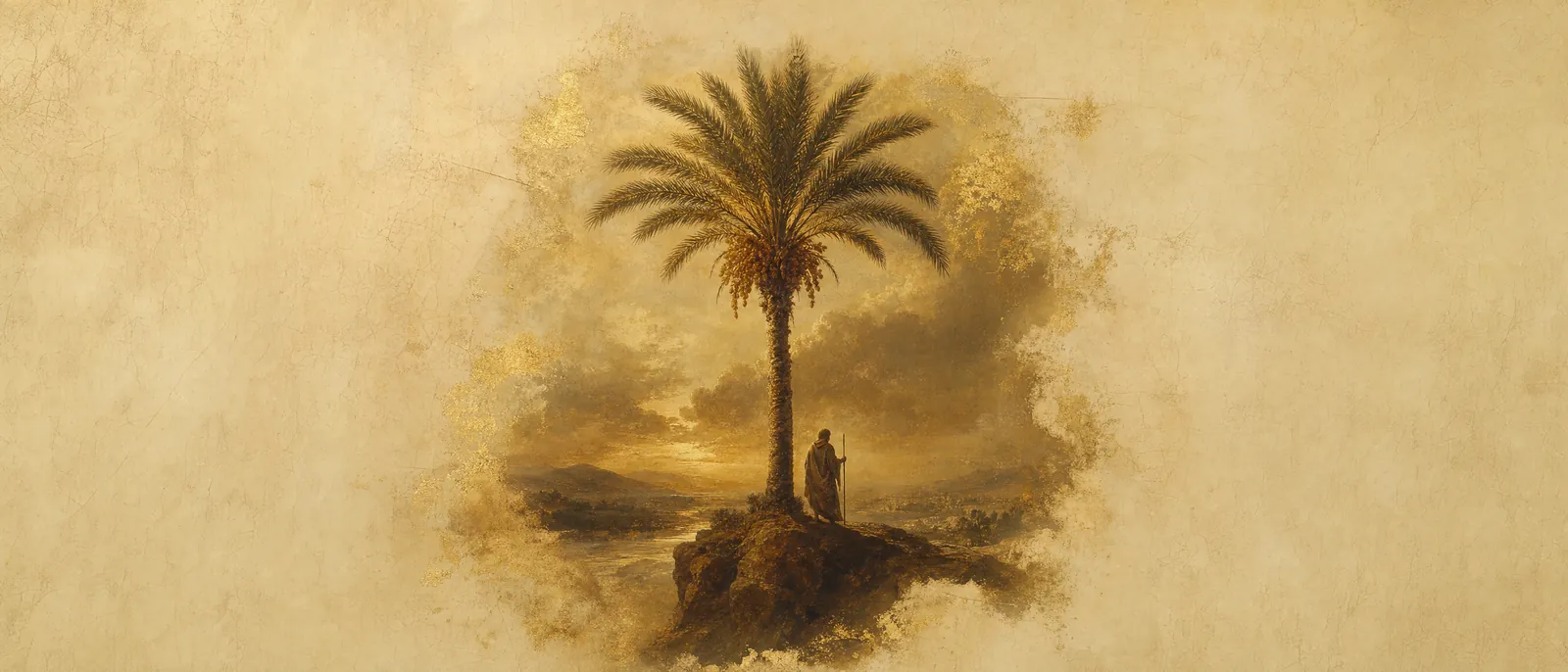
Tamar means date palm — a tree that bears fruit in the desert, upright and patient. But the woman who carried the name first staked her life on a future no one else could see, and that gamble runs through everyone who bears it since.
The Woman Who Refused to Disappear
Tamar's story sits oddly in the middle of the Joseph cycle, interrupting it like something that could not wait. In Genesis 38, she is married to Judah's eldest son, who dies. By the custom of the time she is given to the second son, who also dies. Judah, frightened of her, withholds the third — and Tamar is left in a kind of legal limbo, a widow attached to a family that has quietly decided to forget her.
She does not accept the forgetting. When Judah passes through on his way to shear sheep, she disguises herself, and through a calculated, dangerous act secures the future that was being denied her. The risk is total: months later, visibly pregnant, she is accused of harlotry and Judah orders her burned.
She does not name him. She sends his own seal, cord, and staff with a quiet message: by the man to whom these belong, I am with child. She gives Judah the chance to recognize himself — and he does, saying, 'She is more righteous than I.'
Righteousness That Looks Reckless First
From the outside, almost everything Tamar did would have been called reckless. She acted alone, broke convention, gambled her life on a man's conscience and the strength of evidence she had quietly kept. Nothing about the plan was safe. And yet the verdict the text gives is not 'reckless' but 'righteous.'
This is the architecture the name carries. People named Tamar often see a possibility others cannot — a future that does not yet exist, an outcome that depends on someone doing the uncomfortable thing now. They move toward it before anyone else agrees it is real. The judgment of the people around them tends to arrive in two stages: first the alarm, then, much later, the recognition that they were right all along.
What Was Preserved
The point of Tamar's risk was not defiance for its own sake. It was preservation. The line she secured runs forward through her son Perez — and from Perez, the book of Ruth tells us, comes the house of David, and through it the lineage that Jewish tradition associates with the Messiah. What would have been lost was not just her own standing but an entire future.
People with this name often carry that instinct: they protect what others are willing to let slip. A relationship everyone has given up on, a principle no one is defending, a person being quietly written out of the story. They notice the disappearing thing, and they reach for it.
The Cost of Seeing Early
Seeing the future early is lonely. The Tamar pattern includes long stretches of being misread — judged as stubborn, dramatic, or naive by people who simply have not yet caught up. The vindication comes, but it tends to come late, after the risk has already been taken and the discomfort already absorbed.
The danger, then, is twofold. One is exhaustion: carrying conviction that the room does not share is heavy, and not every battle is worth Tamar's stakes. The other is mistaking every refusal for a cause. The name's gift is discernment about when the future truly depends on you — and the work of a lifetime is learning to tell that from the times it does not.
Upright in the Desert
The literal meaning — the date palm — is worth holding onto. The palm grows tall and straight in conditions that kill other trees, and it bears its sweetest fruit late, after years of looking like it is producing nothing. It is patient and it is unbending at once.
That is the quieter half of the Tamar character. Beneath the dramatic risk is a long endurance — the willingness to stand upright through seasons of not being understood, and to keep faith that the fruit is coming.
Tamar in the Classical Sources
The name is תָּמָר (Tamar), gematria 640, and it means date palm — the tree that grows straight up, fruits in the desert, and bends without breaking. The sources gave its most famous bearer one of the Talmud's highest and hardest-won verdicts, and gave the tree itself the tradition's defining verse about the righteous.
Where the Tanakh Gives the Name
Tamar's chapter is Genesis 38 — the widow twice over, denied the levirate marriage she is owed, who takes the family's future into her own hands at the crossroads. The verse that crowns her is Yehudah's public reversal: confronted — privately, deniably — with his own seal, cord, and staff, he announces, "She is more righteous than I (tzadkah mimeni)." From her twins runs the royal line: Peretz, ancestor of David. The Tanakh's monarchy begins with a woman the establishment had shelved, out-arguing the establishment.
The Sages on Tamar
The Talmud in Sotah draws from her story one of its most quoted ethical rulings: Tamar, being led out, sent the pledges privately rather than name Yehudah in public — and from here the Sages taught that it is better for a person to be cast into a furnace than to shame another in public. Read that again against her stakes: with her life on the line, she left her accuser a door. The tradition made her restraint, not her stratagem, the halachic headline — and made her name a permanent citation in the laws of human dignity.
The Letters and the Tree
Tav–mem–resh: the name opens with tav, the alphabet's last letter — a name that begins where the alphabet ends, fitting for the woman who acted only after every conventional route was exhausted. The tree is the Psalmist's chosen emblem: "the righteous shall flourish like the date palm (katamar yifrach)" — and the commentators explain the choice: the palm has one heart (a single growing core), gives fruit only after years, and every part of it is useful. Righteousness, in the tree's grammar: single-hearted, slow-fruiting, wasting nothing.
What a Name Does
The Talmud in Yoma has Rabbi Meir auditing names for their forecast, and Tamar's audits clean: named for the tree that stands straight in hard ground, she straightened a crooked situation at personal risk and was called righteous by the man who wronged her. The judge she out-taught has his own page — Yehudah, whose public confession the Sages counted as his crown — and the desert-fruiting palm shades Devorah, who judged Israel beneath one. The full index is at Hebrew names.
What does the name Tamar mean?
Tamar (תמר) means 'date palm,' from the root t-m-r — a tree known for growing tall and upright in harsh conditions and bearing fruit patiently. The imagery suggests both endurance and an unbending, towering form.
What is the gematria of Tamar?
The gematria of תמר is 640. We use this value as authoritative for the name as spelled here.
Who was Tamar in the Bible / Tanakh?
The first Tamar appears in Genesis 38 as Judah's daughter-in-law. Widowed twice and denied her rightful place in the family, she took a dangerous, calculated risk to secure her future — and Judah ultimately declared, 'She is more righteous than I.' Her son Perez became an ancestor of King David. (A separate Tamar, daughter of David, appears in 2 Samuel 13.)
What does the name Tamar say about personality?
The name describes a soul drawn to righteous risk: people named Tamar often see possibilities no one else can see and act on them before anyone agrees they are real. They preserve what would otherwise be lost. The cost is being misread until the future proves them right — and the lifelong work is discerning which risks are truly theirs to take.
What ethical law do the Sages learn from Tamar?
Sotah 10b: being led out, Tamar sent Yehudah's pledges privately rather than name him in public — and from here the Sages taught it is better to be cast into a furnace than to shame another person publicly. With her life at stake, she left her accuser a door.
Why is the date palm the emblem of the righteous?
Psalms 92:13 — 'the righteous shall flourish like the date palm (katamar).' The commentators explain: the palm has a single heart (one growing core), fruits only after years, and wastes nothing. Righteousness in the tree's grammar: single-hearted, slow-fruiting, generous.