Cheshvan — the Hebrew month of Scorpio
Cheshvan is the Hebrew month with no holidays — the one called bitter — and the people born under it carry that same withheld quality: depth that surfaces only where it is safe. This is the month of Scorpio, the tribe of Menasheh, and the sense of smell.
You learned early that the most important things in your family were never said aloud. There was a register beneath the spoken one — a held breath, a glance exchanged over your head, a subject the room agreed to walk around — and you became fluent in it before you could name it. This is why people call you guarded. The truth is closer to the opposite: you are reading the entire room while they read only the words. חֶשְׁוָן (Cheshvan) is the autumn month with no festival, no commanded joy, no scaffolding of ritual to lean on — and those born into it tend to live the same way, building their inner life in private where no calendar requires it.
The cost of that fluency is real. You are intensely loyal, and you are also capable of complete disappearance. When trust breaks, you do not argue or escalate — you close, quietly, a door shut so slowly that the person on the other side rarely sees it move until it has already shut. The people who lost you often did not know they were losing you. This is the contradiction the month hands you: a depth of attachment that runs deeper than most, paired with an exit so silent it can look like coldness. It is not coldness. It is self-protection that has gotten too good at its job.
Akrav: the sign that strikes from below
The מַזָּל (mazal) of Cheshvan is עַקְרָב (Akrav) — Scorpio, the Scorpion. Of all the zodiac symbols this is the one that lives in the dark places, under stones, in the gaps, and strikes not from above but from below and behind. It is the emblem of what is hidden, what waits, what is underestimated until the moment it is not. Read into a person, the Scorpion is not about aggression so much as concealment with a sting in reserve. You hold your real position back. You let others reveal their hand first. The danger the symbol warns of is the same one it offers as a gift: the capacity to wound, or to wait, or to see — and which of those you become is the whole question of the month.
Menasheh: the son who was named for forgetting
Cheshvan's tribe is Menasheh, Joseph's firstborn, and the name itself is a confession. Joseph called him Menasheh — מְנַשֶּׁה — "for God has made me forget all my hardship and all my father's house." Here is a man building a new life in a foreign land, naming his child after the act of letting the old pain go. And yet the boy carries the memory of the loss in the very name meant to bury it. That tension is deeply Cheshvan: the work of transforming bitterness into something you can live with, while the bitterness remains legible in the structure you built over it. Menasheh's descendants were known for holding ground and for late, decisive strength — the tribe that did not lead the procession but was not to be moved.
Nun and the sense that the Serpent could not corrupt
In the סֵפֶר יְצִירָה (Sefer Yetzirah), Cheshvan is governed by the letter נ (Nun) and the faculty of smell. Nun is associated with the fifty gates of understanding — depth upon depth of comprehension, the descent into a thing until you reach what it actually is rather than what it appears to be. And smell is singular: the tradition teaches that of all the senses, smell alone was not corrupted by the Serpent in the Garden, which is why it is said that מָשִׁיחַ (Mashiach) will judge not by sight or hearing — the senses that deceive — but by smell, the sense that perceives essence directly. This is the Cheshvan faculty exactly: you sense what is wrong in a room before anyone has said anything wrong. The inner work the month asks for is to bring those hidden depths into the light — to turn the bitterness of Mar-Cheshvan into insight others can use, rather than a vault only you can open. Tradition holds that the Third Temple will be inaugurated in this monthless month, as if to say: the place with no festival is precisely where the deepest dwelling is built.
Where the depth earns its keep
In work, the Cheshvan strengths line up with anything that rewards seeing past the surface and outlasting the difficulty: penetrating insight, resilience, the strategic patience to wait for the right moment rather than the first one. You transform through hardship rather than around it — the setback that breaks others is often the thing that finally makes you serious. These are the qualities that show up in roles like:
- Investigator or forensic analyst
- Psychologist or psychotherapist
- Surgeon
- Deep researcher
- Contrarian investor
- Crisis manager
The growth edges sit on the same axis. The patience that lets you wait can curdle into an inability to let go; the perception that protects you can make trusting another person feel like surrendering your only advantage. Vulnerability reads as exposure rather than connection, and quick optimism — the easy, unguarded "this will be fine" — does not come naturally to someone trained from childhood to read the silence for the threat in it. In relationships this is the recurring test the month sets: whether you can choose openness when nothing is forcing you to. Cheshvan has no holiday; your real tradition is the work you do where no one is watching. The soul question of the month is simply whether you ever let anyone watch.
Cheshvan in the Classical Sources: A Deeper Map
In Hebrew the sign is מַזָּל עַקְרָב — mazal Akrav, the Scorpion — and the month is חוֹדֶשׁ חֶשְׁוָן, chodesh Cheshvan (formally Marcheshvan). It is the only month with no festival and no fast — the calendar's empty room — and the sources treat that emptiness as the month's actual subject: a space held open on purpose.
Sefer Yetzirah: Letter, Tribe, and Faculty
The fifth chapter of the סֵפֶר יְצִירָה assigns Cheshvan the letter נ (Nun), the tribe of Menasheh, and the faculty of smell. Nun is the letter of falling — the Sages note that even King David, alphabetizing Ashrei, skipped the verse of the fallen — and also the letter whose value is fifty, the number of the gates of understanding; the letter of those who go down deep. Menasheh is the son named for survival in exile — "God has made me forget my hardship" — the firstborn of making-it-through. And smell is the faculty the Talmud singles out as the soul's own sense: "What is it that the soul benefits from and the body does not? Smell." It is also the one sense the tradition says took no part in Eden's sin — the eyes saw, the hand took, the mouth ate; the nose stayed clean. A month with no outward holiness gets the inward sense, the one that needs no festival to function. Classical astrology gives Akrav to מַאְדִּים (Ma'adim, Mars) — intensity, held underground.
The Talmud and Tanakh: The Flood and the Unfinished Dedication
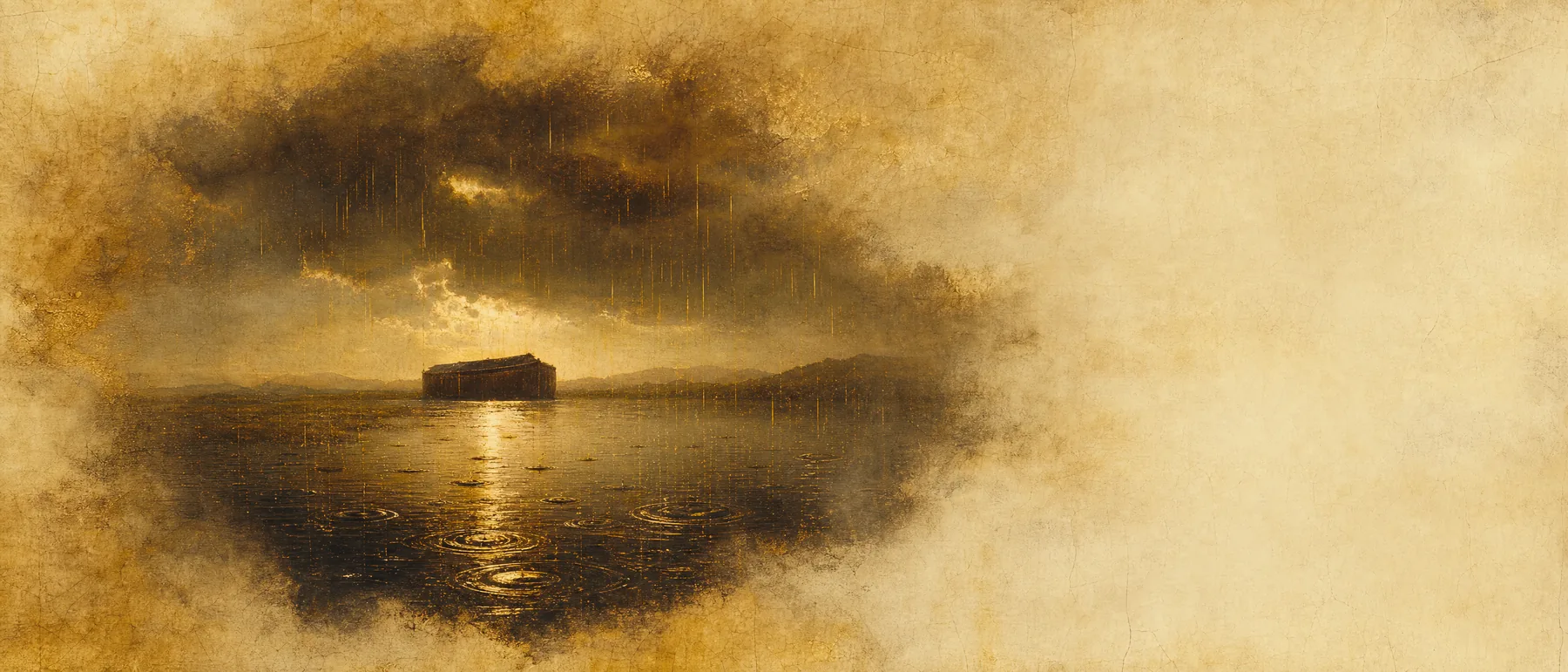
The Talmud in Rosh Hashanah dates the great flood to this month: on the seventeenth of Marcheshvan the rains began, and the world went under the water of its own corruption. Scripture, meanwhile, calls the month Bul — the month in which King Solomon completed the Temple: "in the month of Bul… the house was finished." But the dedication was postponed eleven months, to Tishrei — and the tradition preserved in the Midrash draws the conclusion that defines Cheshvan: the month was, as it were, owed — and the future Temple's dedication is held in trust for it. The month of the flood is also the month holding the calendar's last unredeemed promissory note.
The Maharal: The Waters of Unmaking
In Gur Aryeh, his supercommentary on the Torah, the Maharal of Prague reads the flood not as punishment by drowning but as un-creation: water, the element that preceded all form, released to dissolve a world whose forms had corrupted themselves — "all flesh had corrupted its way." The deluge returns creation to its liquid beginning so that it can be formed again, and the sign of the renewed world is precisely a boundary: the rainbow, light bent into a limit. For Cheshvan-born souls the Maharal's reading is close to a biography: the deep waters are real, and they are not the end — they are the solvent in which a truer form is prepared. The scorpion, armored at the waterline, survives what dissolves everything else.
The Bnei Yissaschar: The Month's Avodah
The Bnei Yissaschar's Cheshvan essays turn the month's emptiness into its assignment. After Tishrei's crowded holiness — a month spent in shul, in the sukkah, inside commanded joy — Cheshvan is the return to ordinary days, and he reads it as the year's first test: whether the holiness acquired in Tishrei survives contact with a month that demands nothing. His emblem for it is the month's own faculty: fragrance is what remains in a room after the flowers are taken out. The avodah of Cheshvan is to be that room — to carry Tishrei's scent through a month with no festivals, and to trust the tradition's promise that the empty month is the one the future has reserved.
Above the Stars
The Talmud's ein mazal l'Yisrael (Shabbat 156a) has a particular edge in Cheshvan: a month whose chart holds a flood and no festivals might read as abandonment, and the sources refuse the reading twice — once by naming the nose, the sense of the soul, as the month's faculty, and once by assigning its empty calendar the Temple still to come. What looks like the year's forgotten month is, in the sources, its most reserved one. The principle in full: Ein Mazal L'Yisrael: Why the Jewish Zodiac Is Not Fate; the whole cycle: the twelve Jewish zodiac signs.
What zodiac sign is Cheshvan?
Cheshvan corresponds to Scorpio, called Akrav (עַקְרָב), the Scorpion, in the Hebrew zodiac. It is an autumn month falling roughly across October and November.
Which tribe is associated with Cheshvan?
Cheshvan is associated with the tribe of Menasheh, Joseph's firstborn son, whose name means 'forgetting' — fitting for a month whose theme is transforming buried bitterness into strength.
What is the personality of someone born in Cheshvan?
People born in Cheshvan tend to be deep, mysterious, introspective, and capable of profound transformation. They are intensely loyal yet private, perceptive enough to read what others leave unsaid, and they do their most important work out of public view.
When does Cheshvan fall in the Gregorian year?
Cheshvan falls in autumn, roughly across October and November, the second month of the Jewish civil year following Tishrei. Its exact dates shift each year because the Hebrew calendar is lunar.
What does mazal Akrav (מזל עקרב) mean?
Mazal Akrav (מַזָּל עַקְרָב) is the Hebrew name for Scorpio, the Scorpion — the sign of Cheshvan (חודש חשוון), the calendar's only month with no festival or fast. The armored creature of the waterline fits the month of the flood: intensity held underground, survival through depth.
Why does Cheshvan have no holidays?
Scripture calls it Bul (I Kings 6:38) — the month Solomon finished the Temple, whose dedication was then postponed to Tishrei. The Midrashic tradition concludes that Cheshvan is 'owed': the dedication of the future Temple is held in trust for it. The empty month is the reserved one.
What is the spiritual meaning of Cheshvan?
The spiritual meaning of Cheshvan is hidden depth. It is the only Hebrew month with no holiday — the flood began in it, and tradition reserves it for the dedication of the future Temple — so its work is finding the sacred in ordinary time, with no festival to carry you.
Born in Cheshvan? Read the chart you were born under.
Your Hebrew month is one thread. The full reading weaves in your day, your hour, and the letters of your name.
Begin Your ReadingThe Hebrew month before Cheshvan, and the soul it carries.
The Hebrew month after Cheshvan, and the soul it carries.
The full map of the mazalot — every Hebrew month, sign, and tribe in one place.