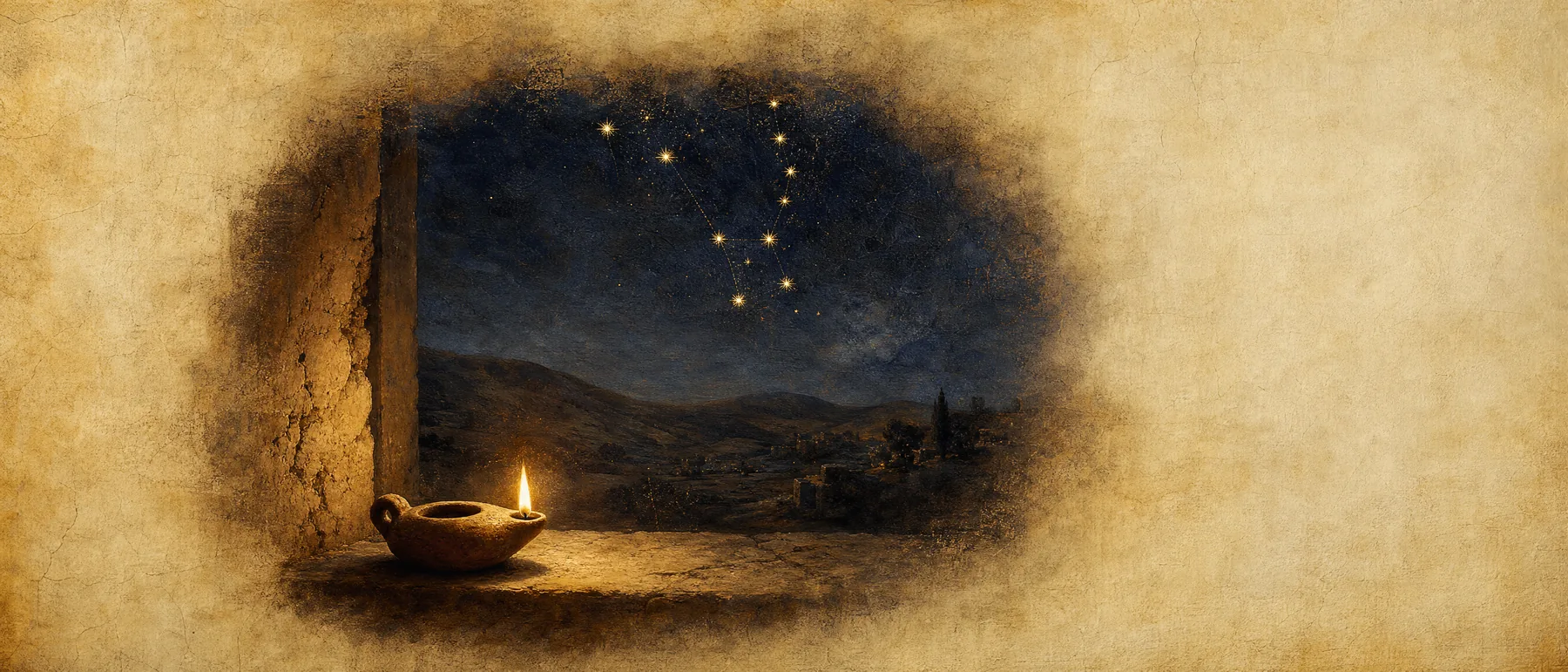
Kislev — the Hebrew month of Sagittarius
Kislev is the Hebrew month of the archer's bow and the Chanukah flame — born to Sagittarius and the tribe of Benjamin, it is the month of trust aimed at a target no one else can see.
You learned early to believe in things that did not exist yet. While other children measured the world by what was in front of them, you were already describing who you would become — out loud, sometimes, to people who only half-listened. This is the signature of the soul born under כִּסְלֵו, Kislev: you have been aiming at invisible targets since childhood, and you rarely lower the bow. The month falls in late autumn, across the seam of November and December, as the year's light thins toward its shortest days — and into exactly that darkness Kislev sets a small, deliberate flame.
What looks like effortless optimism is, in your case, something harder-won. You are an optimist who has been disappointed by reality more often than you let on, and each disappointment was followed not by surrender but by quiet reconstruction. You rebuilt the faith. People mistake this for naivety; it is closer to the opposite. It is discipline disguised as hope — the daily decision to keep aiming after the arrow has already gone wide. The cost is real: you can spend years chasing a vision while the practical ground beneath it erodes, and the people around you do not always survive the wait as well as you do.
Keshet, the Bow That Is Also a Rainbow
The מַזָּל of Kislev is Sagittarius — in Hebrew קֶשֶׁת, Keshet, the Bow. The image is the archer, the figure drawn taut, the arrow already chosen but not yet released. But קֶשֶׁת carries a second meaning the constellation alone does not: it is also the rainbow, the sign of covenant after the flood. Both are bows. One is a weapon of distance and ambition; the other is a promise that the world will not be undone. The Kislev temperament lives in the tension between them — between the will to launch yourself at a far-off mark and the deeper faith that something is holding, that the aim is not foolish. To draw a bow is to hold strain on purpose. You are most yourself when you are pulled tight toward something distant, and least yourself when there is nothing to aim at.
Benjamin, Son of the Right Hand
The tribe of Kislev is Benjamin — בִּנְיָמִין, the son of the right hand, the last son of Jacob, born as his mother died. Benjamin's blessing in the Torah is that of a wolf who hunts, and his tribe produced the great archers and slingers of Israel, the marksmen who could aim at a hair and not miss. That precision is not coincidental to your month; it is its inheritance. Yet Benjamin is also the brother around whom Joseph's story turns — and the dreams of Joseph, the prophet of impossible futures, unfolded in Kislev. You carry both legacies at once: the sharpshooter's exactness and the dreamer's reach. The danger is when the dreamer drowns out the marksman, when the size of the vision excuses the missed details that would have made it land.
Samech, the Sense of Trust
In the סֵפֶר יְצִירָה, the Sefer Yetzirah, each Hebrew month is assigned a letter and a sense. Kislev is given ס, the letter Samech — the only fully closed, circular letter, a form with no opening, an unbroken ring that holds whatever it surrounds. Its faculty is sleep, and beneath sleep, trust. To sleep is to release the day, to let go of control and believe the world will still be there at dawn. This is בִּטָּחוֹן, bittachon — the inner work of your month. Your rectification is not to aim less ambitiously but to aim with full faith and survive the miss: to launch the arrow knowing it may fall short, and to keep your hand steady anyway. The closed circle of Samech is the discipline of trusting what you cannot see all the way around. This is the heart of Chanukah, kindled on the 25th of Kislev — the festival of a small light against impossible odds. The deeper Kislev test is the one named in the pullquote above: faith is lighting the flame before you have evidence it will last.
How the Aim Shows Up in Work and Love
In work, you gravitate toward the long shot — the venture with a low probability and a vast payoff, the idea everyone else calls premature. You are built for the roles where vision is the product: founding something from nothing, inventing what does not yet exist, backing the bet no committee would approve, telling a story large enough to move people. The fields that fit are recognizable in the same way:
- Visionary entrepreneur and inventor — where the value is in seeing the target first
- Long-shot investor — staking on the future against present odds
- Filmmaker — building worlds others cannot yet picture
- Athlete and adventurer — the outdoor pursuit, the body aimed at a peak
Your strengths are real: optimism that does not curdle, the nerve to aim high under pressure, faith that holds when the numbers don't. Your growth edges are the precise inverse. You can skip the detail that grounds a plan, treat limitations as insults rather than information, and confuse impatience with conviction — firing the next arrow before the last one has even landed. The work is tactical patience: the marksman's stillness before release. In relationships, the gift and the burden are the same. You aim higher than your circumstances should allow, and the people who matter learn, slowly, that the aim itself is the gift — that being believed in by you is its own kind of light, even on the nights the oil is running low.
Kislev in the Classical Sources: A Deeper Map
In Hebrew the sign is מַזָּל קֶשֶׁת — mazal Keshet, the Bow — and the month is חוֹדֶשׁ כִּסְלֵו, chodesh Kislev. The sources hand this month a double image: the archer's bow drawn in the year's darkest weeks, and the other keshet — the rainbow, the bow God hung in the clouds as a covenant. One is tension aimed forward; the other is light bent into a promise. Kislev is both.
Sefer Yetzirah: Letter, Tribe, and Faculty
The fifth chapter of the סֵפֶר יְצִירָה assigns Kislev the letter ס (Samech), the tribe of Binyamin, and the faculty of sleep. Samech is the alphabet's only closed circle — the liturgy's word for it is support, somech noflim, "He upholds all who fall" — a letter shaped like the arms that catch you. Binyamin is the only tribe born inside the Land of Israel, and the one in whose portion the Temple stood; Moshe's blessing reads like the month's motto: "the beloved of God dwells securely beside Him… and rests between His shoulders." Security, rest, a circle of support — and so the month's faculty is sleep: the nightly act of absolute trust, in the month of the year's longest nights. It is no accident that nearly every dream in the Torah — Yaakov's ladder, Yosef's sheaves, Pharaoh's cows — is read in shul during Kislev. Classical astrology gives Keshet to צֶדֶק (Tzedek, Jupiter) — whose Hebrew name means "righteousness" — the benefactor-planet, generosity drawn like a bow.
The Talmud: What Is Chanukah?
The Talmud in Shabbat 21b asks the month's famous question — "Mai Chanukah? What is Chanukah?" — and answers with the story the calendar sealed into Kislev's last week: the Greeks defiled the Temple's oils; one cruse remained with the High Priest's seal intact, enough for one day; a miracle stretched it to eight. The Talmud's emphasis is precise and very Kislev: the miracle was not the war (that was human courage) but the light — a small sealed reserve, found intact in the wreckage, burning past its capacity. The halachah of the month follows the same curve: mosif v'holech, the Chanukah lights increase night by night, adding light exactly as the season's darkness peaks.
The Maharal: Eight Against Nature
The Maharal of Prague wrote a dedicated treatise on this month's festival — Ner Mitzvah, "the Candle of the Commandment." Greece, in his reading, is not an army but a worldview: the perfection of nature and reason, the claim that what the mind can grasp is all there is. Seven, for the Maharal, is nature's number — the days of the week, the completed cycle. Eight is the number of what stands beyond it. An eight-day festival of light, established over a single day's oil, is the calendar's permanent answer to Athens: the world runs on nature, and is not exhausted by it. The archer of Keshet, in this frame, is aiming past the visible target.
The Bnei Yissaschar: The Month's Avodah
The Bnei Yissaschar treats Kislev and Tevet in one set of essays, and his Kislev teachings gather the month's threads into a single avodah: trust in the dark. He connects the month's bow to the rainbow seen after the flood — covenant remembered exactly when the sky is at its grimmest — and reads the month's sleep-faculty through its dreams: Yosef, the master dreamer of the Kislev readings, is the tradition's proof that what descends into the pit in darkness rises to govern in the morning. The practical work he assigns is the menorah's: do not curse the darkness and do not merely endure it — add one light more than yesterday, every night, as policy.
Above the Stars
Kislev's festival is itself a commentary on ein mazal l'Yisrael (Shabbat 156a): by every natural reckoning — military, chemical, astrological — the story ends with the empire and the darkness winning. The month's answer is the one the Maharal formalized: Israel's account runs on the number eight, past where nature's ledger closes. The full teaching is at Ein Mazal L'Yisrael: Why the Jewish Zodiac Is Not Fate; the year's whole wheel is at the twelve Jewish zodiac signs.
What zodiac sign is the Hebrew month of Kislev?
Kislev corresponds to Sagittarius, called Keshet (קֶשֶׁת) in Hebrew, meaning the Bow. The same word also means rainbow, the biblical sign of covenant, joining the archer's ambition with the promise of faith.
Which tribe of Israel is associated with Kislev?
Kislev is linked to the tribe of Benjamin, the son of the right hand. Benjamin's tribe was famed for its archers and marksmen, mirroring the sharpshooter precision of the Sagittarius bow.
What is the personality of someone born in Kislev?
People born in Kislev tend to be optimistic, faithful, and visionary, with a dreamlike reach and an archer's precision. Their core trait is trust (bittachon) — aiming at distant, even impossible targets and rebuilding their faith each time reality falls short.
When does Kislev fall in the Gregorian calendar?
Kislev falls in late autumn, roughly across November and December. Chanukah begins on the 25th of Kislev, near the year's longest nights.
What is mazal Keshet (מזל קשת)?
Mazal Keshet (מַזָּל קֶשֶׁת) is the Hebrew name for Sagittarius, the Bow — the sign of Kislev (חודש כסלו). The sources hear both bows in the word: the archer's bow of the Chanukah wars, and the rainbow — the covenant-bow hung in the clouds after the flood, first seen, the tradition says, in this month.
Which classical sources discuss the month of Kislev?
Sefer Yetzirah (ch. 5) assigns Kislev the letter Samech, the tribe of Binyamin, and the faculty of sleep; the Talmud (Shabbat 21b) gives the month its question — 'What is Chanukah?'; the Maharal's Ner Mitzvah reads the festival's eight days as the number beyond nature; and the Bnei Yissaschar's Kislev–Tevet essays make its avodah trust in the dark.
What is the spiritual meaning of Kislev?
The spiritual meaning of Kislev is light kindled in darkness. It is the month of dreams and of the bow — the rainbow first appeared in it, and Chanukah closes it. Kislev teaches trust: aim long, sleep deep, and let a small flame argue with the longest nights of the year.
Born in Kislev? Read the chart you were born under.
Your Hebrew month is one thread. The full reading weaves in your day, your hour, and the letters of your name.
Begin Your ReadingThe Hebrew month before Kislev, and the soul it carries.
The Hebrew month after Kislev, and the soul it carries.
The full map of the mazalot — every Hebrew month, sign, and tribe in one place.