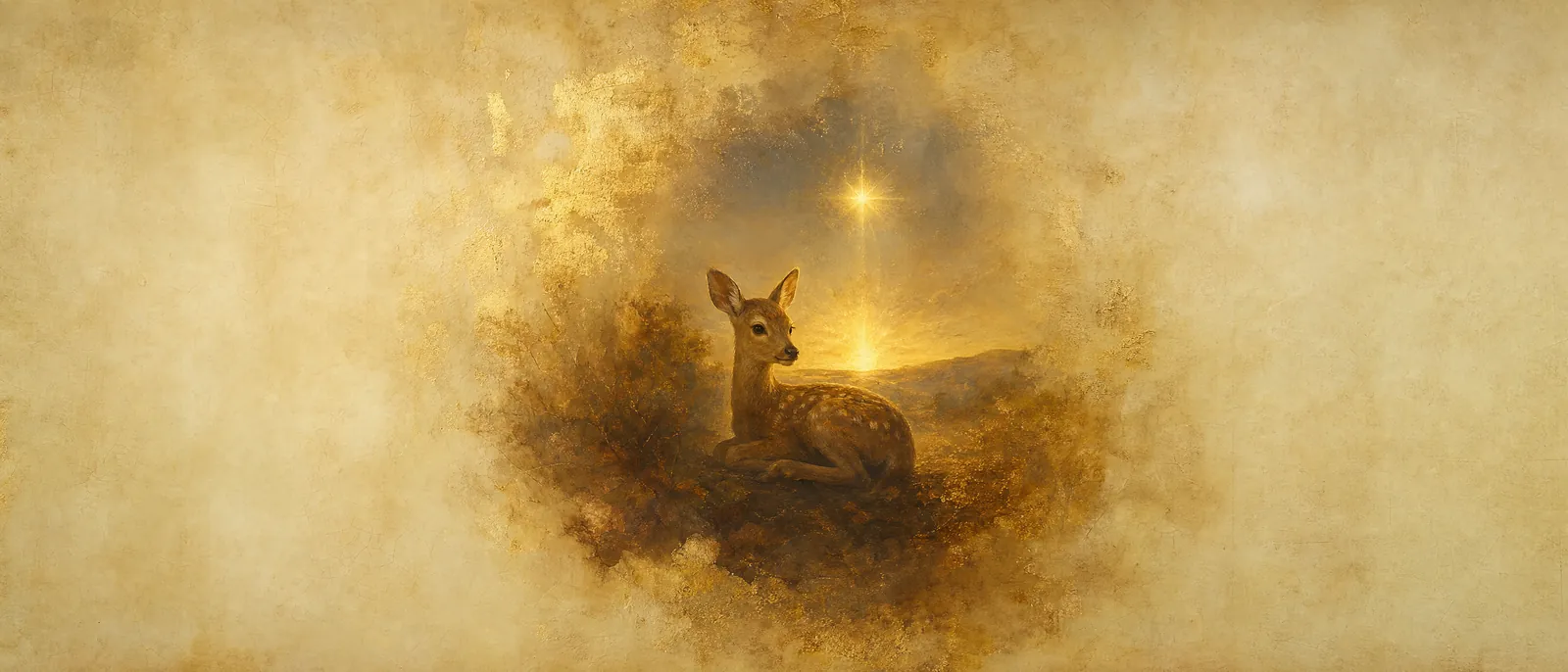
Ayelet — the first light that proves the night is ending
Ayelet is the doe of the dawn — ayelet hashachar, the Hebrew name for the morning star. It is the tradition's image of redemption that comes little by little, then all at once, and the emblem the Talmud fixes to Esther. To carry it is to be the early signal: the one who senses the turn before the sky will admit it.
The Name That Names the Dawn
Ayelet is a modern Israeli name, but the word beneath it is old and precise. Ayelet hashachar — the doe of the dawn — is the Hebrew phrase for the morning star, the last bright point in the sky before the sun. It is not the sun. It is the promise of the sun: the sign that appears while the world is still dark, and means the dark is nearly over.
This is why the name matters more than a pretty gloss suggests. The doe is swift, alert, easily startled — a creature that senses movement early. The dawn it belongs to is not the noon of certainty but the first grey seam at the edge of night. Put them together and you get an archetype that is neither triumphant nor naive: the one who registers the turn while everyone else is still asleep in the dark.
Redemption That Comes Little by Little
The tradition reads ayelet hashachar as the emblem of geulah — redemption — and it insists on a particular shape for that redemption. Not a thunderclap. A dawn. Light that arrives gradually, so gradually that you can argue with it, and then all at once becomes undeniable. The Talmud fixes this image to Esther, whose deliverance came not through open miracle but through a long, quiet accumulation of turns that only afterward looked like a plan.
People who carry this name tend to live on that timescale. They are early — sometimes uncomfortably early — to a sense that something is shifting. They read the seam of grey before the room agrees it is morning. This is a gift and a cost in one motion: the cost is being the one who names the turn before anyone wants it named, who feels the redemption coming while the night is still arguing for itself.
The Doe and the Watchfulness
Alertness is the engine and the tax of this name. The doe survives by noticing first, and an Ayelet often carries a nervous system tuned to the earliest signal — the change in a friend's voice, the crack in a plan, the first light that means the situation is turning. At its best this is a form of hope that is genuinely evidence-based: not wishful, but observant. She trusts the dawn because she has actually seen the star.
The shadow is the vigilance that never fully rests. To always be scanning the horizon for the turn is to be startled easily, to struggle to sit in the plain dark without straining for its edge. The work of this name is learning that the night, too, is allowed — that being the first light does not require standing sentry over every hour of the dark. Redemption comes little by little; so, sometimes, does rest.
Grace and Swiftness
There is a gentler register to the word as well. In Proverbs the doe appears as ayelet ahavim — the beloved doe — an image of grace, swiftness, and affection, one the Sages turn toward Torah herself. So the name is not only vigilance and dawn-watching. It carries lightness, a quickness of movement and feeling, a capacity to be dear to people. The same sensitivity that makes an Ayelet the early signal also makes her tender, quick to warmth, quick to run toward what she loves.
The name asks its bearer to hold both: the watchfulness of the sentinel and the grace of the beloved doe. To notice the turn without hardening into a lookout. To be the first light without forgetting that light is meant to be enjoyed, not only announced.
Ayelet in the Classical Sources
In the sources, Ayelet — איילת, the doe of the dawn — sits on a single luminous image: ayelet hashachar, the morning star. The gematria of the modern spelling is 451. Three texts hold the word, and each turns it a different way: a psalm of the darkest hour, a Talmudic reading of Esther, and a proverb of grace. Together they build the name's architecture — redemption that arrives like first light.
PSALMS 22:1 — THE PSALM OF THE DARKEST HOUR
Psalm 22 opens with a superscription addressed 'to the ayelet hashachar' — to the doe of the dawn. The psalm itself is a cry from the bottom of the night, the voice of one who feels abandoned in the dark. And yet its inscription points at the first light. That tension is the whole meaning of the name: the cry is aimed at the dawn.
The tradition reads this as Esther's psalm — the prayer of the darkest hour, spoken toward the earliest star. It teaches that the doe of dawn belongs precisely to those who call out while it is still night, trusting that the light they cannot yet see is already on its way.
YOMA 29a — THE LAST, LATEST LIGHT
The Talmud in Yoma asks why Esther is compared to the ayelet hashachar, and answers: as the dawn is the end of all night, so Esther was the end of all miracles — the last, latest light. The image is deliberately un-dramatic. Dawn does not shatter the dark; it dissolves it, edge by edge, until morning is simply here.
This is the name's signature. Redemption that comes little by little, then all at once. To carry Ayelet is to belong to this slow, certain kind of arrival — the sensibility of the one who is early to the turn, who reads the last light of the old night as the first light of the new day.
PROVERBS 5:19 — THE BELOVED DOE
Proverbs speaks of the ayelet ahavim — the beloved doe — an image of grace, swiftness, and affection. It is the tradition's other use of the word, and the Sages extend the affection to Torah herself, the beloved one whose grace does not run dry.
So the doe is not only the watchful creature of the dawn. She is also cherished, quick, and dear — lightness and love braided into the same word. The name holds both faces: the sentinel who notices first and the beloved who is quick to warmth.
THE LETTERS AND THE NUMBER
The gematria of Ayelet in its modern spelling, איילת, is 451. That is the whole of the numeric claim — no further equivalence is drawn here, because the name's weight lives less in its arithmetic than in its picture. The doe of the dawn is the tradition's image of geulah, redemption that comes little by little and then all at once.
Read that way, the number is simply the seal on a name already saturated with light. Everything essential is in the word itself: the swift creature and the first star, the darkest hour and its answered edge. Ayelet does not need to add up to the dawn. It already is the dawn's name.
The Talmud's principle shema garim — "the name causes" (Berakhot 7b) — is the tradition's claim that a name gently inclines its bearer. In this library, Ayelet's nearest companions are Esther and Ayala; the full index is at Hebrew names.
What does the name Ayelet mean?
Ayelet (איילת) means 'doe of the dawn' — ayelet hashachar, the Hebrew name for the morning star. It is the tradition's image of redemption that comes gradually and then all at once, the first light that proves the night is ending.
What is the gematria of Ayelet?
The gematria of Ayelet in its modern Hebrew spelling, איילת, is 451. The name's meaning rests less on the number than on its image: the doe of dawn as the emblem of a slow, certain redemption.
Where does the word Ayelet appear in the Tanakh?
Ayelet is a modern Israeli name, but its root word appears in Scripture. Psalms 22:1 is inscribed 'to the ayelet hashachar,' the doe of the dawn, and Proverbs 5:19 speaks of the ayelet ahavim, the beloved doe — grace and swiftness in a single word.
What does the name Ayelet say about personality?
The name marks the early signal — the one who senses the turn before the sky admits it. Like the doe, an Ayelet is alert, swift, and quick to warmth; the cost of that vigilance is a watchfulness that struggles to rest in the plain dark without straining for its edge.
What do the sources say about Ayelet?
Psalms 22:1 aims the cry of the darkest hour at the first light; Yoma 29a compares Esther to the ayelet hashachar as the end of all night and the last of miracles; Proverbs 5:19 names the beloved doe of grace. Together they frame a name of hope that is observant rather than wishful.
Why is Ayelet connected to Esther?
The Talmud in Yoma 29a compares Esther to the ayelet hashachar, the doe of dawn, because her redemption came not as an open miracle but like daybreak — little by little, then all at once. The superscription of Psalm 22 is read as her psalm, the cry of the dark aimed at the coming light.