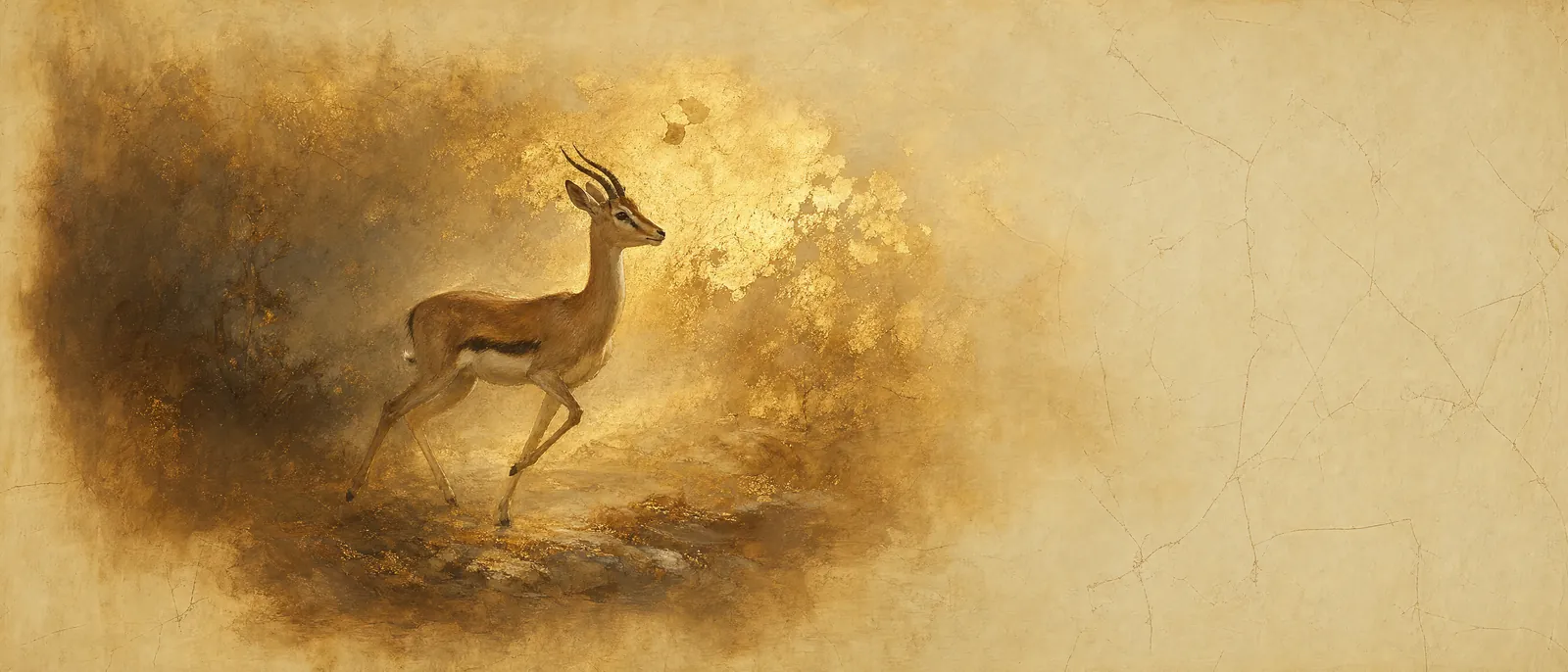
Ayala — the swift one with beautiful words
Ayala means doe — but in the Torah the doe is never only fast. When Yaakov blessed Naftali as 'an ayala let loose,' he tied speed to eloquence in a single animal, and the Psalms added a third note underneath both: thirst. This is a name that runs, speaks, and longs, all at once.
A Name That Runs
Ayala is a modern Israeli name, but its root runs straight into the oldest strata of the tradition. The word means doe — a gazelle, a creature built for speed. And yet the Torah, whenever it lifts up the doe, refuses to let her be only fast. She is quick, yes, but the same breath that names her velocity names something else entirely.
That doubling is the whole architecture of this name. Yaakov, on his deathbed, blesses his son Naftali as 'an ayala set loose' — and then, in the same verse, says this swift one 'gives goodly words.' Speed and speech. Foot and mouth. The image is almost paradoxical: we expect the fast to be impatient, the runner to have no time for language. The blessing insists otherwise.
Speed Paired With Eloquence
People who carry this name tend to move quickly through the world — decisions made on the run, distance crossed before others have finished deliberating. But the second half of Naftali's blessing is the part that surprises. The velocity comes packaged with words that land well. There is an eloquence here, a gift for saying the beautiful thing at speed, that isn't a separate talent bolted on. In the ayala they are one motion.
The cost is real. Speed and eloquence together can look like ease — like everything comes without effort. It rarely does. The runner who speaks well is often running past the thing she hasn't stopped to feel, and the beautiful words can become a way of moving through a room without being caught in it. The gift and the evasion share an engine.
The Thirst Underneath
This is where Psalms opens the third door. 'As the deer yearns for streams of water, so my soul yearns for You.' The same animal that the Torah praises for swiftness becomes, in the mouth of the psalmist, the tradition's central image of thirst — of longing so bodily it aches. The doe runs, and the doe is parched, and these are not two doe. They are one.
So beneath the speed and the beautiful words, the sources locate a wellspring of want — a thirst those who carry the name rarely show. The running may be toward the water. The eloquence may be the sound the thirst makes. To love an Ayala, or to be one, is to understand that the person who moves fast and speaks well is powered by something she does not easily name: a longing she keeps moving to keep ahead of, and moving toward, at once.
Ayala in the Classical Sources
In the sources, the doe — איילה, ayala — is never a simple creature of speed. Across three passages the tradition builds a single figure: swift of foot, graceful of speech, and secretly thirsty. The gematria of the name is 56, and its story is told not in one verse but in the way three verses lean on the same animal to say three different true things.
GENESIS 49:21 — SWIFTNESS AND SPEECH IN ONE ANIMAL
Yaakov's blessing to Naftali reads: 'Naftali is an ayala set loose; he gives goodly words.' The verse is remarkable for what it joins. A doe let loose is an image of pure velocity — freedom of movement, nothing to hold her back. But the second clause pivots to the mouth: beautiful words, eloquence, the giving of language that lands well.
The tradition reads these two together, not as a list of unrelated gifts but as the double nature of one creature. Grace of foot and grace of mouth belong to the same animal. This is the founding note of the name: the person who is fast is also, unexpectedly, the person who speaks beautifully — and neither cancels the other.
PSALMS 42:2 — THE YEARNING DEER
'As the ayal yearns for streams of water, so my soul yearns for You.' Here the same animal that ran freely in Genesis is dying of thirst. The psalmist chooses the deer precisely because her longing is total and physical — she does not want water the way we want a convenience; she wants it the way a body wants to keep living.
This is the deer as the tradition's enduring image of holy thirst. Laid beside the Genesis blessing, it reveals the hidden layer of the name. The swift, eloquent doe is also the parched one. Whatever powers the running and the speaking, the Psalms suggest, is a longing that runs deeper than either.
BERAKHOT 7b — THE NAME EXPLAINS ALL THREE
Berakhot 7b teaches that shema garim — that a name shapes, or at least signifies, the nature of the one who bears it. Applied to the doe-name, the principle is unusually rich, because this single name carries three things at once: velocity, eloquence, and a hidden wellspring of want.
The Talmudic reading refuses to pick one. The name does not mean fast, and separately mean well-spoken, and separately mean longing. It means all three as facets of a single soul — the runner who speaks beautifully because, underneath, she is thirsty. That is the architecture the name describes; it does not decree a fate, but it names a shape.
THE LETTERS AND THE NUMBER
The gematria of Ayala in its modern spelling, איילה, is 56. That value it shares with Nadav — a name built from the root of the free-will offering, the nedavah, the gift no law required. The resonance is quietly exact: the ayala is the doe 'set loose,' released without constraint, and the nedavah is the offering given without obligation.
Both names, then, describe what is given freely — the animal let go and the gift not demanded. There is a generosity written into the number: things that flow because they choose to, not because they must. The doe runs unbound; the offering is laid down unrequired. Read together, they suggest a soul whose grace is precisely that it cannot be compelled.
The Talmud's principle shema garim — "the name causes" (Berakhot 7b) — is the tradition's claim that a name gently inclines its bearer. In this library, Ayala's nearest companions are Ayelet and Tzvi; the full index is at Hebrew names.
What does the name Ayala mean?
Ayala (איילה) means doe or gazelle. Its meaning is anchored in Yaakov's blessing to Naftali in Genesis 49:21 — 'an ayala set loose, who gives goodly words' — where the doe stands for swiftness paired, surprisingly, with beautiful speech.
What is the gematria of Ayala?
The gematria of Ayala in its modern spelling, איילה, is 56. This value is shared with the name Nadav, rooted in the free-will offering — linking the doe 'set loose' and the gift given without obligation as two images of what is given freely.
Where does the word Ayala appear in the Tanakh?
Ayala is a modern Israeli name, but its root appears prominently in Scripture. In Genesis 49:21 Naftali is blessed as 'an ayala set loose,' and in Psalms 42:2 the deer becomes the image of holy thirst: 'As the deer yearns for streams of water, so my soul yearns for You.'
What does the name Ayala say about personality?
The sources point to a person who moves fast and speaks well — velocity and eloquence in one motion, as in Naftali's blessing. Underneath both, Psalms 42:2 locates a hidden thirst: a longing that powers the running and the words but is rarely shown.
What do the sources say about Ayala?
Genesis 49:21 ties the doe's swiftness to beautiful speech; Psalms 42:2 makes the deer the emblem of spiritual longing; and Berakhot 7b, teaching that a name signifies its bearer's nature, reads all three qualities — speed, eloquence, and hidden thirst — as facets of one soul.
Why is the doe in Ayala connected to thirst?
Because the Tanakh uses the same animal for both speed and longing. In Genesis the doe is let loose and free; in Psalms 42:2 she is the creature dying for water. The name inherits both, suggesting a swiftness that is quietly powered by a thirst the person seldom reveals.