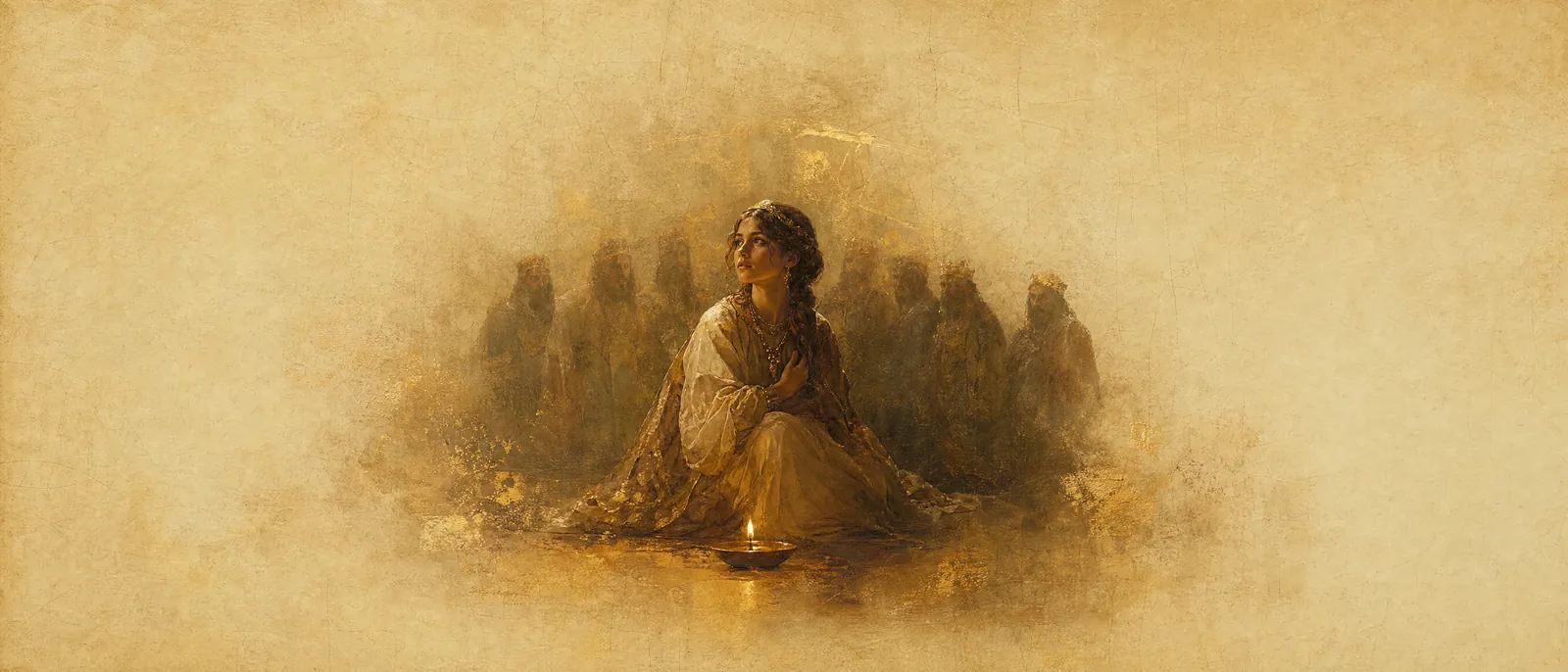
Batsheva — the survivor who crowned the next king
Batsheva begins in the Tanakh's most examined wrong and ends as the mother who secured a throne and taught a king. Her name carries the number of oaths — promises kept late, but kept.
A Name Introduced in the Wrong Chapter
Few names in the Tanakh enter through a door the text itself calls shameful. Batsheva does. She is first seen from a rooftop, named almost as an accusation — the wife of another man, the object of a king's abuse of power. The scripture does not soften this. It names the misuse plainly and then sends a prophet to indict it. For a woman whose name means daughter of the oath, the covenant number, the irony is bracing: she arrives in the story as the site of a broken one.
But the Tanakh is not done with her, and that is the whole point. A name that begins in someone else's sin does not stay defined by it. Batsheva is not the moral of her first chapter. She is the person who lives past it — and the tradition insists we watch her do so.
The Turn: From Object to Agent
Grief comes first — a child lost, a marriage born in ruin. Then the arc bends. When David is old and the succession is contested, it is Batsheva, coached by the prophet Natan, who walks into the king's chamber and speaks. She does not wait to be acted upon. She secures the throne for her son Shlomo with words, timing, and nerve. The rooftop's silent figure becomes the palace's decisive voice.
This is the hinge of the whole name. Batsheva moves from grammatical object — the one things are done to — to grammatical subject, the one who does. People who carry this name often re-enact that grammar. They know what it is to be defined by an event they did not choose, and they refuse to let that event write the ending.
The Teaching Mother
The tradition gives Batsheva a last word most people never associate with her: many read the mother's instruction of Proverbs 31 — the warning to a king about wine, and the famous portrait of the woman of valor — as Batsheva teaching Shlomo. The survivor becomes the sage. The one whose story opened in scandal closes as the source of Scripture's most quoted praise of a strong woman.
That trajectory is the lived signature. Batshevas tend to be long-game people: patient through the bad middle, unwilling to be summarized by their worst season, and quietly determined that whatever they raise — a child, a project, a reputation — will outlast the wreckage. They are cost-aware because they have paid. And they crown other people rather than needing the crown themselves.
The Weight of the Name
To be named Batsheva is to carry both halves at once: the scandal and the salvation, the wrong and the rewrite. It is not a comfortable name. It insists that a life is not its first chapter — but it can only insist that because the first chapter was real. The strength is earned, not decorative.
The shadow is the same as the gift. Someone so practiced at surviving the unspeakable can normalize too much, can wait too long to name harm done to them, can mistake endurance for peace. The name's deeper teaching is that Batsheva did not only endure — eventually she acted, and spoke, and changed the outcome from inside the room.
Batsheva in the Classical Sources
In the sources, בת־שבע — bat sheva, 'daughter of the oath' or 'of seven' — carries a gematria of 774. The name folds the covenant number sheva, seven, into its very structure: the same root that names Beer Sheva, the well of the oath. To study this name is to study how the tradition handles a life that begins in a broken promise and bends toward a kept one.
II SAMUEL 11:3 — THE STORY THE TEXT REFUSES TO SOFTEN
Batsheva enters Scripture in II Samuel 11:3, identified by the men around her — daughter of one, wife of another — as David's men report who she is. What follows is the Tanakh's most examined abuse of power, and the text does not flatter its greatest king. It records the misuse, and then sends the prophet Natan with a parable — the poor man's one ewe lamb — that traps David into condemning himself.
The remarkable thing is the insistence. Scripture could have buried this at the top of the monarchy; instead it names power's crime plainly and lets a prophet's story do the indicting. A name that means daughter of the oath is first shown inside a covenant broken by the man who should have kept it — which is exactly why her later kept promises matter.
II SAMUEL 12:24 — 'AND THE LORD LOVED HIM'
After grief and rebuke, II Samuel 12:24 records the birth of Shlomo to Batsheva — and adds that the Lord loved him. It is a stunning sentence to place where it sits. The child born after all of it is not disqualified by the manner of its beginning; the future is not condemned to repeat the past that produced it.
This verse is the tradition's quiet doctrine on Batsheva's whole name: a life, or a lineage, is not sentenced by its origin story. From this marriage born in ruin comes the king who builds the Temple. The worst chapter is not made the last one — and the text says so out loud.
ROSH HASHANAH 16b — THE DECREE-TEARING CANON
Rosh Hashanah 16b belongs to the tradition's teaching that certain things can tear a harsh decree — that a fate can be rewritten. Batsheva's arc reads as the narrative form of that principle. What began as loss and disgrace did not stay fixed; the outcome was changed from inside the palace itself.
Read against this source, Batsheva is not a passive survivor of a bad decree but an agent of its reversal. She cries out, she acts, she speaks into the king's chamber — and the ending is rewritten. The name carries the teaching that endings are not sealed by their beginnings for those willing to act.
THE LETTERS AND THE NUMBER
The gematria of בת־שבע is 774. Woven into the name is sheva — seven, the covenant number of oaths, the same root that names Beer Sheva, the well of the oath. To carry seven in your name is to carry the arithmetic of promises: the count that closes a covenant, the number a person swears by.
But this is a daughter of promises kept late — kept after the broken ones, kept from inside a chapter that began wrong. The seven in Batsheva is not the ease of a vow made and honored on the same day. It is the harder seven: the oath finally made good after everything that tried to void it.
The Talmud's principle shema garim — "the name causes" (Berakhot 7b) — is the tradition's claim that a name gently inclines its bearer. In this library, Batsheva's nearest companions are David and Shlomo; the full index is at Hebrew names.
What does the name Batsheva mean?
Batsheva (בת־שבע) means 'daughter of the oath' — or 'daughter of seven,' since sheva is the number seven and the root of covenant-oaths. The same root names Beer Sheva, the well of the oath. It is a name about promises and the covenant number folded into a person.
What is the gematria of Batsheva?
The gematria of בת־שבע is 774. The name embeds sheva, seven, the covenant number of oaths — a numerical signature of promises kept late but kept.
Where does Batsheva appear in the Tanakh?
Batsheva first appears in II Samuel 11:3, in the account of David's abuse of power, and again in II Samuel 12:24 at the birth of her son Shlomo. The tradition also associates her with the teaching mother of Proverbs 31, instructing a king.
What does the name Batsheva say about personality?
The name carries a survivor's architecture — someone defined early by an event they did not choose, who refuses to let it be the last word. Batshevas tend to be patient, long-game people who move from being acted upon to acting decisively, often crowning or elevating others rather than needing the spotlight.
What do the sources say about Batsheva?
II Samuel 11–12 refuses to soften the wrong done at the top of the monarchy, yet 12:24 says the Lord loved her son Shlomo — a future not disqualified by its past. Rosh Hashanah 16b's teaching that a decree can be torn reads as the narrative shape of her arc: an ending rewritten from inside the palace.
Why is Batsheva called 'the kingmaker'?
When David was old and the succession contested, Batsheva — coached by the prophet Natan — entered the king's chamber and secured the throne for her son Shlomo. She turned from the silent figure of chapter eleven into the decisive voice of the palace, which is why the tradition remembers her as the one who crowned the next king.