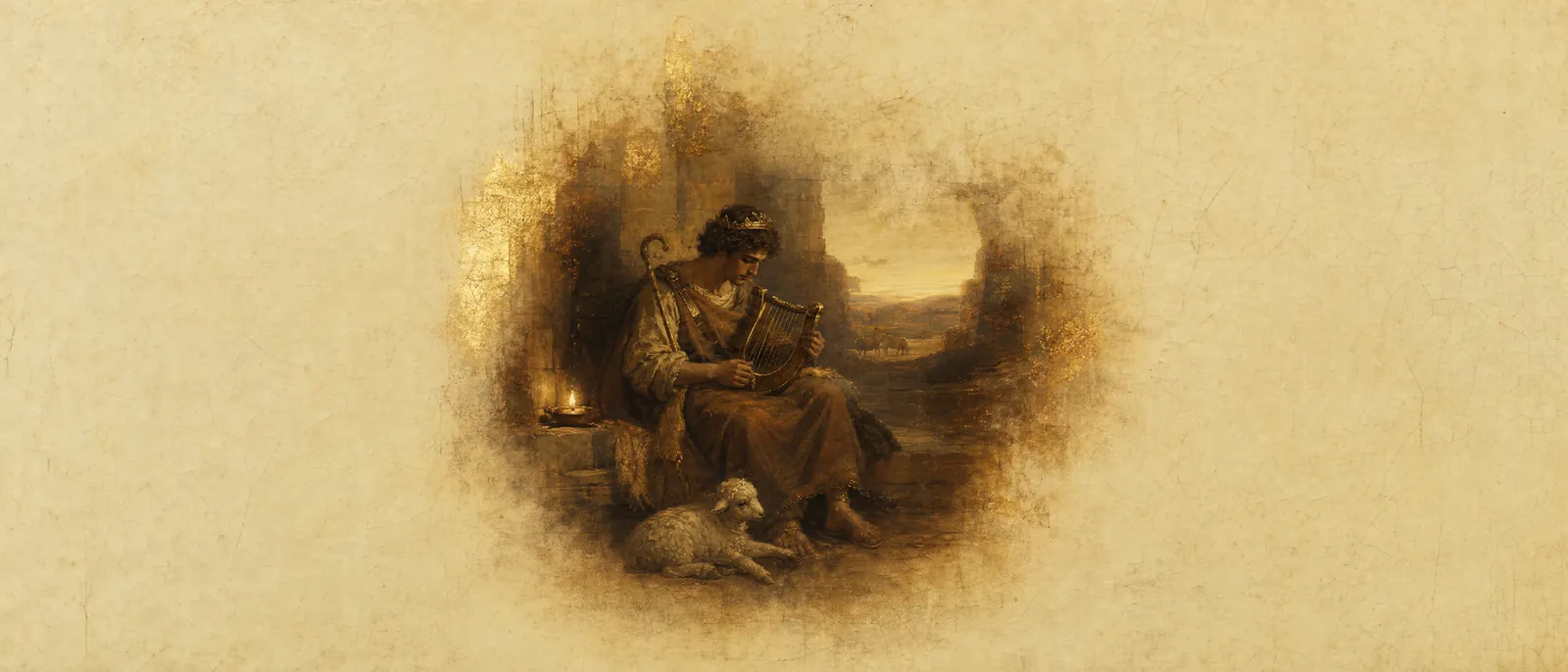
David — the singing king
Warrior and poet, sinner and saint, king and shepherd — David held opposites in one body. The name belongs to people who feel everything at full volume and spend a lifetime learning to carry all of it at once.
The Name and Its Root
David — דוד — means "beloved," built on the root dod, which the Song of Songs uses for the lover, the cherished one. It is one of the gentlest names in Tanakh, and it belongs to one of its most turbulent lives. That gap is the first thing to notice. The name promises tenderness; the man who wore it carried a sword.
The word is short, almost symmetrical — two outer letters cradling a single vav. It reads like a name designed to be called out, easy in the mouth, the kind of word a mother or a nation might say with love. And indeed, Scripture says of him that all Israel and Judah loved David. The name is not describing what he did. It is describing how he was held.
The Figure in Tanakh
We meet David in 1 Samuel as the youngest of Jesse's sons, overlooked in the field with the sheep while the prophet Samuel inspects his brothers. He is anointed in secret, then summoned to play the harp for a tormented King Saul — music as medicine before he is ever a warrior. Then comes the valley of Elah, Goliath, and a boy with five smooth stones.
From there the life refuses to settle into one shape. He is the fugitive who twice spares Saul's life when he could have killed him. He is the dancing king who brings the Ark to Jerusalem with such abandon that his wife despises him for it. He is also the man of the Bathsheba episode in 2 Samuel — the king who takes another man's wife and arranges that man's death, then is broken open by the prophet Nathan's parable and writes, by tradition, the rawest psalm of repentance in the canon. Tanakh does not airbrush him. It records the adultery, the murder, the family that tears itself apart, the son Absalom who rebels and dies — and David weeping at the gate.
And through all of it, the Psalms. The same hands that held a sling and a scepter held a harp. He is credited as the voice of Israel's prayer, the one who gave grief and praise their language.
The Lived Pattern
People named David often have unusual emotional range. The highs and the lows arrive at full volume, with little dimmer between them. A David can be in the dancing-before-the-Ark mode in the morning and the cave-of-despair mode by evening, and both are completely real. This is not instability so much as bandwidth — they simply feel across a wider spectrum than most people are built to carry.
The temptation is to amputate. To decide that the warrior is the problem and try to become only the poet, or to decide the tenderness is weakness and armor over it. The biblical David never does this. He is all of it at once — and the integration is the achievement, not the contradiction.
The cost is exhaustion and, sometimes, the spectacular failure that comes when so much intensity is pointed at the wrong object. The Bathsheba story is a warning written into the name: the same drive that makes a David magnetic and devoted can, untended, become entitlement. The work is not to feel less. It is to aim the whole range somewhere worthy.
The Work of a David
The task that comes with this name is integration without amputation — holding the warrior and the poet, the sinner and the saint, the king and the shepherd in one body without cutting any of them out. The Davids who do this become extraordinary: people of enormous warmth and courage who have made peace with their own contradictions.
The ones who don't tend to live in pieces, swinging between the parts and exhausting the people around them. The name does not decree which it will be. It describes the architecture — a soul with rooms for everything — and leaves the question of how to live in it open.
David in the Classical Sources
The name is דָּוִד (David), gematria 14, from the root dod — beloved. It is the most consequential fourteen in the tradition: the name of the king from whose line the Mashiach is promised, the credited voice of the Psalms, and the man the Talmud describes with the strangest double portrait it owns.
Where the Tanakh Gives the Name
David is named in the anointing scene at Bethlehem: the prophet Shmuel has rejected seven taller brothers when the youngest is fetched from the sheep — "and the Lord said: Arise, anoint him, for this is he. … and the spirit of the Lord gripped David from that day forward." The verse is the name's whole arc in miniature: overlooked, summoned, chosen — and permanently seized by something larger than himself.
The Sages on David
The Talmud's two portraits of David belong on this page together. In Berakhot: a harp hung over his bed, and when midnight came the north wind would stir its strings and wake him — "until now I have sung; now I rise to study" — the king who kept a musician's night schedule for the soul's sake. And in Moed Katan, the Sages unpack his title Adino haEtzni: when he sat over Torah he made himself soft as a worm, and when he went out to war he was hard as wood. That sentence is the rabbinic verdict on the name: not a compromise between poet and warrior but full amplitude in both directions, switched by context rather than blended into mush.
The Letters and the Number
Dalet–vav–dalet: two identical letters holding a single vav between them — the connector-letter, the hook, standing alone at the center of the beloved's name. The tradition reads dalet as dal, the poor one, the open door; a name that begins and ends in poverty of spirit, joined in the middle. Its gematria, 14, equals that of יָד — yad, hand (10+4) — the shepherd's hand, the slinger's hand, the harpist's hand: one number for a life defined by what its hands held. Fourteen is also the count of the Amidah's blessing for Jerusalem — the liturgy's Davidic petitions clustering around his number.
What a Name Does
The Talmud's rule shema garim — the name causes — reads cleanly here: called "beloved," he became the man Scripture says all Israel and Judah loved, and the tradition's psalmbook still opens on his affections three thousand years later. His inner circle fills the shelves beside him: Yonatan, the friend whose love the Mishnah made a category, and Ruth, the great-grandmother whose name the Talmud reads as his overture. The full index is at Hebrew names.
What does the name David mean?
David (דוד) means "beloved," from the root dod, which conveys affection and the loved one — the same root the Song of Songs uses for the cherished lover. Scripture says all Israel loved David; the name describes how he was held more than what he did.
What is the gematria of David?
The name דוד carries a gematria of 14, formed from dalet (4), vav (6), and dalet (4). It is a compact, near-symmetrical name — two outer letters cradling a single vav.
Who was David in the Tanakh?
David was the shepherd anointed by Samuel, the harp-player who soothed Saul, the slayer of Goliath in the valley of Elah, and the second king of Israel. His life in 1 and 2 Samuel holds triumph and grave failure alike — including the Bathsheba episode and his repentance — and he is traditionally credited as the voice of the Psalms.
What does the name David say about personality?
Davids often carry an unusually wide emotional range, with highs and lows that arrive at full volume. They hold opposites — strength and tenderness, action and reflection — in one body. The work of the name is integrating every part without amputating any of them, and aiming that intensity at something worthy.
Where is David named in the Tanakh?
At the anointing in Bethlehem (I Samuel 16:13): Shmuel has rejected seven older brothers when the youngest is fetched from the sheep — 'Arise, anoint him, for this is he… and the spirit of the Lord gripped David from that day forward.'
What does the Talmud say about David's dual nature?
Moed Katan 16b unpacks his title Adino haEtzni: when he sat over Torah he made himself soft as a worm, and in war he was hard as wood. Berakhot 3b adds the harp over his bed that woke him at midnight to study — full amplitude in both directions, switched by context.