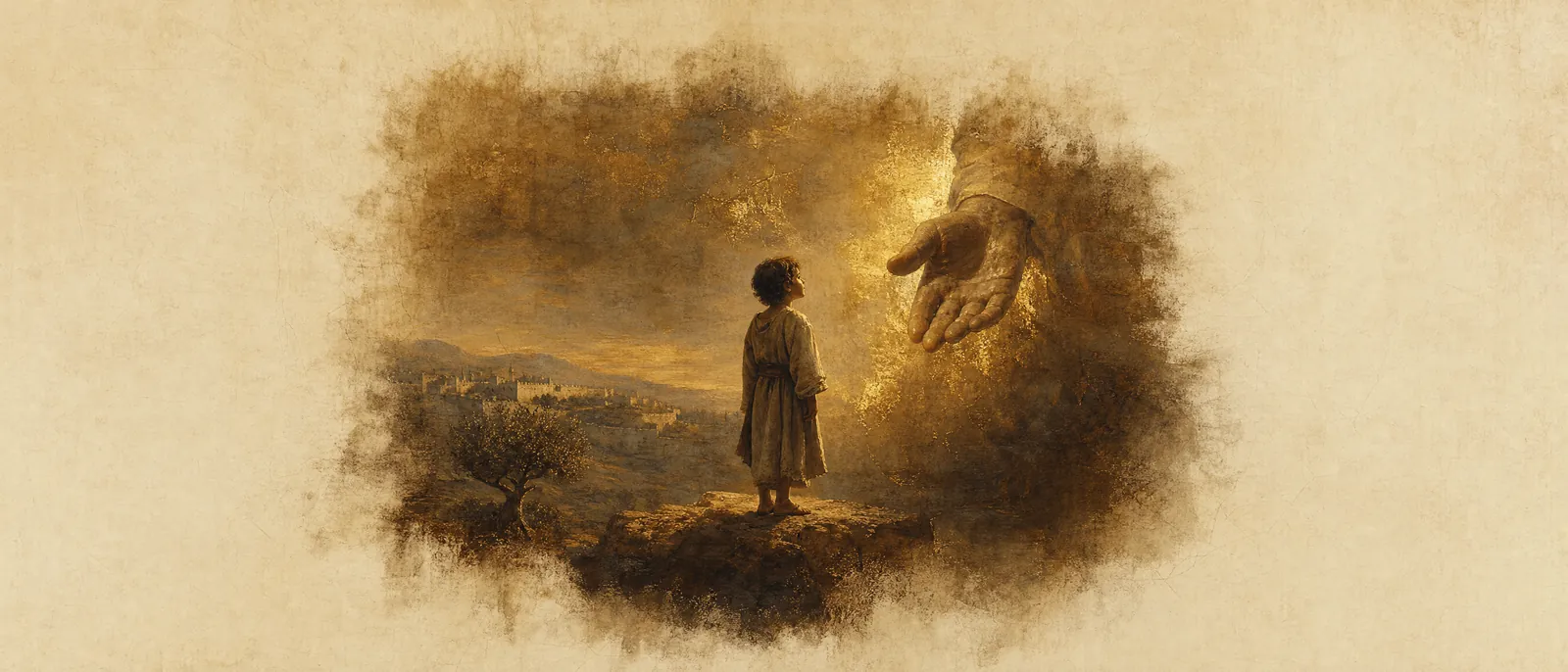
Binyamin — the beloved youngest who carries two names
Binyamin (בנימין) is the only person in the Torah named twice in a single verse — Ben-Oni by his dying mother, Binyamin by his living father. The name means 'son of the right hand,' and it carries, from its first minute, the whole distance between grief and strength.
A Name Born in the Same Breath as a Death
Most names arrive as a hope. Binyamin arrives as an argument. In a single verse, Rachel — dying in childbirth — calls him Ben-Oni, 'son of my sorrow,' and Yaakov overrules her with his last word, calling him Binyamin, 'son of the right hand.' The child never wears the first name for even a full sentence. But it was said. It was breathed over him. That is the architecture of this name: not sorrow erased, but sorrow answered.
To carry Binyamin is to carry a renaming. People with this name often know, in some form, what it is to be handed a grief and asked to make strength of it — to be the youngest, the last-born, the one who arrived when something was already ending, and to decide which of the two names spoken over you will be the one you live by.
The Youngest, and the Most Held
Binyamin is the baby of the family — the twelfth son, the second and last of Rachel's, the one his father cannot bear to send to Egypt because he is all that remains of a lost love. That protectedness is real, and it has a cost. The beloved youngest can grow up watched, guarded, kept close; strength has to be built rather than assumed, because everyone around you is busy shielding you from the sorrow your name already names.
The lived pattern here is a person who is more capable than they are treated as being. The name says 'right hand' — the working hand, the strong hand, the hand that acts — and Binyamin spends a life proving that the youngest, the tender one, the one born into loss, is precisely the one strong enough to hold what matters most.
The Portion That Reached Down to the Foundations
Here the name turns from personal to monumental. Of all the tribal portions, it was Binyamin's — the youngest's — that held the Temple's altar. The smallest, last-born inheritance became the ground where the Divine Presence rested. This is the deepest logic of the name: the one born in sorrow becomes the site of the highest strength.
Binyamin people tend to hold things quietly, structurally, from underneath — foundations rather than facades. They are not always the loudest in the room, but remove them and something sacred loses its floor. The name that began as 'son of my sorrow' ends as the ground beneath the holiest place a people ever built.
Binyamin in the Classical Sources
In the sources, Binyamin — בנימין, 'son of the right hand,' with a gematria of 162 — is Scripture's clearest study in the power of a name to be contested and rewritten. Three texts read it: one names him, one shows what his name became, and one makes him the model for renaming itself.
GENESIS 35:18 — THE DOUBLE NAMING
As Rachel's soul departs in childbirth, she names her son Ben-Oni, 'son of my sorrow' — the last word of a dying mother. In the same verse, Yaakov calls him Binyamin, 'son of the right hand.' It is the only case in the Torah of a person named twice within a single verse, and the two names pull in opposite directions: grief and strength contending over one newborn.
The verse does not delete Ben-Oni. It records both. This is why the name carries a doubled weight — the sorrow is not denied, it is answered. Yaakov does not pretend the loss did not happen; he insists that the child born of it will be strength, not only mourning.
YOMA 12a — THE ALTAR IN HIS PORTION
The Talmud in Yoma 12a teaches that the Temple's altar stood within the tribal portion of Binyamin — the youngest brother's inheritance became the ground of the holiest service. This reads Moshe's blessing in Deuteronomy 33:12, 'he rests between His shoulders,' as the Shechinah, the Divine Presence, dwelling in Binyamin's land.
The image completes the name's arc. The last-born, the one whose name began in a mother's dying sorrow, is given the portion where God chooses to rest. Sorrow becomes foundation; the youngest becomes the one who holds the sacred center.
ROSH HASHANAH 16b — THE NAME-CHANGE CANON
Rosh Hashanah 16b belongs to the classical discussion of how a change of name can change a person's course. Binyamin is Scripture's starkest instance: renamed within the first minute of his life, carried directly from his mother's grief into his father's right hand.
Where other renamings — Avram to Avraham, Sarai to Sarah — come with the weight of a lived history, Binyamin's arrives at the very threshold of existence. He is the proof-text that a name is not a decree but a direction: the same infant, the same breath, and two futures offered — and one chosen for him to grow into.
THE LETTERS AND THE NUMBER
The gematria of Binyamin is 162. The name closes on the long final nun — the letter that alone among its forms descends below the line, reaching down past where the other letters stand.
That descending stroke is the whole story in a single mark: the youngest brother whose portion reached down to hold the Temple's foundations. The name does not merely sit on the line with the others; it drops beneath, to the level where things are anchored, where the floor of the sacred is laid.
The Talmud's principle shema garim — "the name causes" (Berakhot 7b) — is the tradition's claim that a name gently inclines its bearer. In this library, Binyamin's nearest companions are Yosef and Rachel; the full index is at Hebrew names.
What does the name Binyamin mean?
Binyamin (בנימין) means 'son of the right hand' — the strong hand, the working hand. It was given by Yaakov in Genesis 35:18, replacing the name Ben-Oni ('son of my sorrow') that Rachel spoke with her dying breath.
What is the gematria of Binyamin?
The gematria of Binyamin is 162. The name ends in the long final nun, the letter that descends below the line — an echo of the youngest brother whose portion reached down to hold the Temple's foundations.
Where does Binyamin appear in the Tanakh?
Binyamin is the twelfth and youngest son of Yaakov, the second son of Rachel, named in Genesis 35:18. His name is famous as the only case in the Torah of a person named twice within a single verse.
What does the name Binyamin say about personality?
The name suggests someone who carries a renaming from sorrow to strength — often the beloved youngest, more capable than they are treated as being. Like the tribe whose portion held the Temple's altar (Yoma 12a), Binyamin people tend to hold what matters quietly, from underneath, as a foundation rather than a facade.
What do the sources say about Binyamin?
Genesis 35:18 records his double naming; Yoma 12a places the Temple's altar in his tribal portion, reading Deuteronomy 33:12's 'he rests between His shoulders' as the Divine Presence dwelling there; and Rosh Hashanah 16b treats him as Scripture's starkest case of a life redirected by a change of name.
Why was Binyamin given two names?
His mother Rachel, dying in childbirth, named him Ben-Oni, 'son of my sorrow'; his father Yaakov renamed him Binyamin, 'son of the right hand,' in the very same verse (Genesis 35:18). The sorrow is not erased but answered — the Torah preserves both names, so the child born of loss is turned toward strength.