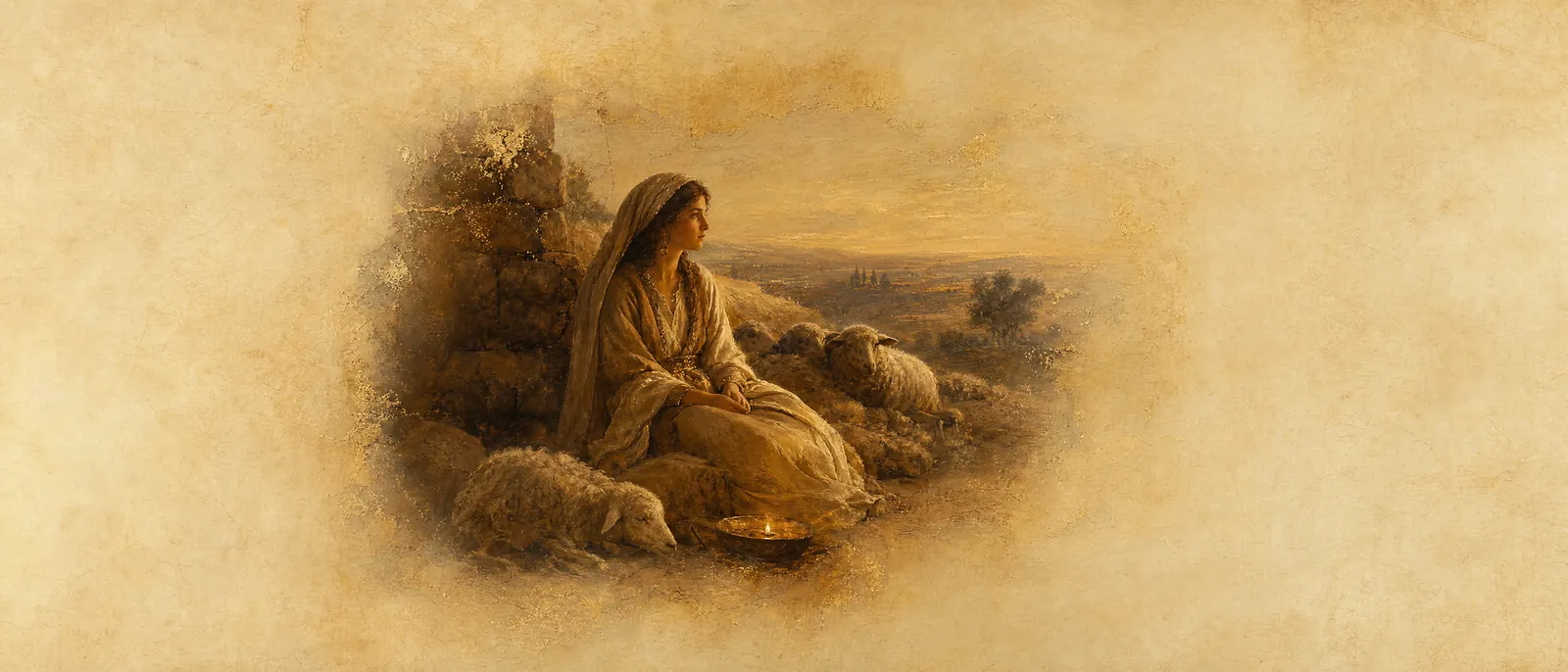
Rachel — the beloved who waits
Rachel is the name of the woman Jacob worked fourteen years to marry — and the one whose quietest sacrifice made the whole house of Israel possible. It is a name about love that gives more than it shows.
The Name and Its Root
Rachel — רחל — means "ewe," a female sheep. It is a shepherd's word, and Rachel first appears in Genesis as exactly that: a shepherdess, leading her father Laban's flock to the well where Jacob is waiting. The name carries no grandeur. It speaks of tending, of patience, of the slow daily work of keeping something alive.
There is a softness built into the word, but it is not weakness. A shepherd's gentleness is a kind of vigilance — the constant low-grade attention of someone responsible for creatures that cannot protect themselves. People who carry this name often have that quality: a watchfulness disguised as calm.
The Beloved Who Waits
Jacob loved Rachel from the moment he saw her, and agreed to work seven years for her hand. Genesis says the years "seemed to him but a few days, because of the love he had for her." Then Laban substituted Leah on the wedding night, and Jacob worked seven more years. Fourteen years of waiting sit inside this name.
But the deeper waiting was Rachel's. She was the beloved who watched her sister bear children while she remained barren — "Give me children, or I die," she cried. The longing in that line is the engine of her whole story. Rachel knew what it was to want something profoundly and be made to wait for it, to love and be loved and still feel the years stretching out empty.
People named Rachel often live near this tension: they are wanted, chosen, central to someone — and still carry an ache that the love around them doesn't quite reach. The waiting is rarely about patience. It is about a longing they keep quiet.
The Secret Signs
The most astonishing thing Rachel ever did, the tradition records, happened in the dark and was never meant to be seen. When their father planned to deceive Jacob by sending Leah to the wedding tent in Rachel's place, Rachel had agreed with Jacob on secret signs so he could recognize her. Then she gave those signs to Leah.
She handed her own beloved to her sister rather than let Leah be exposed and shamed at the marriage altar. It cost Rachel the very thing she had waited seven years for — and she told no one. The sacrifice was invisible by design.
This is the lived pattern in the name. People called Rachel often love so deeply that they make sacrifices no one fully sees — quiet acts of self-erasure that they would never announce, because announcing them would defeat the point. They give away advantages, take the smaller portion, absorb a humiliation meant for someone else. And because the cost is hidden, it is also unacknowledged. They can carry a private ledger of all they have surrendered while the people around them assume things simply worked out.
The Mother on the Road
Rachel died giving birth to Benjamin, her second son, and Jacob buried her not in the family tomb but on the road to Bethlehem — alone, at the roadside, where travelers pass. The midrash explains this placement as another act of foresight: she lies there so that generations later, when the exiles are driven past into Babylon, they will have a mother to weep with.
Jeremiah gives her that voice: "Rachel weeping for her children, refusing to be comforted, because they are not." And God answers her — and only her — with the promise that the children will return. Her tears, the tradition says, moved heaven where the merits of the patriarchs could not.
This is what "sacrifices that echo through generations" means. Rachel's quiet givings do not stay quiet forever. They surface, decades or lifetimes later, as the thing that holds. People with this name often discover that what they gave away in silence became, eventually, the foundation someone else stood on.
Living the Name
The risk inside this architecture is self-erasure mistaken for love. Rachel can give the secret signs so reflexively that she forgets she was allowed to keep them — that wanting her own portion was never a sin. The most important growth for someone with this name is learning that her longing is legitimate, that "Give me children, or I die" was a holy sentence, not a selfish one.
The gift is real, though. There are people who hold the world together through sacrifices no one will ever clock, and the tradition honors Rachel above her more visible sister precisely because of it. To carry this name well is to give generously and still keep enough of yourself that there is someone left to be loved.
Rachel in the Classical Sources
The name is רָחֵל (Rachel), gematria 238, and it means ewe — the mother-sheep. The sources built two portraits on that name: the shepherdess Yaakov loved at first sight, and the mother the prophet Yirmiyahu stationed on the road of exile, weeping for children not her own. Between those two scenes runs the tradition's whole theology of love that gives itself away.
Where the Tanakh Gives the Name
She enters at a well, working: "and Rachel came with her father's sheep, for she was a shepherdess" — the only woman in the Torah introduced by her profession. The text then gives her its plainest declaration of beauty and its heaviest price tag: seven years of labor that "seemed to Yaakov but a few days, in his love for her" — and a wedding at which she is replaced. Her death comes on the road, birthing Binyamin, and she is buried not in the family cave but at the roadside near Beit Lechem — a grave placed, the tradition insists, on purpose.
The Sages on Rachel
The Talmud in Megillah and Bava Batra preserves her defining act: on the wedding night, knowing her father's swap, Rachel handed her sister the private signs she and Yaakov had agreed on — so that Leah would not be humiliated in the dark. The Sages call it one of the great renunciations in Scripture: she gave away her own wedding to protect her rival's dignity, and in its merit, they teach, royalty descended from her line. And Yirmiyahu completes the portrait: "a voice is heard in Ramah… Rachel weeping for her children" — the Midrash has her rise from her roadside grave to argue for exiled Israel when even the patriarchs fall silent, and hers is the plea that wins the promise: "your children shall return to their border."
The Letters and the Number
Resh–chet–lamed: the name ends in lamed, the alphabet's tallest letter, the one that rises above the line — a name that stands at the roadside and reaches upward. The ewe of her name is the tradition's emblem of Israel itself — "like a ewe before her shearers" — the gentle creature whose wool clothes others; the commentators note the fit: the woman named for the flock's mother became, in Yirmiyahu, the mother of the whole flock — the shepherdess promoted, at the roadside grave, to shepherd of the exile itself.
What a Name Does
The Talmud teaches shema garim — a name inclines its bearer — and Rachel's inclined her twice: shepherdess of her father's flock, then shepherd-mother of a nation's exiles. Her sister's page faces hers — Leah, the other party to the signs — and her firstborn's is at Yosef, the son she named "may He add." The full index is at Hebrew names.
What does the name Rachel mean?
Rachel (רחל) means "ewe" — a female sheep. The root evokes the shepherd's world of tending, gentleness, and patient care. Rachel herself first appears in Genesis as a shepherdess bringing her father's flock to the well.
What is the gematria of Rachel?
The gematria of רחל is 238. It is a name whose numerical weight, like its bearer, is quieter than the grand patriarchal names around it — fitting for a woman whose greatest act was done in secret.
Who was Rachel in the Tanakh?
Rachel was the beloved wife of Jacob, for whom he worked fourteen years, and the mother of Joseph and Benjamin. Genesis tells how she gave her sister Leah the secret signs to spare her shame at the wedding, how she longed for children, and how she died on the road to Bethlehem. In Jeremiah 31 she weeps for her exiled children and is promised their return.
What does the name Rachel say about personality?
Rachel describes a soul who loves deeply and gives quietly — often making sacrifices no one fully sees. The strength is a watchful, shepherd's tenderness; the risk is self-erasure, surrendering her own portion until she forgets she was allowed to keep it. Those who carry the name well give generously while still holding enough of themselves to remain.
What was Rachel's act of the hidden signs?
The Talmud (Bava Batra 123a) relates that Rachel, knowing her father's wedding swap, handed her sister the private signs she and Yaakov had agreed on — giving away her own wedding so Leah would not be shamed. In that merit, the Sages teach, royalty descended from her line.
Why does Jeremiah describe Rachel weeping?
Jeremiah 31:14 stations her at the roadside grave: 'Rachel weeping for her children.' The Midrash has her rise to argue for exiled Israel when even the patriarchs fall silent — and hers is the plea that wins the promise: 'your children shall return to their border.'