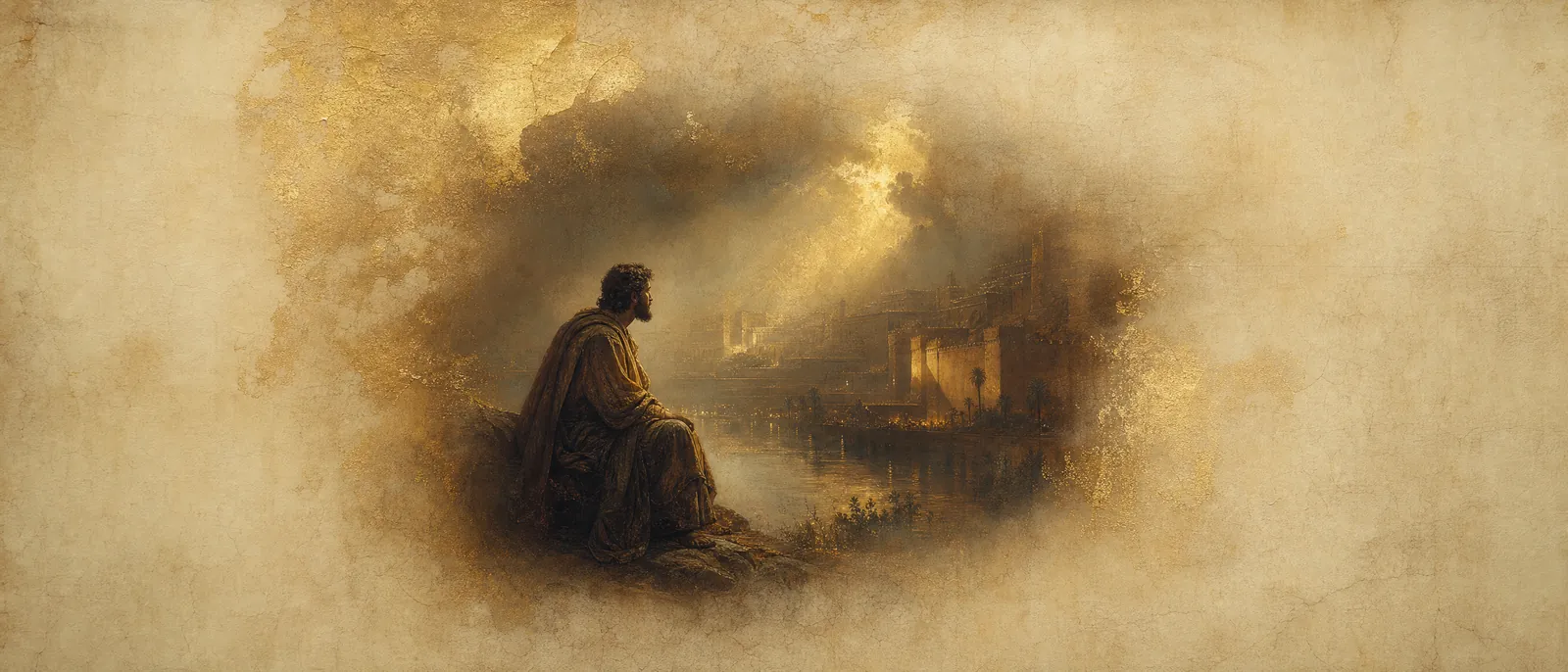
Daniel — the one who stays himself in Babylon
Daniel ate kosher in Nebuchadnezzar's palace and prayed three times a day with the windows open. People with this name often work inside systems they don't fully belong to. The work is staying themselves while serving the system.
The Name Itself
Daniel — דניאל — joins two words into a single claim: דין, judgment, and אל, God. "God is my judge." Not the king. Not the court. Not the system that fed him, trained him, and renamed him. The name is a quiet jurisdictional argument, settled before any pressure arrives: there is one bench that matters, and it isn't the one in the throne room.
This is a name built around a hierarchy. It does not deny that other authorities exist — Daniel served them faithfully for decades — but it knows which one is final. People who carry this name often live with that same internal ranking, sometimes without naming it: an instinct that loyalty has a ceiling, that obedience stops somewhere, that there is a line they will hold even when holding it costs them.
The gematria is 95.
The One Who Stays Himself in Babylon
The Book of Daniel opens with a young Judean taken into the Babylonian court after the fall of Jerusalem. He is selected for his promise, enrolled in the royal training program, and given a new name — Belteshazzar — meant to absorb him into the empire. The text records the renaming, then keeps calling him Daniel anyway.
His first act of resistance is almost comically small: he refuses the king's rich food and asks for vegetables and water instead. Not a rebellion. A diet. But it is the whole story in miniature — Daniel will rise to the top of the administration of three successive empires, and he will do it without eating what they eat, without becoming what they are.
The famous scenes — the writing on the wall, the lions' den — all turn on the same hinge. When Darius signs a decree that no one may pray to anyone but the king, Daniel goes home, opens his windows toward Jerusalem, and prays three times a day exactly as before. He doesn't hide it. He doesn't make a speech. He simply doesn't change.
The Lived Pattern
People named Daniel often find themselves inside institutions they serve well but don't fully belong to — companies, governments, families, faiths whose terms they didn't write. They're good at it. They get promoted. The system trusts them, which is precisely the position that makes the name's tension live.
Because the real work, for this name, isn't getting in or rising up. It's staying yourself while you do. The Daniel pattern is competence without absorption: doing the job thoroughly, earning the keys, and still keeping one practice, one limit, one window open toward somewhere the system can't see. The danger isn't corruption by force — it's corruption by comfort, the slow erosion where the new name starts to feel like your real one.
The cost is loneliness. To keep your windows open is to be visible, and being visible makes you a target the moment someone wants leverage. Daniel survived; his integrity put him in the lions' den first. People with this name should expect that the line they won't cross will, eventually, be the exact thing tested.
The Edge
Daniel's strength can harden into something brittle. Not everything is a den of lions. Some compromises are just collaboration, the ordinary give-and-take of living among other people, and the Daniel temperament can read every concession as a betrayal of the self. The name carries a risk of mistaking rigidity for integrity — of refusing the king's food when the king is only offering lunch.
The discipline is knowing which lines are load-bearing. Daniel didn't resist Babylon at every turn; he served it brilliantly. He spent his refusals carefully, on the few things that actually defined him, and gave everything else freely. That economy is the skill. The window faced Jerusalem — not away from Babylon in protest, but toward home in fidelity. The orientation, not the opposition, was the point.
Daniel in the Classical Sources
The name is דָּנִיֵּאל (Daniel), gematria 95, and it reads as a complete sentence: dan + i + El — "God is my judge." It is the name of a man who spent his entire adult life inside foreign courts of judgment — Babylonian and Persian — while answering, by name, to a higher one.
Where the Tanakh Gives the Name
Daniel enters his book as an exile: a young noble of Judah, carried to Babylon and enrolled in Nevuchadnezzar's palace academy, where the chief officer "gave them names — and to Daniel he gave the name Belteshazzar." The renaming is the empire's whole program in one verse: absorb the exile, overwrite the identity. The book's quiet drama is that the new name never takes. The text keeps calling him Daniel; he keeps praying toward Jerusalem three times a day with the windows open, lions notwithstanding. The name that says "God is my judge" refuses to be replaced by one that honors a Babylonian idol.
The Sages on Daniel
The Talmud in Sanhedrin ranks him extravagantly — weighing whether Daniel outmeasured all the sages of the nations combined — and reads his visions as the tradition's sealed map of history's empires and their end. But the Sages' most personal note is about his prayer: Daniel is their model of the exile who keeps his window open toward Jerusalem — loyalty practiced in full view of a hostile capital, three times a day, as routine rather than defiance. For the rabbis, themselves living under empires, that was the skill worth canonizing.
The Letters and the Number
The name divides cleanly: דָּן (dan, judge) — י (the possessive yud: my) — אֵל (El, God). Grammatically it is a confession of jurisdiction: whatever court I stand in, my case is heard elsewhere. The yud in the middle is the hinge — the smallest letter, carrying the word "my": the whole name turns on one point of personal ownership. Its gematria, 95, equals that of הַמֶּלֶךְ — hamelech, "the King" (5+40+30+20) — the name that answers to no earthly king counting out, precisely, to the word for the true one.
What a Name Does
The Talmud in Yoma describes Rabbi Meir reading names as forecasts — and Daniel's book is the rare place Scripture itself stages the experiment: an empire renames a man, and the name fails to hold, because the original was load-bearing. In this library his nearest companions are Esther and Mordechai — the other Jews of a foreign court whose doubled names carry the same tension. The full index is at Hebrew names.
What does the name Daniel mean?
Daniel (דניאל) combines דין, "judgment," with אל, "God," yielding "God is my judge." The name asserts a final authority above any earthly court — fitting for a man who served kings without ever conceding that they were the highest bench.
What is the gematria of Daniel?
The gematria of דניאל is 95.
Who was Daniel in the Tanakh?
Daniel was a young Judean carried into the Babylonian court after Jerusalem's fall, central to the biblical book bearing his name. He refused the king's food, interpreted dreams and the writing on the wall, and kept praying toward Jerusalem with his windows open even under a royal ban — which landed him in the lions' den. He rose to the top of three empires without assimilating into any of them.
What does the name Daniel say about personality?
It points to someone who works effectively inside systems they don't fully belong to, staying competent and trusted while quietly holding a line the institution can't touch. The strength is integrity without withdrawal; the risk is rigidity — mistaking every compromise for betrayal. The skill is knowing which lines are truly load-bearing and spending refusals carefully.
What does the name Daniel mean?
Daniel (דניאל) reads as a complete sentence: dan + i + El — 'God is my judge.' It is the name of a man who spent his life inside Babylonian and Persian courts of judgment while answering, by name, to a higher one.
What is the gematria of Daniel?
Daniel totals 95 — the same as hamelech (המלך), 'the King' (5+40+30+20). The name that bowed to no earthly king counts out precisely to the word for the true one.