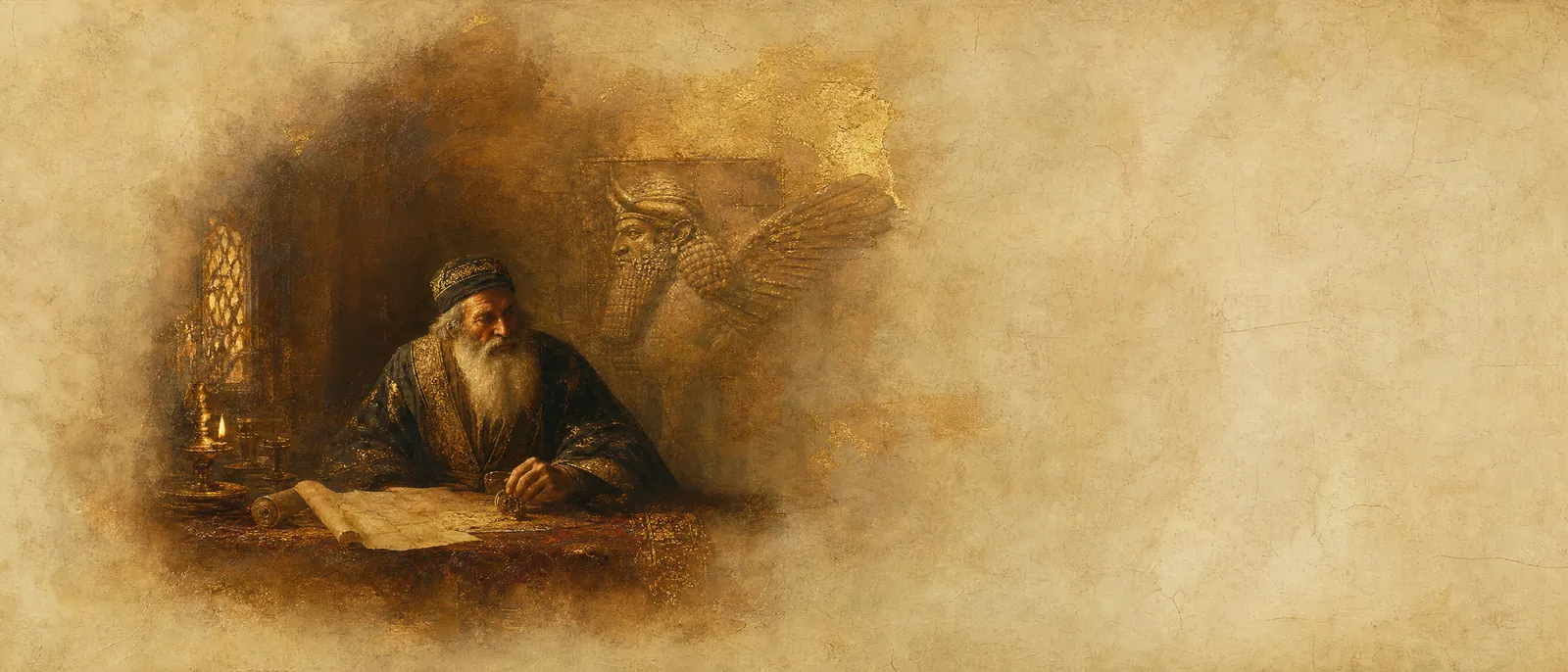
Mordechai — the one who does not bow
The whole book of Esther turns on a man standing still while everyone around him bends. Mordechai's greatness was not what he did, but what he refused to do.
The Refusal at the Gate
The entire drama of the Megillah hangs on a single sentence: Mordechai sat at the king's gate, and he would not bow to Haman. Everyone else bowed. The king had commanded it. Mordechai had every prudential reason to lower his head — he was a Jew in exile, a man without standing, a guardian of a young woman whose safety depended on not drawing attention. He bowed to none of it.
What is striking is how little the text explains him. It does not give us a speech, a theology, a defense. It simply says, again and again, that he would not bow. The refusal is the character. The plot — the lots cast, the decree of annihilation, the sleepless night, the reversal — all of it unspools from that one immovable line.
The Name and Its Roots
The meaning of Mordechai is genuinely contested, and honesty requires saying so. The most common scholarly reading connects it to Marduk, the chief god of Babylon — a name carried, like Esther's link to Ishtar, out of the world of exile. This is uncomfortable for a hero of Jewish memory, and the rabbis read it differently, hearing in it echoes of *mar dror*, pure myrrh, the first ingredient of the holy anointing oil.
Both readings hold something true. A name born in Babylon, worn by a man who would not assimilate one inch beyond the surface. The exile shaped his name; it did not bend his spine.
What 274 Carries
The gematria of Mordechai is 274. It is not a round number, not a number that announces itself. It belongs to a man whose significance was never in spectacle — he held no office, sought no throne, asked for no recognition. His weight accumulated quietly, in a posture maintained day after day at a gate where bowing would have cost him nothing visible and refusing cost him nearly everything.
The number sits as he sat: present, exact, unmoved.
The One Who Does Not Bow
People who carry this name tend to organize themselves around a single non-negotiable. There is one thing they will not do, one line they will not cross, and they often cannot fully explain it even to themselves — it simply is not available for discussion. Friends learn where it is. Adversaries discover it the hard way.
This is real strength, and it is real exposure. The same fixedness that makes a Mordechai trustworthy in a crisis can make him rigid in a season that calls for bending. The story rewards his refusal — but the story is also nearly a catastrophe, and Esther, not Mordechai, is the one who has to maneuver, time things, and risk her life inside the system he would not engage.
The Work of Choosing the Line
The lesson in the name is not *never bow*. It is *choose your one refusal wisely*. A person with one unshakeable principle is formidable when that principle is just, and merely stubborn when it is not. The difference between dignity and obstinacy is entirely in the choosing.
Mordechai chose well — he refused to grant a man the homage owed only to something higher. But the architecture of his soul could just as easily have fixed itself on something petty. The gift comes with no guarantee that the line will be drawn in the right place. That is the labor a Mordechai is handed at birth: not whether to stand firm, but where.
Notice, too, that Mordechai's refusal endangered others before it saved them. Those who love a person like this often live downstream of a principle they did not choose. The mature Mordechai learns to count that cost honestly — to know the difference between a line worth everyone's risk and a line that is merely his own pride dressed as conviction.
Mordechai in the Classical Sources
The name is מָרְדְּכַי (Mordechai), gematria 274 — a Persian-era name the Talmud went out of its way to reclaim, locating it in the Torah itself inside the recipe for the Temple's anointing oil. Few names got a more surprising rabbinic etymology.
Where the Tanakh Gives the Name
The Megillah introduces him with a full pedigree: "There was a Jewish man in Shushan the capital, and his name was Mordechai, son of Yair, son of Shimi, son of Kish, a Binyaminite." The verse's first two words became his title — ish Yehudi, "a Jewish man" — the first time Scripture uses "Yehudi" as the name of the whole people rather than one tribe. The man who refuses to bow in chapter three is, by the text's own grammar, the first person simply called a Jew.
The Sages on Mordechai
The Talmud in Chullin asks: "Mordechai — where is he in the Torah?" and answers from the anointing oil of Exodus: מָר דְּרוֹר — mar dror, "pure flowing myrrh" — which the Aramaic translation renders mira dachya, echoing his name. The rabbinic portrait hides inside the spice: myrrh is bitter (mar) yet heads the sacred perfume — the exile's bitterness, refined into the Temple's fragrance. In Menachot the Sages seat him in the Sanhedrin and credit him with seventy languages — the court Jew who understood every dialect of the empire and stayed unmistakably himself in all of them.
The Letters and the Number
The name splits, in the Talmud's hearing, into mar + dror: bitterness and freedom — dror is the Torah's own word for liberty, the one proclaimed by the Jubilee. A name holding the exile's two poles: the taste of a foreign court, and the release smuggled inside it. It ends in yud, the smallest letter — fitting for the man whose defining act was the refusal to bend, executed in the quietest possible way: he simply did not bow.
What a Name Does
The Talmud in Yoma has Rabbi Meir reading names as compressed forecasts — and Mordechai's is the rare one the Sages themselves unpacked, letter by letter, into myrrh: bitter at first touch, foremost in fragrance. His partner in the palace holds the facing page — Esther, the hidden queen — and the other unbending Jew of a foreign court is Daniel. The full index is at Hebrew names.
What does the name Mordechai mean?
The meaning is debated. Many scholars link Mordechai to the Babylonian deity Marduk, a name carried out of exile. The rabbinic tradition reads it instead through *mar dror*, 'pure myrrh,' the chief spice of the holy anointing oil. Both readings reflect a man whose name was shaped by Babylon but whose loyalty was not.
What is the gematria of Mordechai?
The gematria of Mordechai (מרדכי) is 274. It is a quiet, exact number — fitting for a man whose significance came not from office or spectacle but from a posture maintained, unmoved, day after day.
Who was Mordechai in the Tanakh?
Mordechai is the central figure of Megillat Esther, the Scroll of Esther read on Purim. A Jew in the Persian exile, he was cousin and guardian to Esther, who became queen. The story's entire crisis begins with his refusal to bow to Haman, the king's elevated official — a refusal that triggers Haman's plot and, ultimately, its reversal.
What does the name Mordechai say about personality?
People with this name often build themselves around a single non-negotiable principle — one line they will not cross, often without needing to explain why. It makes them deeply trustworthy in a crisis and occasionally rigid when flexibility is called for. The defining work of the name is choosing that one principle wisely, and reckoning honestly with the cost it imposes on others.
Where does the Talmud find Mordechai in the Torah?
Chullin 139b locates him in the Temple's anointing oil (Exodus 30:23): mar dror, 'pure flowing myrrh,' rendered in Aramaic as mira dachya — echoing his name. Myrrh is bitter yet heads the sacred perfume: exile's bitterness refined into fragrance.
Why is Mordechai called 'a Jewish man'?
Esther 2:5 introduces him as ish Yehudi — the first time Scripture uses 'Yehudi' for the whole people rather than one tribe. The Talmud in Menachot 65a seats him in the Sanhedrin and credits him with knowing seventy languages.