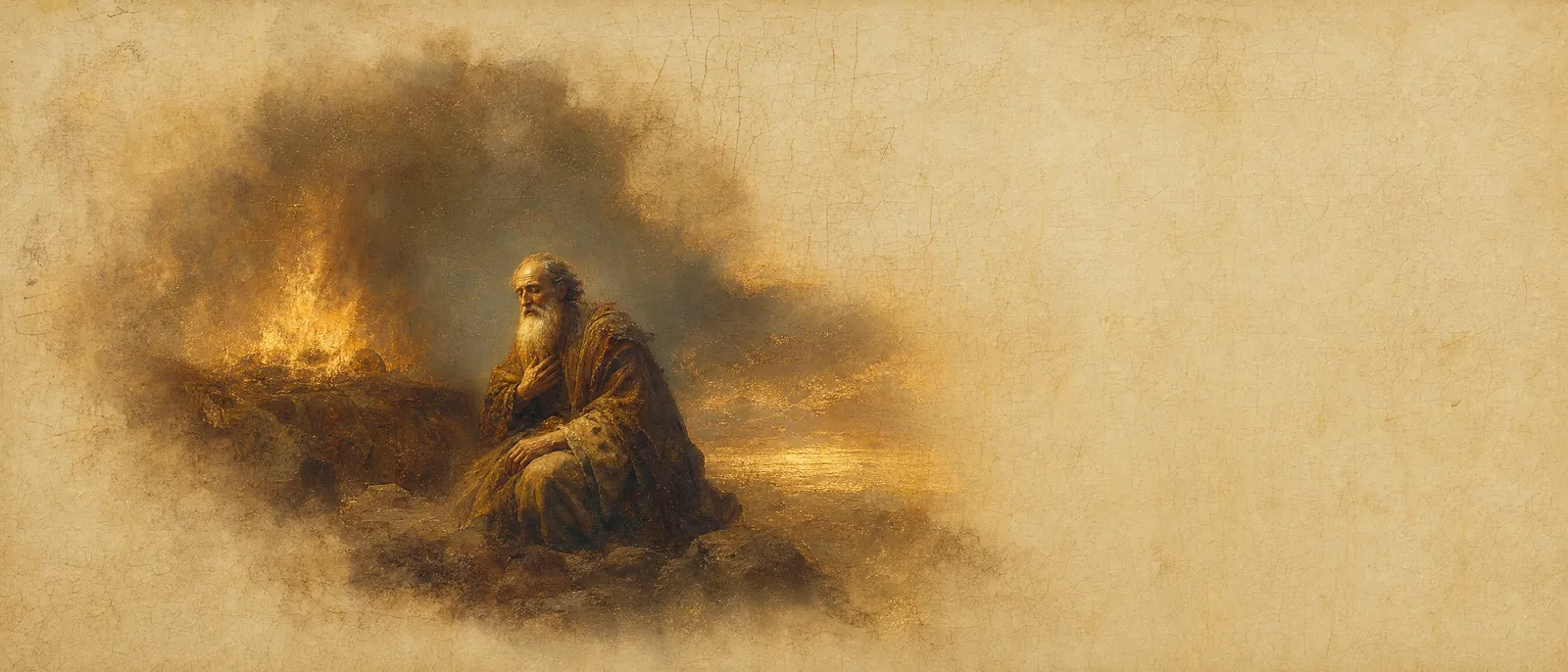
Eliyahu — the fire and the still voice
Eliyahu held two opposites at once: the fire that fell from heaven on Mount Carmel, and the thin whisper of silence he heard alone in a cave. The name carries that whole range — and the lifelong work of learning when each one is called for.
The Name Itself
Eliyahu is a confession folded into a name. Eli — "my God" — joined to Yah, the divine name, declaring: my God is the LORD. It is not a description of the bearer so much as a stake driven into the ground, a loyalty announced before the person has done anything to earn it.
That structure matters. The name does not say "God is good" or "God is gracious." It says my God — possessive, partisan, almost combative. People who carry this name often feel that their commitments are personal in exactly that way. A principle is not abstract to them; it is theirs, and they will defend it as one defends a household.
The Prophet of Fire
The Eliyahu of the books of Kings (1 Kings 17 onward) arrives in Israel like a drought — abruptly, announcing that no rain will fall except by his word. He confronts King Ahab and Queen Jezebel at the height of their power. On Mount Carmel he stages the great contest: build two altars, call on your god, I will call on mine, and the God who answers by fire is God. The prophets of Baal cry out all day and nothing comes. Eliyahu soaks his altar with water, prays once, and fire falls and consumes everything — wood, stones, dust, even the water in the trench.
It is one of the most decisive moments in Tanakh, and it is total victory. The fire vindicates him. The crowd falls on its face. And then, almost immediately, Jezebel sends word that she will kill him by tomorrow — and the man who just called down heaven runs for his life into the wilderness, sits under a broom tree, and asks God to let him die.
This is the pattern worth noticing. The bearer of conviction wins the argument and is left more alone than before. Being right, it turns out, does not refill the well.
The Still Small Voice
What follows is the heart of the name. Eliyahu flees to Horeb, the mountain of God, and hides in a cave. A great wind tears the mountains — but God is not in the wind. An earthquake — God is not in the earthquake. A fire — and God is not in the fire. Then comes the kol demama daka, the "sound of thin silence," the still small voice (1 Kings 19). And it is in that whisper, not in any of the spectacles, that God finally speaks.
The man whose whole ministry was fire is taught that the divine is found in the quiet. It is a correction aimed precisely at his gift. The voice asks him a plain question — "What are you doing here, Eliyahu?" — and does not let him answer with grievance forever. It gives him work, a successor, and a way down off the mountain.
The Lived Pattern
People who carry this name often have a real moral engine — a sensitivity to wrong, a willingness to stand alone, a refusal to soften what they believe is true. This is a genuine strength, and the world is frequently better for it. The fire is not the flaw.
The flaw, when it comes, is the inability to come down afterward. The conviction that wins the day can curdle into the exhaustion of "I, even I only, am left." Eliyahus can mistake intensity for fidelity, can keep calling down fire when the moment is actually asking for the whisper — for rest, for a quieter relationship, for the patience of a long teaching rather than a single dramatic stand.
The test of this life is the cave. Can the same soul that summons the fire also grow still enough to hear the voice that calls it back? Eliyahu eventually does — he names Elisha, he hands his mantle on, he stops trying to carry the whole covenant alone. The name's promise is not that you will avoid the fire. It is that you can learn to hear what comes after it.
Gematria and Legacy
Eliyahu carries the gematria value of 52. The number is offered here as a contemplative companion to the name, not as a code or a forecast — a quiet figure to sit beside the louder story of fire and silence.
In later tradition Eliyahu never quite leaves. He is carried up in a whirlwind by a chariot of fire (2 Kings 2) rather than dying, and so he becomes the prophet who returns — at every Passover seder a cup is poured for him, at every brit milah a chair is set. The name belongs to the one who is expected back, the herald of repair. To carry it is to be associated, fairly or not, with the work of reconciliation that is always still arriving.
Eliyahu in the Classical Sources
The name is אֵלִיָּהוּ (Eliyahu), gematria 52, and it is a theological sentence: Eli + Yahu — "my God is the Lord." It is also the only name in this library whose bearer, by the tradition's account, never died — which is why it is the one name with a standing appointment at every bris and every Seder table.
Where the Tanakh Gives the Name
Eliyahu arrives in Kings with no genealogy and no introduction — he simply appears, mid-verse, already arguing: "And Eliyahu the Tishbi… said to Achav: As the Lord God of Israel lives, before whom I stand, there shall be no dew or rain these years except by my word." A man who walks into the royal court and shuts off the sky. And at the other end of Scripture, the prophet Malachi gives the name its forward address: "Behold, I send you Eliyahu the prophet before the coming of the great day" — to turn the hearts of parents to children and children to parents. The name's first verse is confrontation; its last is reconciliation.
The Sages on Eliyahu
Because he ascended alive in the whirlwind, the Sages treat Eliyahu as the tradition's open line: the Talmud is full of his visits — he appears to rabbis in the study hall and the marketplace, settles arguments, and when the Gemara reaches a question it cannot resolve it files it under teiku, which tradition reads as a note that the Tishbi will answer it at the end of days. Every unresolved debate in the Talmud is, in effect, addressed to this name. No other figure got the job of history's final editor.
The Letters and the Number
The name contains the divine twice over: it opens with אֵל (El, God) and closes with the letters yud–heh–vav — three of the four letters of the Name itself. And the arithmetic completes the thought: 52 is exactly twice 26, the gematria of the four-letter Name — a life that counts out to the divine Name doubled, fitting for the prophet whose signature miracle at Carmel was making the people cry out the Name twice: "the Lord, He is God! the Lord, He is God!"
What a Name Does
The Talmud's shema garim — the name inclines — reaches its extreme case here: a name meaning "my God is the Lord," borne by the man whose entire career was forcing that sentence into the national mouth, and who now personifies its patience — present at every covenant, expected at every redemption. In this library his heirs are Daniel, the other prophet of hostile courts, and Chaim — for the only man the tradition never let die. The full index is at Hebrew names.
What does the name Eliyahu mean?
Eliyahu combines Eli, "my God," with Yah, a form of the divine name, yielding "My God is YHWH." It reads less as a description than as a declaration of loyalty — a confession of allegiance built into the name itself.
What is the gematria of Eliyahu?
Eliyahu (אליהו) carries a gematria value of 52. We offer it as a point of reflection alongside the name's deeper themes rather than as a prediction or hidden code.
Who was Eliyahu in the Tanakh?
Eliyahu — Elijah — is the prophet of the books of Kings who confronts King Ahab and Queen Jezebel. He calls fire down from heaven on Mount Carmel against the prophets of Baal, then flees to the cave at Horeb where he hears God in the "still small voice." He is taken up in a fiery whirlwind in 2 Kings 2 and, in tradition, awaited as a herald of redemption.
What does the name Eliyahu say about personality?
It points to intense moral conviction — a soul willing to stand alone for what it believes. The strength is the fire; the work is the cave. People with this name often must learn to hear the quiet voice that calls them back from being right toward being whole, and to let others share the burden rather than carrying it alone.
What does the name Eliyahu mean?
Eliyahu (אליהו) is a theological sentence: Eli + Yahu — 'my God is the Lord.' Its gematria, 52, is exactly twice 26, the value of the four-letter divine Name — fitting for the prophet who made the people cry 'the Lord, He is God!' twice at Carmel.
Why is Eliyahu present at every bris and Seder?
Because he ascended alive in the whirlwind, the tradition treats Eliyahu as still on assignment: Malachi 3:23 promises his return before the great day, to turn the hearts of parents and children toward each other. Every unresolved Talmudic debate (teiku) is traditionally left for him to settle.