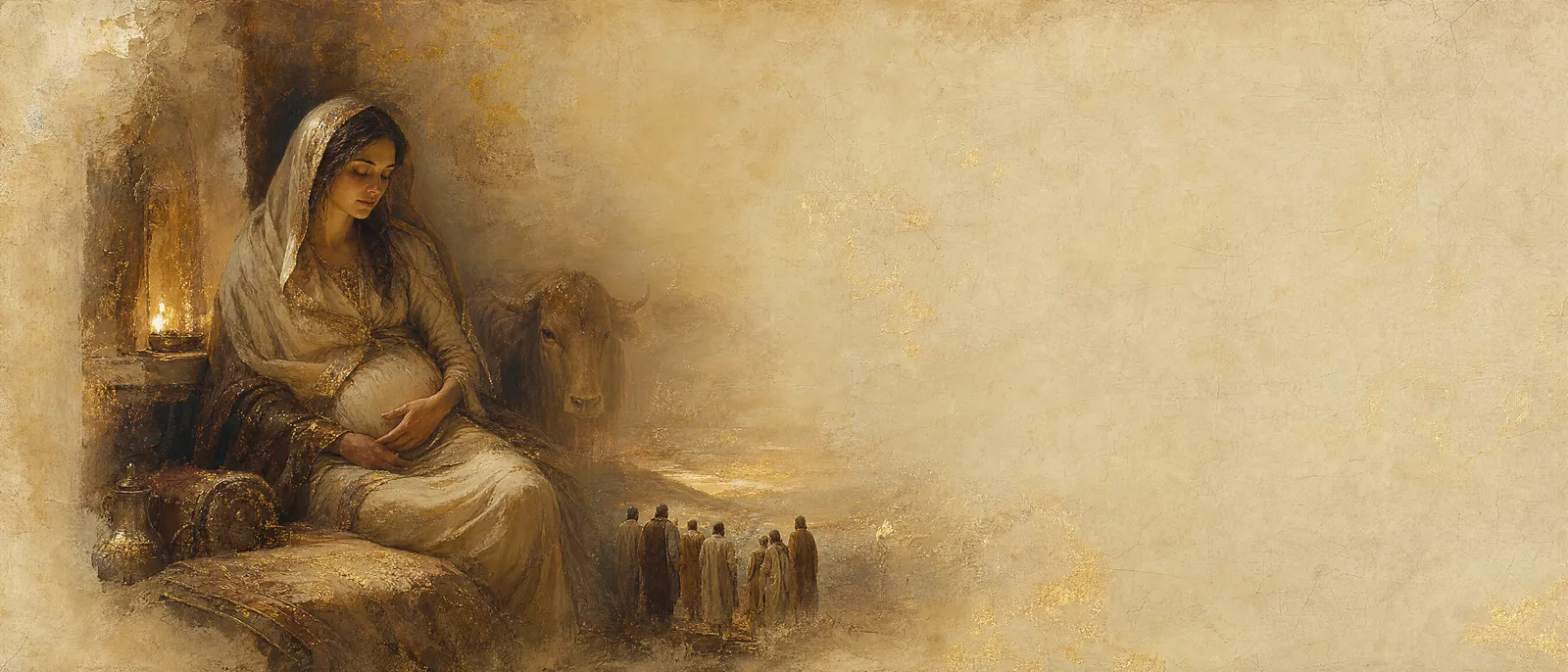
Leah — the mother of kings
Leah knew she was not first chosen — and nevertheless became the mother of David, of Mashiach, of every Jewish king. People with this name often learn early what it means to give yourself fully to someone who is not fully looking at you.
The name and its root
Leah, לאה, is most often traced to the root meaning "weary" or "worn" — a name that carries tiredness inside it, the fatigue of someone who has waited and worked and not yet been seen. Some scholars suggest an older sense closer to "wild cow," a term of strength and fertility from the ancient Near East. The meaning is genuinely debated; what is not debated is the weight the name acquired in the story attached to it.
That tension — weariness on one side, fierce generative power on the other — is the whole architecture of the name. Leah is not soft. She is durable. She is what remains standing after the romance fades and the actual building begins.
Leah in the Tanakh
In Genesis, Jacob loves Rachel and labors seven years for her. On the wedding night Laban substitutes Leah, the older sister, and Jacob wakes to find he has married the wrong woman. The text is unsparing: "And the Lord saw that Leah was hated" — senuah, unloved — "and He opened her womb" (Genesis 29).
From that unchosen position Leah bears Reuben, Simeon, Levi, and Judah, and later more. With each son's name she records her longing for Jacob's attention. But the turn comes at Judah — Yehudah, "this time I will thank the Lord" — where she stops naming her hunger and names her gratitude. From Levi comes the priesthood. From Judah comes David, and the line of kings, and Mashiach.
Leah is buried beside Jacob in the Cave of Machpelah — not Rachel, the beloved, but Leah, the one he did not choose. The matriarch of the burial place is the one who built the future.
What the gematria opens
Leah's name carries the value 36. In Jewish tradition 36 is lamed-vav — the number of the hidden righteous, the lamed-vavniks, on whose unnoticed merit the world is said to quietly stand. It is a fitting number for a woman whose contribution was unseen in her lifetime and load-bearing for all of history.
Thirty-six is also twice chai, double life — the number that does its work in pairs, in the second place, in the part of the equation no one is looking at. Leah lived the whole truth of that number: not the one in front, the one underneath.
The lived pattern
People named Leah often know, early and bodily, what it is to pour themselves into someone who is only half-turned toward them. They give first and most, and they keep a running count of what is and isn't returned — not out of pettiness but out of a deep need to be seen for the giving.
The growth in this name is the same growth Leah found at Judah's birth: the move from "will he finally love me" to "I will thank, regardless." When a Leah stops naming her children — her work, her projects, her care — after the absence she's mourning, and starts naming them after gratitude, everything changes. Her output stops being a plea and becomes a legacy.
The cost is real. A Leah can spend years building for people who don't notice, can mistake endurance for love, can stay too long in the second place because she's learned to live there. The gift is that what she makes in those years outlasts everyone who failed to look up.
The shape of the soul
This is not a name of being chosen. It is a name of choosing anyway — of fertility that doesn't wait for permission, of building a dynasty out of a marriage that began as a deception. Leah's name describes a soul that produces under conditions of not-enough-attention and produces the most important thing in the room.
What a Leah brings into the world will outlast everything that did not see her. The kings come from her. The thanks comes from her. The future is buried beside Jacob, and it has her name on it.
Leah in the Classical Sources
The name is לֵאָה (Leah), gematria 36 — and the sources give its bearer a distinction that reverses her whole biblical portrait: the woman Scripture introduces second became, in the Sages' accounting, the matriarch who buried queens and priests and kings in her line, and the tradition's first proof that tears can renegotiate a fate.
Where the Tanakh Gives the Name
She enters mid-comparison, in the verse every Leah has had to make peace with: "And Lavan had two daughters: the name of the elder was Leah, and the name of the younger was Rachel. And Leah's eyes were soft (rakkot), and Rachel was beautiful of form and beautiful of appearance." The unloved elder sister, married by deception, who names her sons like a diary of her heart — "now my husband will love me" — until the fourth son, when the diary changes key: "this time I will thank the Lord."
The Sages on Leah
The Talmud in Bava Batra refuses the plain reading of "soft eyes" as a flaw. Rav's teaching there: her eyes were soft from weeping — people on the road would say the elder daughter is destined for the elder son, Esav, and Leah cried that fate out of existence until her tears, the Sages say, unmade the match. The Gemara's point is enormous: the first thing the tradition tells us about Leah is that she is the person who refused an arranged destiny and won. Her reward runs through history — from her son Yehudah come the kings, from Levi the priests.
The Letters and the Number
Lamed–alef–heh: the name opens with the tallest letter in the alphabet — lamed, the letter of learning, the only one that rises above the line — followed by alef, the silent letter of the One. A name that reaches up and then goes quiet. Its gematria, 36, is one of the tradition's charged numbers: double chai (18 + 18, life twice over), and the number of the hidden righteous — the lamed-vav tzadikim, the thirty-six unnoticed people on whom, the tradition says, the world's existence rests. The overlooked sister's name counts out to the number of the world's overlooked sustainers.
What a Name Does
The Talmud teaches that tears, prayer, and change can tear a decree — Leah is the case the Sages actually cite for it, the woman whose weeping rewrote the roadside prophecy. Whoever carries her name carries that precedent. Her sister's page faces hers in this library — Rachel, the other half of the Torah's most complicated sisterhood — and her fourth son, the one named for thanks, is at Yehudah. The full index is at Hebrew names.
What does the name Leah mean?
Leah (לאה) is most commonly understood to mean "weary" or "worn," from the root ל-א-ה. Some scholars propose an older sense of "wild cow," a term of strength and fertility. The meaning is debated, but both readings sit inside her story: fatigue and fierce generative power.
What is the gematria of Leah?
Leah (לאה) has a gematria of 36. In Jewish tradition 36 is lamed-vav, the number of the hidden righteous on whose unseen merit the world is said to stand — and twice chai, double life. Fitting numbers for a matriarch whose unnoticed work carried all of history.
Who was Leah in the Bible?
Leah was the elder daughter of Laban and the first wife of Jacob, married to him through Laban's substitution on his wedding night (Genesis 29). Though described as unloved, she bore six of the twelve tribes, including Levi (the priesthood) and Judah (the line of David and Mashiach). She is buried beside Jacob in the Cave of Machpelah.
What does the name Leah say about personality?
Leah describes a soul that gives fully to people who are only half-looking — durable, generative, keenly aware of what is and isn't returned. Its growth is the move from longing for attention to acting in gratitude regardless. The risk is staying too long in second place; the gift is building things that outlast everyone who failed to notice.
What do the Sages say about Leah's eyes?
The Talmud in Bava Batra 123a refuses to read 'soft eyes' as a flaw: her eyes were soft from weeping — people said the elder daughter was destined for Esav, and Leah cried that fate out of existence until her tears unmade the match. She is the tradition's first proof that tears can renegotiate a destiny.
What is the gematria of Leah?
Leah (לאה) totals 36 — double chai (18+18, life twice over) and the number of the lamed-vav tzadikim, the thirty-six hidden righteous on whom the world rests. The overlooked sister's name counts out to the number of the world's overlooked sustainers.