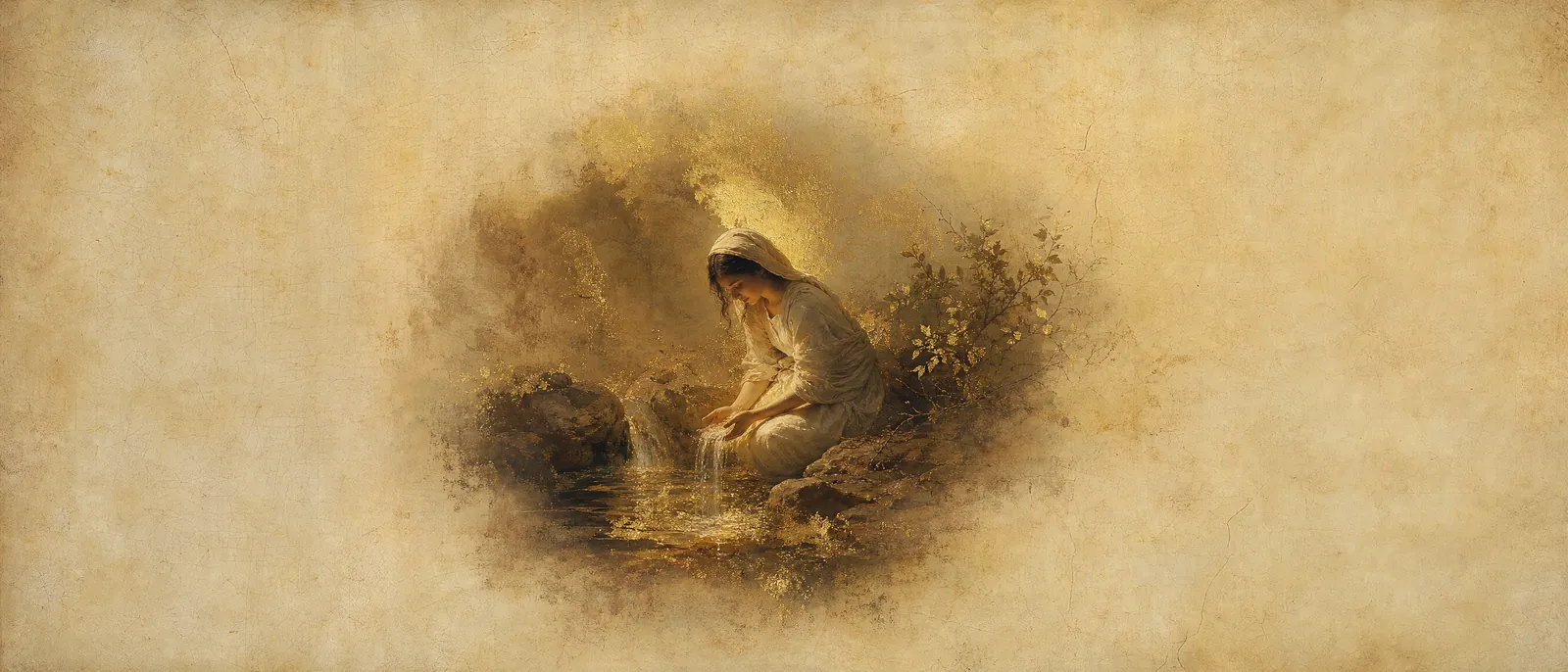
Maayan — the source that renews itself
Maayan is a modern Israeli name that carries an old image: not water someone hauls in, but water that pushes up on its own, from a source below. It is the emblem the tradition reached for when it wanted to describe a mind that generates more than it consumes.
The Water No One Carries
Most water in the ancient world was labor. You drew it, carried it, rationed it, guarded it. A cistern held what you poured in; a well gave back what the rains had left. But a maayan — a spring — was different in kind. It rose on its own. No one filled it. Its source was below, in the ground itself, and it kept coming whether anyone showed up with a bucket or not.
That distinction is the whole meaning of the name. Maayan is not a container and not a reservoir. It is the thing that produces. This is why the word became, in Jewish tradition, the highest available metaphor for a mind that learns deeply enough to generate — not merely to store and repeat, but to bring up something new from below.
A person named Maayan tends to carry that architecture: self-replenishing, quietly productive, the one others come to when they need something drawn. The gift is real, and so is its shadow — the source that keeps giving can forget it is a resource other people rely on, and can be taken for granted precisely because it never seems to run dry.
The Cost of Rising on Your Own
A spring's virtue is also its exposure. Because it renews itself, people stop asking whether it is tired. They bring their buckets and assume the water will be there, and it usually is — until the day it isn't, and no one has learned how to fill it in return. The self-sourcing person often discovers that the world is very good at drawing and very bad at replenishing.
There is a second tension. Water that rises from below has to keep moving or it stagnates. The maayan personality often feels this literally — a need to be flowing, producing, generating, and a low-grade restlessness when the flow is blocked. The strength that 'strengthens as it flows' can curdle into a fear of stillness. The work of the name is to trust that the source is still there even when nothing is visibly pouring out.
Isaac's Wells
The tradition ties the number to a life. Gematria 180 (in the modern spelling מעיין) is exactly the years of Yitzchak's life — the patriarch whose signature act, recorded in Genesis, was re-digging the wells his father had dug and his enemies had stopped up. Isaac did not find new water so much as reopen access to old water. He cleared what had been blocked.
It is a fitting resonance for a name that means spring. The maayan work is rarely inventing the source — the source is given, is below, is already there. The work is keeping it open: clearing the debris that stops it, refusing to let others fill it in, insisting the water keep rising. A wellspring counted out in the years of the man who spent his life unstopping wells.
Maayan in the Classical Sources
In the sources, the Hebrew מעיין — maayan, whose gematria is 180 — is never a neutral word for water. It is the word Scripture and the sages reach for when they want to describe rescue, origin, and a mind at its best. Three passages carry it, and each turns the spring into an image of something larger than itself.
ISAIAH 12:3 — THE SPRINGS OF SALVATION
Isaiah imagines redemption not as a delivery but as a spring: 'You shall draw water with joy from the ma'ayanei hayeshua — the springs of salvation.' The choice of metaphor is deliberate. Rescue is not pictured as cargo shipped in from elsewhere; it is water that rises from the ground you are already standing on, available to be drawn again and again.
This is the verse sung at Havdalah, at the seam between Shabbat and the working week — the moment you turn back toward labor and want to believe the source will still be there. For a person named Maayan, it is a fitting anchor: joy and rescue framed not as something that arrives, but as something that rises.
PSALMS 87:7 — ALL MY SPRINGS ARE IN YOU
The psalmist, addressing Zion, declares: 'All my springs (mayanai) are in you.' Every personal source — every stream of life, memory, and belonging — is traced back to one deep original. The plural springs resolve into a single wellspring.
The verse gives the name its humility. A maayan produces, yes, but the water it brings up is not its own invention; it comes from a source deeper than itself. To be a spring is to be a place where something older rises — a channel, not the origin. It keeps the self-renewing person honest about where the water actually begins.
PIRKEI AVOT 2:8 — THE EVER-STRENGTHENING SPRING
When Rabban Yochanan ben Zakkai ranks his greatest students, the highest praise he can find is a spring. He calls Rabbi Elazar ben Arach a 'ma'ayan hamitgaber' — a spring flowing ever stronger. Of all the images available to describe a mind, the tradition chose the one that generates rather than the one that merely holds.
This is the compliment buried inside the name. A cistern's value is fixed by what was poured in; a maayan's value grows as it flows. The praise is not for retention but for generation — for the person whose giving increases their capacity rather than depleting it. It is the standard the name sets and, quietly, the standard it must live up to.
THE LETTERS AND THE NUMBER
The one numeric claim the tradition makes here is precise and worth sitting with: the gematria of מעיין, in its modern spelling, is 180 — and 180 is exactly the number of years of Yitzchak's life. The word for a spring counts out to the full span of the patriarch whose defining act was re-digging the wells others had stopped up.
It is a rare kind of rhyme. Isaac's genius was not discovery but persistence — clearing blocked water, insisting the source stay open. That the word maayan should land on the exact count of his years reads less like coincidence than like commentary: a spring is measured by the life spent keeping it flowing.
The Talmud's principle shema garim — "the name causes" (Berakhot 7b) — is the tradition's claim that a name gently inclines its bearer. In this library, Maayan's nearest companions are Yitzchak and Eden; the full index is at Hebrew names.
What does the name Maayan mean?
Maayan (מעיין) means a spring or wellspring — water that rises from its own source rather than water that has to be carried or poured in. It is a modern Israeli name whose meaning is rooted deeply in the Tanakh, where the spring is an image of rescue, origin, and self-renewing life.
What is the gematria of Maayan?
The gematria of Maayan (מעיין) is 180. The tradition notes that 180 is exactly the number of years of Yitzchak's life — the patriarch whose signature act was re-digging the stopped-up wells of his father.
Where does the word Maayan appear in the Tanakh?
Maayan is a modern name, but its root runs through Scripture. Isaiah 12:3 speaks of drawing water with joy from 'the springs of salvation,' and Psalms 87:7 declares 'all my springs are in you,' tracing every personal source back to Zion.
What does the name Maayan say about personality?
The spring is water that renews itself, so the name suggests someone self-replenishing and quietly productive — the person others come to draw from. Its shadow is being taken for granted: a source that never seems to run dry is easily assumed to be inexhaustible.
What do the sources say about Maayan?
Isaiah frames rescue as a spring, Psalms traces all personal springs to one deep origin, and Pirkei Avot 2:8 crowns its greatest student a 'spring flowing ever stronger.' Together they make the maayan an emblem of generation — a mind and soul that give more than they hold.
Why is Maayan connected to Isaac and his wells?
The gematria 180 matches the years of Yitzchak's life, and Isaac's defining act in Genesis was re-digging the wells his enemies had stopped up. The resonance suggests that the maayan's real work is not inventing the source but keeping it open — clearing what blocks the water so it can keep rising.