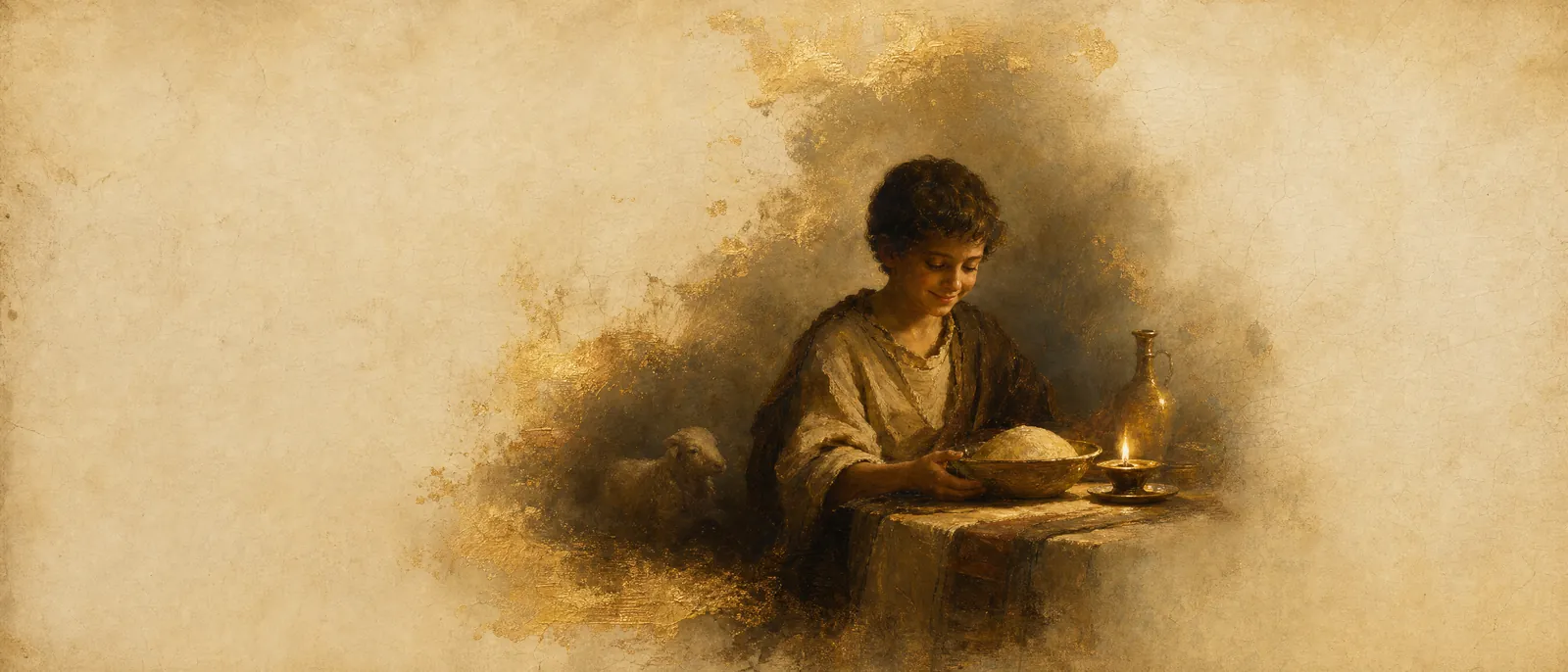
Yitzchak — the quiet inheritor
A name born from laughter, carried by the one patriarch who never left home, never changed his name, and spent his life completing what his father began. Yitzchak is the architecture of inheritance — and the question of whether you can honor a legacy without disappearing into it.
The Name Born From Laughter
Yitzchak comes from the Hebrew root צחק — to laugh. The name is given before the child arrives: God tells Avraham that Sarah will bear a son, and that his name will be Yitzchak. But the laughter is double-edged. Both Avraham and Sarah laugh when they hear the promise — laughter that is part wonder, part disbelief that a child could come from such old bodies (Genesis 17–18).
So the name records a moment of incredulity that became joy. It carries the memory of a thing thought impossible. That tension lives inside the name: Yitzchak is the proof that something improbable was carried through — and the one who must now carry it further.
The Patriarch Who Stayed
Of the three patriarchs, Yitzchak is the still one. Avraham travels, argues with God, hosts angels. Yaakov wrestles, schemes, builds a nation of sons. Yitzchak does almost none of this. He is bound on an altar by his father and survives (the Akedah, Genesis 22). He marries the wife his father's servant selects for him. He stays in the land while famine drives others out, because God tells him not to leave.
His most defining act is in Genesis 26: the Philistines have stopped up the wells his father Avraham dug, and Yitzchak re-digs them — and gives them the same names his father gave. He does not innovate. He restores. He makes the old water flow again.
This is not weakness. It is a different kind of strength — the discipline of continuation, of keeping a thing alive across a generation that could have let it die. But it is quieter, and the world rarely applauds it.
The Lived Pattern: Completing What Began Before You
People with this name often feel they are finishing something they did not start. A family pattern, an unfinished sentence, a vision someone else couldn't see through. There is a sense of arriving mid-story — of being handed a project, a name, a wound, a responsibility that has roots older than you.
This can be a gift. Yitzchaks are often deeply loyal, steady, and reliable in ways flashier people are not. They show up. They maintain. They re-dig the wells. They keep faith with the dead and with promises made before they were born.
The cost is the question of where the inheritance ends and the self begins. The danger for this name is spending a whole life being a faithful steward of someone else's vision — never asking whether the wells are the ones you would have dug. The work is honoring the inheritance without being trapped by it.
The Blindness and the Blessing
In old age Yitzchak goes blind, and in that blindness the great blessing of the family is given to the wrong son — Yaakov, disguised, instead of Esau (Genesis 27). It is one of the strangest scenes in the Torah: the patriarch deceived in his own tent, the future of the covenant passing through a trick.
There is a hard truth in it for this name. The inheritor who keeps his eyes only on the past can be blind to what is actually happening in front of him. Yitzchak's love for Esau, the hunter, blinds him to the son who will actually carry the line. Those who carry this name should ask, gently, whether their loyalty to an inherited picture is keeping them from seeing who and what is really before them.
What 208 Holds
The gematria of Yitzchak is 208. It is a number you can feel rather than decode — the weight of a name that was promised before it was born, spoken by God before the child existed. The numerical value belongs to a name that is, from its first appearance, about a future being kept.
For the one who carries it, the invitation is to be more than a vessel. Re-dig the wells, yes — but also know which water is yours to drink. Continuation is holy. So is the day you decide what to add.
Yitzchak in the Classical Sources
The name is יִצְחָק (Yitzchak), gematria 208 — and it holds a distinction unique in the Torah: it is the only patriarchal name chosen by God before the child's birth, and the only one never changed afterward. A name meaning "he will laugh," issued in advance, to a family that had every reason not to.
Where the Tanakh Gives the Name
God names him mid-covenant, answering Avraham's own astonished laughter at the promise of a son at a hundred: "your wife Sarah shall bear you a son, and you shall call his name Yitzchak." At the birth, Sarah gives the name its second verse: "God has made laughter for me; whoever hears will laugh with me (yitzchak li)." The commentators note the tense — yitzchak, he will laugh: the only name in the Torah conjugated in the future. The laughter is not a memory; it is a forecast.
The Sages on Yitzchak
The Talmud in Shabbat stages the tradition's most staggering scene for him. In the future, God tells the patriarchs their children have sinned. Avraham argues justice; Yaakov argues justice; only Yitzchak defends: he runs the arithmetic of a human life — subtract the years before responsibility, the nights of sleep, the hours of prayer and eating — and says: Master of the world, half is Yours already; and if You bear the rest, good, and if not, let half be on me and half on You. The Gemara crowns him for it: in that hour Israel will say "for you are our father." The bound son of the Akeidah becomes, in the Talmud's ending, the parent who saves his children with wit and mercy — laughter's long game.
The Letters and the Number
Yud–tzadi–chet–kuf: the name opens with the smallest letter and contains tzadi — the letter of the tzadik — at its heart. Its gematria, 208, is exactly eight times 26, the value of the divine Name: the middle patriarch's name counts out the Name eightfold, seated between Yaakov's sevenfold 182 and Yosef's sixfold 156 — three generations descending in multiples of 26, a family spelled in God's arithmetic. Eight, the tradition's number beyond nature, suits the only patriarch born of a ninety-year-old mother.
What a Name Does
Yitzchak's page is the tradition's counterweight to the renaming doctrine: the Talmud teaches a changed name can tear a decree — but a name issued by heaven needs no revision, and his never got one. The laughter was load-bearing from the start. His parents' pages flank his — Avraham and Sarah, both renamed toward him — and the son who inherited the struggle is at Yaakov. The full index is at Hebrew names.
What does the name Yitzchak mean?
Yitzchak (יצחק) comes from the Hebrew root צחק, 'to laugh,' and means 'he will laugh' or 'he laughs.' The name commemorates the laughter of Avraham and Sarah when they were told that Sarah, in old age, would bear a son (Genesis 17–18) — laughter that mixed disbelief with eventual joy.
What is the gematria of Yitzchak?
The gematria of Yitzchak (יצחק) is 208. It is the numerical weight of a name that was spoken by God and promised before the child was ever born.
Who was Yitzchak in the Tanakh?
Yitzchak (Isaac) is the second patriarch, son of Avraham and Sarah and father of Yaakov and Esau. He is bound on the altar in the Akedah (Genesis 22), marries Rivka, re-digs the wells his father Avraham had dug (Genesis 26), and in his blindness gives the patriarchal blessing to Yaakov in disguise (Genesis 27). He is the one patriarch who never leaves the land of Canaan.
What does the name Yitzchak say about personality?
Yitzchak is the architecture of the faithful inheritor. People with this name are often steady, loyal, and reliable — drawn to completing what others began, maintaining family patterns, and keeping old promises alive. The challenge is to honor that inheritance without disappearing into it, and to stay awake to what is actually before them rather than only to the picture they were handed.
Why is Yitzchak the only patriarch whose name never changed?
His name was chosen by God before his birth (Genesis 17:19) — the only patriarchal name issued by heaven in advance — and it never needed revision. The Talmud counts renaming among the levers that move a decree; a heaven-issued name has no decree to escape.
What does the Talmud say Yitzchak will do at the end of days?
Shabbat 89b: when the patriarchs are told their children have sinned, only Yitzchak defends them — running the arithmetic of a human life and offering to carry half the burden himself — until Israel says of him, 'for you are our father.' The bound son becomes the arguing parent.