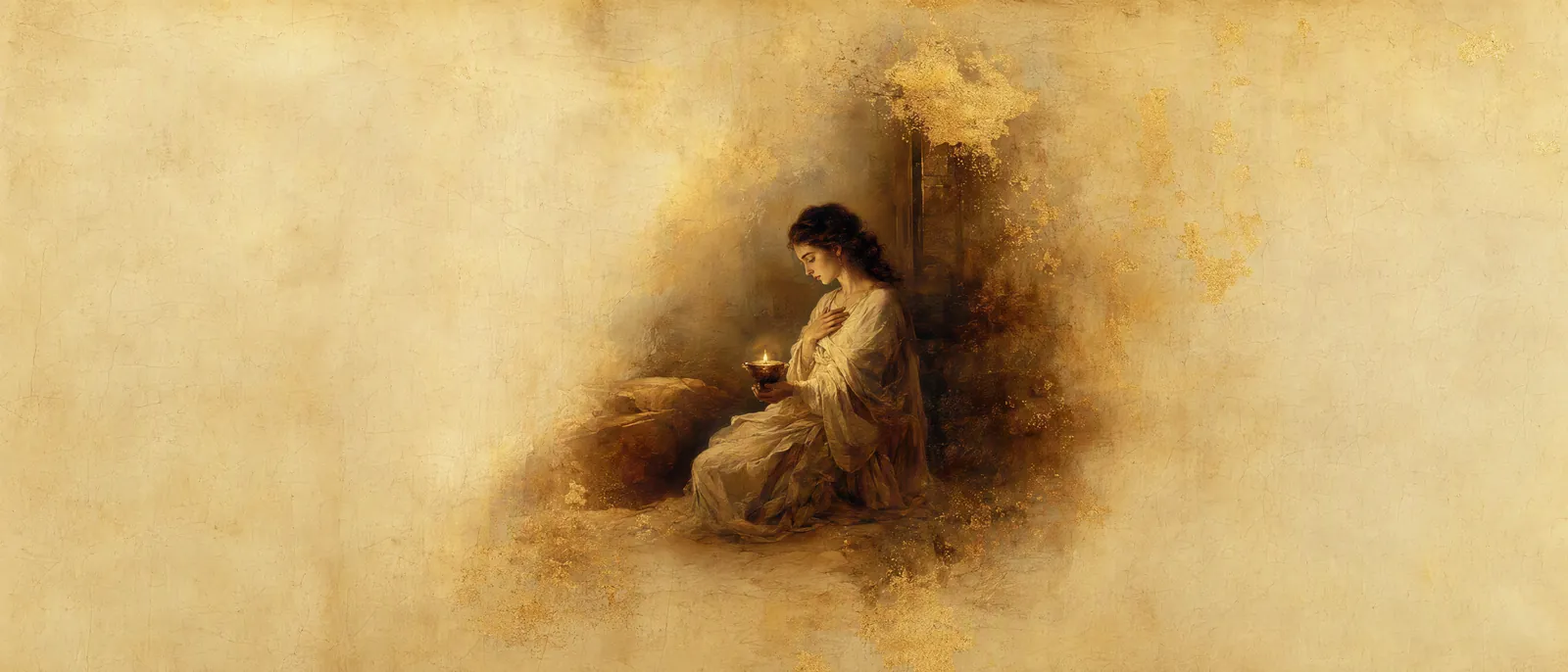
Michal — the one who loved first and paid for it
Michal is the name of the only woman in all of Tanakh whom the text dares to say loved a man. It is a name built like a question — 'who is like God?' — asked in a woman's voice, and answered, once, with a rope lowered out a window into the dark.
The Name That Is a Question
Michal — מיכל — is one of the great compressed names of the Hebrew Bible, a contraction the sages hear as a question folded into three letters: mi cha El, 'who is like God?' It is the same question that stands upright inside her brother-archetype's name, Michael, but here it is asked in a woman's voice. A name that asks 'who is like God' is not a name of certainty. It is a name of reaching — toward something higher than the house you were born into, higher than the men who claim you.
The story attached to this question is the singular one in the entire Tanakh. Of all the loves, betrothals, and marriages the text records, it names a woman's love out loud exactly once: 'And Michal, Shaul's daughter, loved David.' The narration usually keeps women's interior lives silent. For Michal it makes an exception, and the exception is the whole tragedy in miniature — she loved first, she loved openly, and the story around her never quite paid her back for it.
The Window and the Cost
When her father the king sent men to kill her husband in the night, it was Michal who lowered David out of a window and put a household idol in the bed to buy him time. She saved the man she loved and lost everything for it: her father's favor, her marriage's stability, her place in the palace. She became a woman caught in the seam between her father's house and her husband's crown — given away to another man in David's absence, then reclaimed as a political asset, then estranged in one bitter exchange over how a king should dance.
This is the architecture the name describes. People who carry Michal tend to love earlier and harder than the situation has earned, and to act on that love decisively — the window, the rope, the risk taken while others are still deliberating. They are the ones who move first to protect. The cost, historically, is that the world is slow to reciprocate at that pitch. Michal souls learn young that devotion is not a transaction, and that loving the highest thing does not guarantee being loved back in kind.
The Crown She Claimed Anyway
What redeems the name from pure lament is what tradition remembers her doing with her own hands. The Talmud preserves a picture of Michal wrapped in tefillin — a woman taking up the crown of the commandments that most assumed belonged to men, with the Sages declining to protest. It reframes the whole life. Here is a woman who asks 'who is like God' and then does not wait passively for the answer; she binds it to her arm and her head.
So the Michal pattern is not only the wound of loving unrewarded. It is also the refusal to be defined only by whose daughter or whose wife you are. These are people who claim a spiritual seriousness on their own terms, who keep reaching upward even after the reaching has cost them, and who would rather be the one who loved first than the one who was safe.
Michal in the Classical Sources
In the sources, Michal — מיכל — reads as a compressed question, mi cha El, 'who is like God,' in the feminine. Her gematria is 100, a complete and rounded hundred. What follows is where the tradition anchors both the name and the woman who wore it.
I SAMUEL 18:20 — THE ONE DECLARED LOVE
The verse is startling in its plainness: 'And Michal, the daughter of Shaul, loved David.' In a narrative that almost never reports what women feel, this is the single time the text states, in its own voice, that a woman loved a man. The grammar is active — she is the subject, love is the verb, David is the object. She is not desired; she desires.
This is the seed of the whole archetype. To carry Michal is to be marked by the one verse in Scripture that lets a woman's love stand as a fact rather than a footnote — and to inherit its unfinished feeling, the sense of having loved more openly than the surrounding story knew how to answer.
ERUVIN 96a — THE WOMAN IN TEFILLIN
The Talmud in Eruvin records that Michal, described as the daughter of the Kushite, wore tefillin, and that the Sages did not protest. In a legal culture where the binding of tefillin was largely understood as a men's obligation, this is a remarkable precedent — the tradition preserving, without objection, the memory of a woman who claimed the crown of the commandments for herself.
It is this detail that keeps Michal from being only a figure of sorrow. The number 100 fits her here — the count of the daily blessings, a complete round of devotion — a fitting measure for the woman the Talmud remembers wrapped in the very sign of covenant.
YOMA 83b — THE NAME READ ALOUD
Among the Sages' practice of reading meaning out of names, Michal is heard as the royal daughter's version of Michael's question — 'who is like God?' — asked in the feminine. It is a name that poses the highest possible question about who can be compared to the Divine.
And the life answered the question in the most physical way imaginable: with a rope lowered out a window to save a life. The name asks about heaven; the woman acted on earth. That gap between the exalted question and the desperate, practical rescue is exactly the tension the name carries.
THE LETTERS AND THE NUMBER
The gematria of Michal is 100 — a complete, rounded hundred. It is not a jagged or partial number; it closes a full cycle, the sum you reach when nothing is left over.
One hundred is also the traditional count of the daily blessings a Jew is meant to say — a full measure of devotion offered from morning to night. That count sits fittingly on Michal, the woman the Talmud remembers wrapped in tefillin: a life reaching for a complete round of the sacred, claimed on her own terms.
The Talmud's principle shema garim — "the name causes" (Berakhot 7b) — is the tradition's claim that a name gently inclines its bearer. In this library, Michal's nearest companions are David and Avigail; the full index is at Hebrew names.
What does the name Michal mean?
Michal (מיכל) is a contraction the sages read as 'who is like God,' asked in the feminine — the same question that stands inside the name Michael, voiced by a woman. It is a name of reaching upward, and it belongs to the daughter of King Shaul who became David's first wife.
What is the gematria of Michal?
The gematria of Michal is 100 — a complete, rounded hundred. It corresponds to the traditional count of the hundred daily blessings, a full measure of devotion fitting for the woman the Talmud remembers wearing tefillin.
Where does Michal appear in the Tanakh?
Michal appears in the books of Samuel as the daughter of King Shaul and the first wife of David. I Samuel 18:20 records the singular line, 'And Michal, the daughter of Shaul, loved David' — the only time the Tanakh's narration states a woman's love for a man.
What does the name Michal say about personality?
People who carry Michal tend to love first, love openly, and act decisively to protect — the window and the rope over cautious delay. The shadow is that the world is slow to reciprocate at that pitch, so Michal souls learn early that devotion is not a transaction.
What do the sources say about Michal?
I Samuel 18:20 names her love outright; Eruvin 96a records that she wore tefillin without the Sages protesting; and Yoma 83b reads her name as Michael's question in the feminine. Together they draw a woman of open devotion who claimed sacred seriousness on her own terms.
Why is Michal called 'the one who loved first and paid for it'?
Because she is the only woman the Tanakh says loved a man, and she lowered David out a window to save his life — losing her father's favor, her marriage's stability, and her palace place in the process. The name carries both the courage of loving first and the cost of being under-repaid for it.