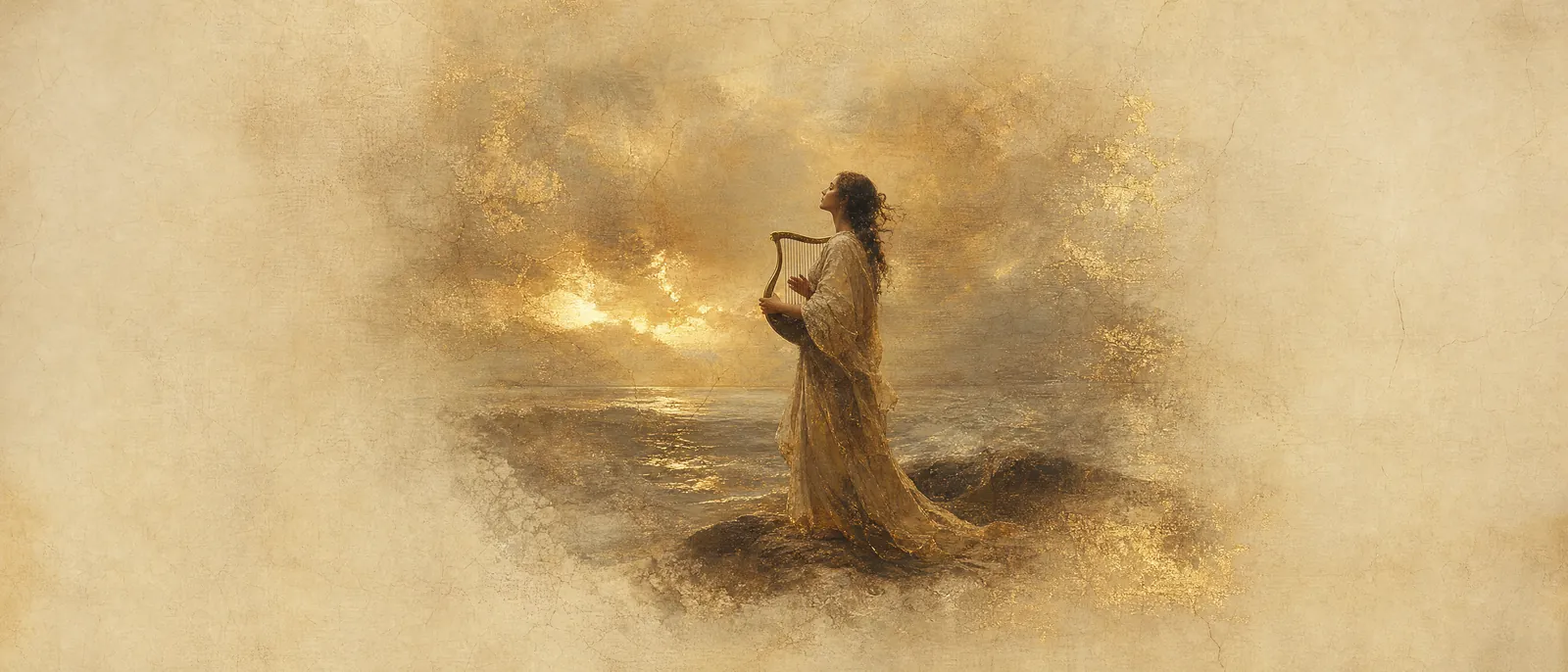
Shira — the one who turns events into music
Shira is not a story about a person in the Torah. It is a story about a moment — the instant Israel stood on dry land, looked back at the sea, and could not simply live through what had happened. They had to sing it. That impulse is the whole name.
A Word Before It Was a Name
Shira is honest about what it is: a modern Israeli name built from an ancient Torah word. No woman named Shira walks through the Book of Exodus. Instead, the word itself walks through — שירה, song — and specifically one song, the first one, sung by a whole nation at the edge of the water.
This matters, because the name does not hand its bearer a biblical biography to inherit. It hands her a verb. Az yashir — 'then he sang.' The name lives in that 'then': the moment after the danger, when survival is not enough and the event demands to be turned into something that can be repeated, remembered, carried.
The One Who Cannot Leave It Unsaid
People carrying this name tend to share a particular reflex: nothing has fully happened to them until it has been said, sung, or written down. The wedding is not the wedding until the toast lands. The loss is not grieved until it has a form. The good news is not real until it has been told to someone who will feel it back.
This is a gift and a tax. The gift is that a Shira makes experience legible — she gives the room its language, turns a chaotic evening into a story people will tell for years, finds the melody in the noise. The tax is that the unexpressed can feel, to her, like it never occurred. Feelings held silently can curdle. The work of this name is learning that some things are true even before they are sung — that the sea parted whether or not anyone wrote the poem.
There is also the matter of timing. The Song at the Sea was not sung during the crossing. It came after — on the far shore, on dry land, when the fear had passed. The Shira instinct is retrospective: it needs the safety of the other side before it can shape what happened. Learning to trust that the song will come, rather than forcing it mid-crisis, is a lifelong calibration.
A Name Whose Category Is Not Yet Full
The Sages count ten great shirot across history — the sea, the well, Devorah's song, David's psalms, and onward — and they leave the tenth open, reserved for the future, for a song not yet sung. This is the strange spaciousness inside the name. It is not a monument to something finished. It is a category still accepting entries.
To be named Shira is to belong to an unclosed list. It suggests a person who is not meant to merely preserve what already sings, but to add to it — to be, at her best, one of the voices the tradition was still waiting for.
Shira in the Classical Sources
In the sources, שירה (shira) — 'song' — is anchored not in a person but in an event so overwhelming it could only be answered in music. The gematria of the name is 515. To read Shira in the sources is to trace how a nation, a group of women with drums, and a rabbinic argument about names all circle the same idea: that song is not decoration but the deepest form of response.
EXODUS 15:1 — THE FIRST MASS MUSIC
'Then Moshe and the children of Israel sang this shira to the Lord.' This is the verse that gives the name its bones. It is the Torah's first song — not an individual's prayer but an entire people singing together, on the far side of the sea, on dry ground, with the fear finally behind them.
The grammar is famously strange: az yashir, 'then he will sing' — a future tense used for a past event, as if the song exists outside ordinary time. The tradition reads volumes into this. For the name, it means the impulse to sing is not tied to a single moment; it is a standing capacity, always available, waiting for the right shore.
EXODUS 15:20 — THE TIMBRELS PACKED IN ADVANCE
The shira has a second verse. Miriam takes a timbrel, and all the women follow her with timbrels and dancing. The Sages note something quietly astonishing: where did the drums come from, mid-flight from Egypt? The women had packed them. They left slavery trusting there would be something worth singing about — carrying instruments for a celebration that had not yet been earned.
This is the other half of the Shira temperament: not just responding to what happened, but preparing to respond, keeping the instrument ready. It is faith expressed as readiness — the refusal to be caught without a way to mark the moment when it comes.
BERAKHOT 7b — DESTINY CARRIED IN LETTERS
On the daf at Berakhot 7b, the Talmud engages the idea of shema garim — that a name shapes what a person becomes — and in the surrounding sugya derives David's psalms and lineage through the name of Ruth. Song, in this reading, is destiny folded into letters, passed down and waiting to unfold.
For a name that is literally the word 'song,' this is more than incidental. It suggests that to be called Shira is to carry a leaning — toward expression, toward turning what is lived into what can be sung — encoded in the very syllables one answers to.
THE LETTERS AND THE NUMBER
The gematria of שירה is 515. The letters spell the plainest possible thing: song. There is no hidden figure to decode, no buried biography — the name means exactly what it says, which is itself a kind of teaching. Some names conceal; this one declares.
What the tradition adds is scale. The Sages count ten shirot across history — the song at the sea, the song of the well, the song of Devorah, the songs of David — and they hold the tenth in reserve, for a future not yet arrived. So the name belongs to an unfinished sequence: its category is not yet complete. To bear it is to stand inside a list that is still waiting for its last entry.
The Talmud's principle shema garim — "the name causes" (Berakhot 7b) — is the tradition's claim that a name gently inclines its bearer. In this library, Shira's nearest companions are Miriam and David; the full index is at Hebrew names.
What does the name Shira mean?
Shira (שירה) means 'song,' and specifically the Song at the Sea from Exodus 15:1 — the song Israel sang after crossing the water. It is a modern Israeli name built directly from this Torah word, so its meaning is expression itself: turning experience into something that can be sung.
What is the gematria of Shira?
The gematria of שירה is 515. The name is the literal Hebrew word for 'song,' which the tradition treats as one of ten great shirot in history — with the tenth reserved for the future.
Where does the word Shira appear in the Tanakh?
The word shira anchors the Song at the Sea in Exodus 15:1 — 'Then Moshe and the children of Israel sang this shira to the Lord' — and its second verse in Exodus 15:20, where Miriam and the women sing with timbrels. Shira is a modern name drawn from this word rather than the name of a biblical figure.
What does the name Shira say about personality?
Shira describes a soul that metabolizes life into expression — nothing feels fully real until it has been said, sung, or written. At her best she gives a room its language and finds the melody in the noise; her challenge is trusting that some things are true even before they are put into words.
What do the sources say about Shira?
Exodus 15 grounds the name in the first mass song of the Jewish people, sung on the far shore of fear, and in Miriam's timbrels — instruments packed in advance out of faith. Berakhot 7b adds the idea that a name carries destiny in its letters, fitting for a name that is literally the word 'song.'
Why is Shira called a name whose category is not yet complete?
The Sages count ten great shirot across history — the sea, the well, Devorah, David and others — but hold the tenth for the future, a song not yet sung. Because Shira means exactly this word, the name belongs to an unfinished list, suggesting a person meant not only to preserve song but to add to it.