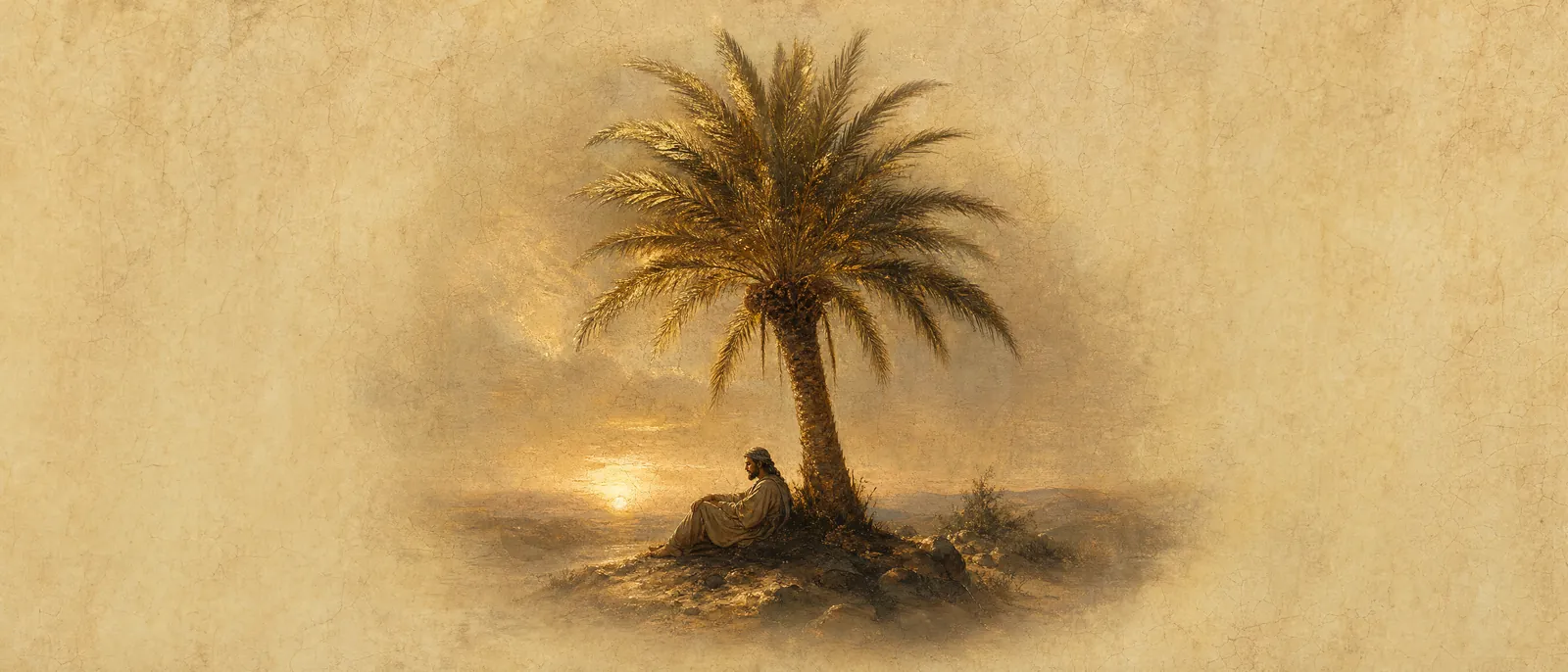
Tomer — the upright one who shades others
Tomer is a modern Israeli name carrying an ancient tree inside it: the palm that grows straight up in hard ground, fruits only after years of patience, and gives shade to whoever sits at its base.
A Tree Worn as a Name
Tomer is not a biblical person. It is a biblical tree, made into a name — the masculine of Tamar, the palm. And the palm is one of the most exact images the tradition owns. It does not sprawl. It does not branch out sideways looking for easier soil. It goes straight up, single-trunked, in ground that would defeat softer plants, and it makes you wait for its fruit. What it finally gives — dates, sweetness, shade — arrives late and arrives reliably.
To carry this name is to carry an instruction about time. The tomer is a long-trajectory person: seasons that look unspectacular from the outside, no visible flowering, and then, after the waiting, the dates. The temptation for such a soul is to read the quiet years as failure. The name says otherwise — the quiet is the growing.
Uprightness You Can Sit Beneath
The most telling appearance is a courtroom. Devorah judged Israel from under a palm, and the people came up to her for judgment. The palm was not incidental; it was the setting. Justice was dispensed in the shade of an upright thing. That is the Tomer archetype at its best: someone straight enough that others come and sit at the base of them — for a ruling, for a steady word, for shelter from the sun.
Notice the cost embedded there. Shade is not free. The tree spends itself standing upright and open so that others can rest in what it produces. People named Tomer often become the ones others lean toward in a crisis — the fixed point in a shifting room. The risk is quiet depletion: giving shade to everyone, sitting in none of it themselves.
Height and Fruit Are Not Rivals
There is a false choice many upright people make — grow tall or grow generous, reach up or give out. The palm refuses the choice. It gains height and it fruits, and it manages both precisely by refusing to lean. Its verticality is what lets it bear.
For a Tomer, this is the working truth to hold. The ambition to rise and the willingness to shelter are not in competition; they are the same discipline seen twice. The straightness that makes the tree tall is the straightness that makes it a place worth sitting under. Lean — toward shortcuts, toward the crowd, toward the easier soil — and both the height and the fruit are lost together.
Tomer in the Classical Sources
In the sources, Tomer is the palm — תומר — the masculine form of Tamar. Its gematria is 646. To study the name is to study a single tree that recurs across the Tanakh as an image of the upright and the patient: judge's shade, tzadik's flourishing, and a quiet instruction about how growth actually works.
JUDGES 4:5 — THE PALM AS COURTROOM
Devorah sat under a palm — a tomer — between Ramah and Bethel, and the children of Israel came up to her for judgment. The tree is named in the verse, which is unusual; Scripture rarely bothers to identify furniture. Here it matters. Justice happened in the shade of something upright.
This is the archetype's clearest picture: a person straight enough that others gravitate to their base for a ruling and for shelter both. The palm does not go to the people; the people come up to it. Tomer souls often find themselves in this posture — sought out, sat beneath, trusted to hold still while everyone else moves.
PSALMS 92:13 — THE RIGHTEOUS FLOURISH LIKE THE PALM
'The righteous will flourish like the palm.' Of all the trees, the psalm chooses this one for the tzadik — and the choice is precise. The palm is single-trunked, single-hearted, slow to fruit, and it wastes nothing. It does not diversify into hedges; it commits to one upward line.
Worn as a name, the verse becomes a description of temperament: single-minded, patient with slow returns, and productive in a way that arrives late but arrives. The flourishing the psalm promises is not fast flowering. It is the long, quiet, vertical kind.
BERAKHOT 7b — THE NAME AS GROWTH INSTRUCTION
Berakhot 7b teaches shema garim — that a name influences the one who bears it, that the word shapes the soul. Read that way, Tomer is not a label but an instruction, and the palm's own biology is the lesson.
The instruction is this: height and fruit are not rivals. The tree becomes tall and generous by the same act — refusing to lean. For a person, that means the drive to rise and the willingness to shelter others are one discipline, not two competing ones. Stay straight, and both come.
THE LETTERS AND THE NUMBER
The gematria of Tomer is 646. The name is the masculine of Tamar — the righteous woman of Genesis 38 — so one tree carries two names, both grown straight in difficult soil. That doubling is the whole meaning in miniature: the same upright palm, given a masculine and a feminine form, describing the same architecture of patience.
No further numeric claim is made here — only that the name is the palm, and that its two forms, Tomer and Tamar, name a single kind of soul: one that stands vertical where standing is hard, and fruits when it is time.
The Talmud's principle shema garim — "the name causes" (Berakhot 7b) — is the tradition's claim that a name gently inclines its bearer. In this library, Tomer's nearest companions are Tamar and Devorah; the full index is at Hebrew names.
What does the name Tomer mean?
Tomer (תומר) means palm tree — the masculine form of Tamar. It is a modern Israeli name rooted in the Tanakh's recurring image of the palm as an upright, patient, sheltering tree, most famously the palm under which Devorah judged Israel (Judges 4:5).
What is the gematria of Tomer?
The gematria of Tomer (תומר) is 646. As the masculine of Tamar, it carries one tree under two names — both, in the tradition's image, grown straight in difficult soil.
Where does the word Tomer appear in the Tanakh?
Tomer is a modern name, but its word and root are biblical. The palm — tomer — names the tree under which Devorah judged in Judges 4:5, and the palm is the tree the righteous 'flourish like' in Psalms 92:13.
What does the name Tomer say about personality?
The palm archetype points to a long-trajectory temperament: single-minded, patient, uncomfortable with shortcuts, and slow to show results — then reliably fruitful. Tomer souls tend to become the fixed point others sit beneath in a crisis, with quiet self-depletion as the real risk.
What do the sources say about Tomer?
Judges 4:5 makes the palm a courtroom — uprightness you can sit beneath. Psalms 92:13 makes it the tree of the tzadik, slow-fruiting and wasting nothing. Berakhot 7b, on shema garim, reads the name as a growth instruction: height and fruit are not rivals.
Why is Tomer connected to the name Tamar?
Tomer is simply the masculine form of Tamar, the same Hebrew word for palm. Genesis 38's Tamar and the tree of Judges and Psalms share the image: one palm, two names, both standing straight in hard ground and bearing fruit only after patience.