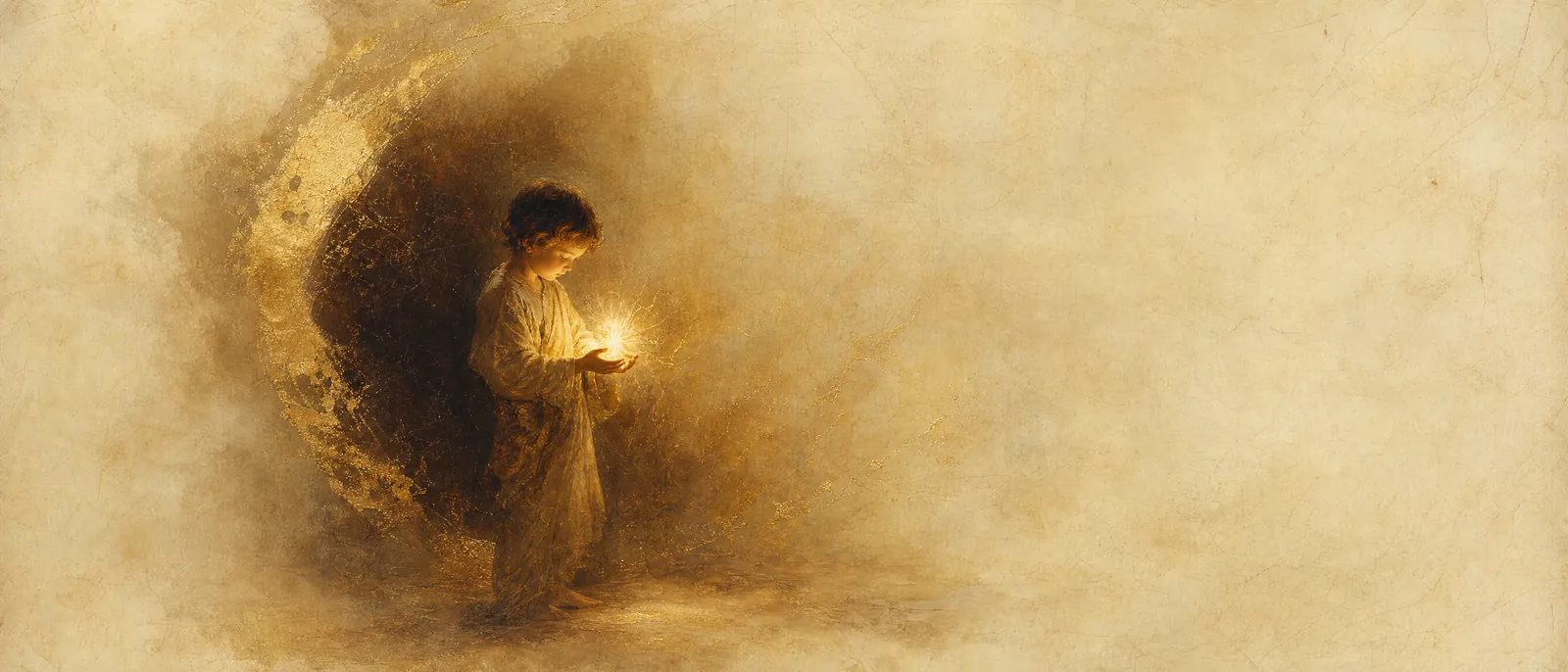
Uri — the light that builds
Uri means "my light" — and in the Torah it belongs not to a mystic but to a father, the man who stood one generation behind the master craftsman of the Mishkan. A name about illumination that arrives as work you can hold.
A Name That Points at Light and at Someone Who Owns It
Uri is a modern Israeli name, but its root is the oldest word in the Torah's vocabulary of creation: or, light, the very first thing God calls into being. Add the possessive yod and you get אורי — not "light" in the abstract, but my light. The grammar is the whole personality. This is not a name for the person who admires the sun; it is a name for the person who claims a piece of it and carries it around.
And the Torah, when it uses the name, does something quietly instructive. Uri is not a hero of his own chapter. He appears as a lineage marker — the father of Betzalel, the artisan filled with the spirit of God to build the sanctuary. The light-named man is positioned one generation behind the maker. That is the architecture of this soul: illumination that proves itself not in what it feels but in what it hands forward.
The Lived Pattern: Clarity That Finishes
People who carry this name tend to illuminate by making. Their brightness is not primarily verbal or emotional — it shows up as finished work. Ask them what they think and you may get a shrug; watch what they build and you'll see exactly what they meant. The clarity is real, but it routes through the hands.
This has a cost. Uri can struggle to be present as a person when there is no project underway — the light needs a workshop, a task, an object to land on, or it can feel dimmed and restless. Idleness reads as darkness to this temperament in a way it doesn't for others. And because the illumination is invested in output, an Uri can undervalue the ordinary human need to simply be seen without having produced anything first.
The gift, though, is rare and durable. Where others promise light, an Uri leaves it behind — installed, functional, usable by whoever comes next. Betzalel could build the place where the divine light dwelled precisely because his father was a man named for owned, transmissible light. The name describes a soul that treats clarity as inheritance: something you don't just possess, but pass down like tools.
Light as the End of Fear
There is a second register to this name, and it belongs to the season of return. The psalm read through the month of Elul opens on Uri's exact word: "The Lord is my light (ori) and my salvation — whom shall I fear?" The verse binds light to the dissolving of fear, and it does so in the possessive — my light, not the light. That is the same grammar as the name.
For someone called Uri, this is the deep instruction embedded in the letters: courage is not the absence of threat but the presence of an owned, carried source of clarity. Fear recedes not because the dark leaves but because the light is yours to hold.
Uri in the Classical Sources
In the sources, the name Uri (אורי) is read through its root or — light — and its possessive yod: not light seen, but light owned. Its gematria, 217, and its three anchoring texts each turn on the same idea, that illumination in this name is something carried, built, and inherited rather than merely admired.
EXODUS 31:2 — THE LIGHT-NAMED FATHER
"See, I have called by name Betzalel, son of Uri, son of Hur, of the tribe of Judah." This is the Torah's formal appointment of the artist who will build the Mishkan — and it introduces him by his lineage. Betzalel, the first person Scripture describes as filled with the spirit of God in wisdom and craft, is the son of a man named "my light."
The placement is the teaching. Uri does not build the sanctuary himself; he stands behind the one who does. The name for illumination sits one generation upstream of the illumination made concrete. This is the model for the whole personality: light that proves itself by what it produces in the next hands, not by what it displays in its own.
PSALMS 27:1 — LIGHT AS THE END OF FEAR
"The Lord is my light (ori) and my salvation — whom shall I fear?" The psalm recited throughout the month of Elul, the season of return, is built on this name's exact word. Light here is not decorative; it is the direct answer to fear.
Crucially, the verse uses the possessive — ori, my light — the same grammar embedded in the name Uri. The claim is that courage comes not from the disappearance of the dark but from an owned, carried source of clarity. To bear this name is to carry that instruction in the letters themselves.
BERAKHOT 7b — THE POSSESSIVE THAT CARRIES
The Talmud in Berakhot 7b, in its readings of how meaning attaches to words, illuminates the difference the possessive makes: not or, light in general, but ori — my light, a light claimed and held. The name Uri lives in that yod.
This is the source-level ground for the whole archetype. Light in this name is not observed at a distance; it is owned, carried, and — as Exodus shows — handed to the next generation like a workshop passed from father to son. The grammar insists that clarity, for an Uri, is property to be transmitted, not scenery to be watched.
THE LETTERS AND THE NUMBER
The gematria of Uri (אורי) is 217. That number carries a striking companionship: it is shared exactly with Devorah (דבורה), the prophet-judge whom tradition remembers as beginning her life's work as a maker of wicks for the sanctuary. Two figures whose stories orbit light — one named for owned light, one who literally fashioned the vessels that held the flame — meeting at a single number.
The pairing sharpens what the name already says. Both are light-workers whose illumination is practical, made, installed. Devorah's wicks and Uri's craftsman-son are two versions of the same idea: light that matters is light someone has done the work of making usable. At 217, the name keeps company with a maker.
The Talmud's principle shema garim — "the name causes" (Berakhot 7b) — is the tradition's claim that a name gently inclines its bearer. In this library, Uri's nearest companions are Ora and Lior; the full index is at Hebrew names.
What does the name Uri mean?
Uri (אורי) means "my light," from the Hebrew root or (אור) — the very first thing God creates in the Torah. The possessive form makes it personal: not light in general, but light claimed and carried.
What is the gematria of Uri?
The gematria of Uri (אורי) is 217. That value is shared exactly with Devorah (דבורה), the judge whom tradition remembers as a maker of wicks for the sanctuary — two light-workers meeting at one number.
Where does the word behind Uri appear in the Tanakh?
Uri is a modern Israeli name, but it appears in the Torah as the father of Betzalel, the master craftsman of the Mishkan (Exodus 31:2). Its root word, ori, "my light," also opens Psalms 27:1: "The Lord is my light and my salvation."
What does the name Uri say about personality?
Uri describes a soul that illuminates by making — whose clarity shows up as finished work rather than words. The gift is durable, transmissible light; the cost is a restlessness or dimness when there is no project underway to carry it.
What do the sources say about Uri?
Exodus 31:2 places Uri as the father of the sanctuary's builder, framing light as lineage. Psalms 27:1 uses the name's exact word to link light with the end of fear, and Berakhot 7b highlights the possessive — light owned and carried, not merely observed.
Why is Uri connected to building rather than just light?
Because in the Torah the name belongs to the father of Betzalel, the first person called filled with the spirit of God in wisdom and craft (Exodus 31:2). The light-named man stands one generation behind the maker — a pattern in which illumination proves itself as inherited, usable work.