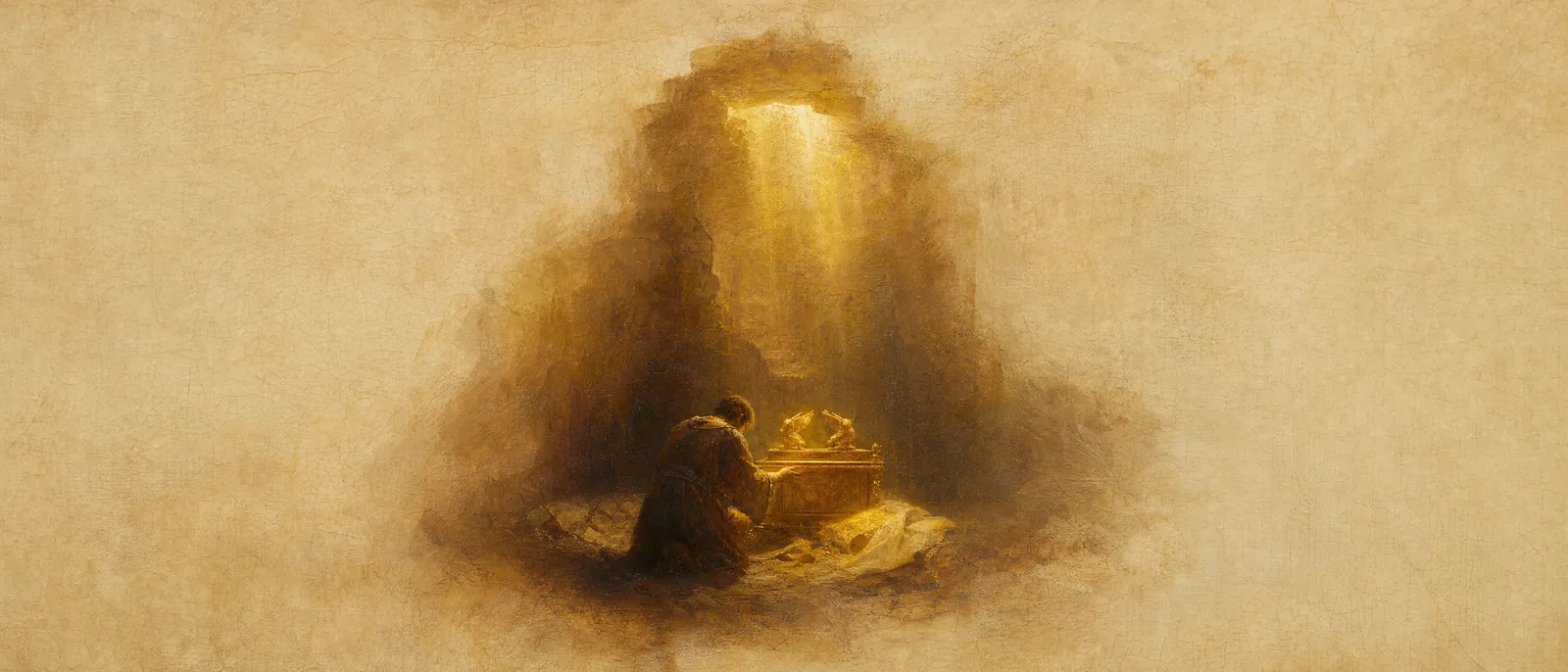
Yocheved — the mother of the three deliverers
Yocheved is the name at the head of the Exodus's cast list that almost no one repeats — the mother of a prophetess, a priest, and a lawgiver, whose most consequential act was watching a basket float away.
The Name That Precedes Every Famous Name
Yocheved, יוכבד, breaks into two pieces that argue with each other in the best way: Yah, the divine Name, and kavod, honor or weight or glory. 'The Lord is honor.' It is a theology compressed into a signature — the claim that whatever weight this world assigns, the real one comes from elsewhere. And it is given to a woman who would spend her life producing weight she would never be credited with carrying.
She is the mother of Miriam, Aharon, and Moshe — the prophetess, the priest, and the lawgiver. Three children, three institutions of a people. No other parent in the Tanakh has that résumé. And yet her name is the one you have to look up. This is the architecture the name describes: not the deliverer but the one who delivers the deliverers, and then steps out of the frame.
The Unphotographed Founder
People who carry this name tend to be the ones whose children's, or students', or company's names are famous because of decisions no one witnessed. The pattern is not modesty as performance — it is a genuine reorientation of where the honor lives. Yocheved names a soul that measures success in what walked out the door and thrived, not in what got attributed back.
The cost is real and worth naming. To be the unphotographed founder is to be constantly underestimated in the room and constantly essential outside it. There is a particular loneliness to raising something bigger than your own reputation — to knowing that the story will be told with your name as a footnote. Yocheved-people either make peace with that arithmetic or are quietly wounded by it for years. The name does not promise recognition. It promises consequence.
The Basket and the Decree
Her defining act was disobedience dressed as surrender. Pharaoh decreed that every Hebrew boy be drowned in the Nile. Yocheved hid her son three months, and when hiding failed, she did the strange, defiant thing: she put him in the very river that was meant to kill him — waterproofed, aimed, and let go. She used the instrument of death as a vehicle of rescue.
This is the deepest grammar of the name. Yocheved-people rarely fight decrees head-on. They find the seam in the decree, the loophole in the machinery, the way to comply in form while overturning it in substance. It looks like yielding. It is the opposite. The honor of the name lives in that quiet, technical, world-changing refusal to accept that the water only takes.
What Survives the Silence
The tradition remembers that when Moshe was born the house filled with light — the sign that this hidden birth was a hinge of history. But Yocheved could not have known that in the moment. She acted in the dark, on hope, before any of it was confirmed. That is the final truth of the name: it belongs to those who build on faith rather than on evidence, who keep honor alive in the slave quarters when nothing suggests it will ever be redeemed. The redemption came. Her name stayed small. Both things are the story.
Yocheved in the Classical Sources
In the sources, the name יוכבד — a compound of the divine Name Yah and the word kavod, honor — sits at a strange crossroads of prominence and obscurity. Its gematria is 42, a number the tradition treats as belonging to a hidden Name; fitting, for a woman the tradition treats as its most hidden mother. Three anchors carry her: a genealogy verse, a Talmudic birth-story, and a teaching about what a name garims — what it draws down into a life.
EXODUS 6:20 — THE LINEAGE VERSE
Exodus 6:20 records the marriage that produced Aharon and Moshe, and it names Yocheved as their mother. It is a genealogy verse — the kind readers skim — and that is precisely its power. The entire cast of the Exodus, the plagues, the sea, the Sinai revelation, threads back through this one quiet name lodged in a list.
The verse does not editorialize. It does not call her righteous or brave. It simply establishes the fact of her, at the head of everything that follows. The name's whole disposition is in that placement: essential, foundational, and stated without fanfare.
SOTAH 12a — THE HOUSE FILLED WITH LIGHT
Sotah 12a gives the Sages' expansion of Moshe's birth: Yocheved's defiance of Pharaoh's drowning decree, the concealment of the child, and the striking detail that the house filled with light at his birth — a sign that this hidden act carried the weight of the world. The Talmud dwells on the basket she waterproofed and set upon the Nile, the instrument of death repurposed into a vessel of rescue.
What the passage preserves is the texture of hope acting without proof. She did not know how it would end. The light in the house is the tradition's way of saying that some acts of quiet defiance are luminous long before history confirms them — and that the person performing them usually cannot see the glow.
BERAKHOT 7b — A NAME DRAWS ITS LIFE
Berakhot 7b teaches shema garim — that a name influences, even generates, the trajectory of the one who bears it. Applied to Yocheved, whose name declares 'the Lord is honor,' the teaching lands with unusual precision. She is the woman the tradition credits with keeping honor — kavod — alive in the slave quarters of Egypt, where honor had every reason to die.
The principle suggests the name was not decorative but directive. A life spent insisting that true weight comes from the divine, not from Pharaoh's recognition, is a life that lived out its own name. Berakhot 7b lets us read that not as coincidence but as vocation.
THE LETTERS AND THE NUMBER
The gematria of Yocheved is 42. The kabbalists know 42 as the number of the hidden Name embedded in the Ana B'Koach prayer — one of the tradition's most guarded and consequential divine Names, associated with acts of concealment and creation. That the number falls to a woman whose entire greatness was hidden, whose name means 'the Lord is honor,' is a resonance the tradition treats as anything but accidental.
A hidden-Name number for the tradition's most consequential hidden mother: it names a soul whose work is done out of sight and whose weight is measured only later, by what it produced. The 42 does not announce itself. Like Yocheved, it is powerful precisely because it stays concealed.
The Talmud's principle shema garim — "the name causes" (Berakhot 7b) — is the tradition's claim that a name gently inclines its bearer. In this library, Yocheved's nearest companions are Miriam and Moshe; the full index is at Hebrew names.
What does the name Yocheved mean?
Yocheved (יוכבד) means 'the Lord is honor,' combining the divine Name Yah with the word kavod, meaning honor, weight, or glory. It is the theological claim that true honor comes from God rather than from human recognition — fitting for a woman whose greatness went largely uncredited.
What is the gematria of Yocheved?
The gematria of Yocheved is 42. The kabbalists know 42 as the number of the hidden Name of the Ana B'Koach prayer — a hidden-Name number for the tradition's most consequential hidden mother.
Where does Yocheved appear in the Tanakh?
Yocheved is named in Exodus 6:20 as the mother of Aharon and Moshe, at the head of the Exodus's entire genealogy. The Talmud in Sotah 12a expands her story, recounting her defiance of Pharaoh's decree and the hiding of Moshe in a basket on the Nile.
What does the name Yocheved say about personality?
The name describes the unphotographed founder — the one whose children's or projects' names become famous because of choices no one saw her make. Yocheved-people build things larger than their own reputations and measure success by what thrives after leaving their hands, often at the cost of recognition.
What do the sources say about Yocheved?
Exodus 6:20 places her at the head of the Exodus lineage; Sotah 12a records the house filling with light at Moshe's birth and her defiance of the drowning decree; and Berakhot 7b's principle that a name shapes a life fits a woman credited with keeping honor — kavod — alive in the slave quarters of Egypt.
Why is Yocheved called the mother of the three deliverers?
She bore Miriam the prophetess, Aharon the priest, and Moshe the lawgiver — three figures who together carried the redemption of a people. No other parent in the Tanakh has that record, yet her own name remains the quiet one you have to look up, which is the whole point of the name's soul-theme.