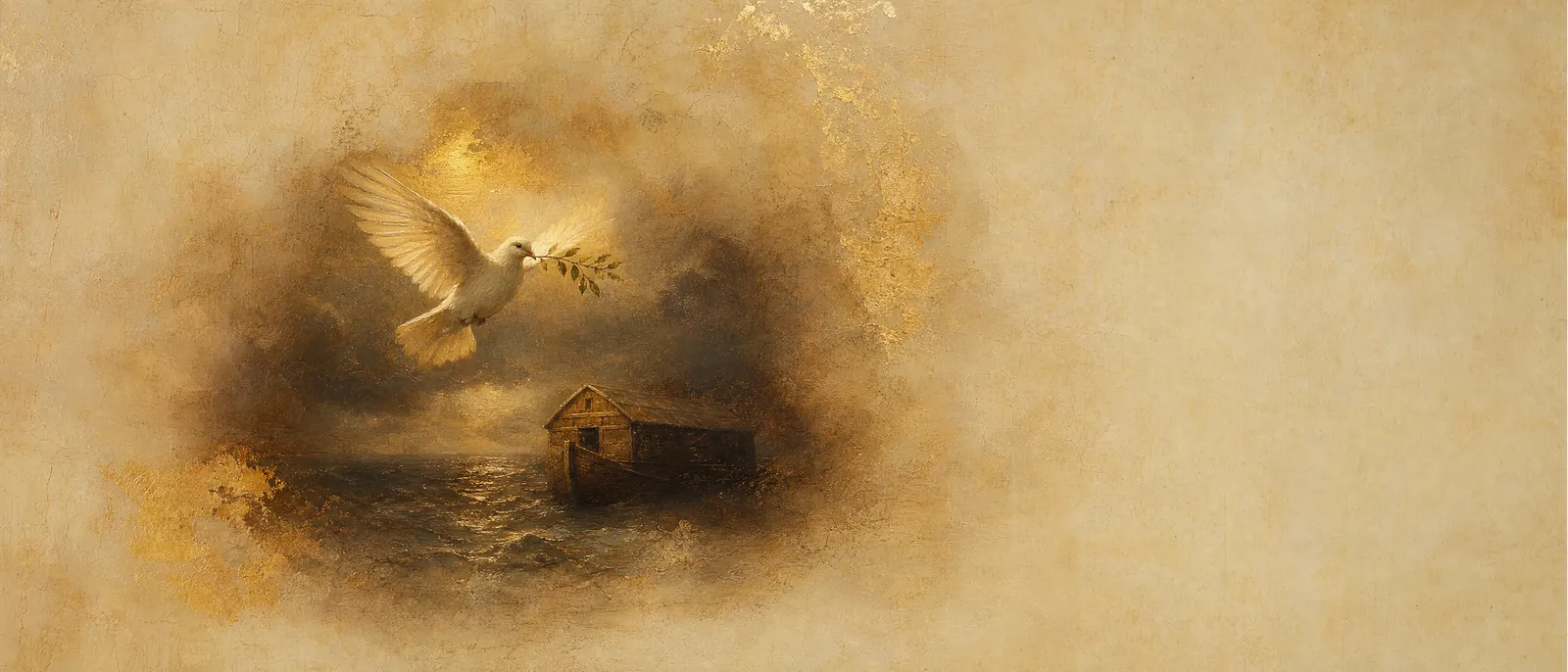
Yona — the reluctant messenger the sea returned
A dove and a prophet share one name — the bird that came back to the ark, and the man who ran from his errand until the sea carried him home. Yona is the Torah's name for return, and return is not always tender.
The Bird Sent Out
Before Yona was a prophet, Yona was a bird. In the flood story, Noach releases a dove over a drowned world and waits; it returns with a plucked olive leaf, and that leaf becomes the oldest image of peace the human imagination keeps. The dove is defined by a single motion — it goes out and it comes back. It is not a raven, sent once and lost to the ruin. It is the creature engineered for return, homing across water to the hand that let it go.
This is the architecture the name carries. Yona is not the story of leaving; it is the story of the arc that brings you back. People who bear this name often live inside that arc — flung outward by circumstance or their own flight, and drawn, sometimes against their will, toward the place they were meant to be all along.
The Prophet Who Ran
The Book of Jonah gives the name its hardest and most honest chapter. Called to Nineveh, the prophet does the opposite of a dove: he flees, boards a ship in the wrong direction, and tries to put a sea between himself and his errand. The storm comes. He is thrown overboard, swallowed, and — this is the point — returned. The fish delivers him to dry land and the errand is still waiting, unchanged, as if the whole detour were merely the long way to the same door.
This is the tension inside Yona: the calling and the resistance to it are equally real. The name does not promise a willing servant. It describes someone who circles the thing they are for, argues with it, tries the boat and the sea and the belly of the fish — and lands, at last, on the shore they were headed toward before they ever ran. The reluctance is not a flaw in the story. It is the story.
The Lived Pattern
Watch a Yona choose a life and you often see the delay first. The gift is obvious to everyone but the bearer, who tries several wrong directions with real conviction. There is a cost to this: years spent on the boat, energy poured into flight, the exhaustion of resisting a pull that does not weaken. But there is also a grace in it — a Yona who arrives at the calling by way of the storm holds it differently than one who never questioned. They know exactly what the running cost.
The tradition's mercy is that the errand keeps. Nineveh does not close its gates while the prophet sulks in the deep. The point of the whole book — read at the exhausted end of Yom Kippur — is that the Sender's patience outlasts the messenger's resistance, and that mercy, in the end, is the thing being defended. A Yona is rarely early. But a Yona, having gone the long way around, tends to bring the olive leaf back in their mouth.
Yona in the Classical Sources
In the sources, יונה (Yona) — the dove — is read as the emblem of the soul and of Israel itself: gentle, homing, faithful to a single mate. Its gematria is 71. The Song of Songs speaks the word 'my dove' as a term of intimate address, and the tradition hears in the name both the bird of the flood and the prophet who could not outrun his God.
JONAH 1:1 — THE PROPHET WHO FLED
The Book of Jonah opens with a call and an immediate evasion: the word of God comes to Yona, and Yona rises — to flee. What follows is the storm, the lots, the sea, and the great fish, and then the errand resumes exactly where it was abandoned. The book is read on Yom Kippur afternoon precisely because its subject is mercy: not the prophet's, whose heart stays hard toward Nineveh, but God's, whose compassion extends even to a city of the ignorant and their cattle.
For the name, this is the defining text. Yona is the archetype of the messenger who resists the message and is delivered to it anyway — proof that the calling is not cancelled by the flight, only postponed by it. The bearer of this name inherits both the running and the return.
GENESIS 8:11 — THE OLIVE LEAF
The name's first bearer is not a man but a bird. Noach sends the dove from the ark, and it returns with a freshly plucked olive leaf in its beak — the sign that the waters have receded and life has begun again above the drowned world. This is the tradition's original image of peace carried back from ruin, and the dove is its bearer.
The verse gives the name its deepest layer: Yona means the creature that returns bearing evidence of hope. Where the raven flew off and did not come back, the dove came home. To be named for the dove is to be named for the arc of return itself — the motion that turns a flood into a beginning.
BERAKHOT 7b — THE NAME INCLINES
The Talmud in Berakhot 7b teaches shema garim — that a name inclines its bearer, exerting a gentle pull on the shape of a life. The dove-named prophet is a living demonstration: Yona learns the dove's own lesson, that there is no shore beyond the Sender's reach, no sea distant enough to make the errand disappear.
Read against the name, the passage suggests that a Yona is inclined toward return even when inclined to flee. The two impulses live in the same soul. The name does not force the calling — it bends the bearer toward it, patiently, the way water bends a swimmer back toward land.
THE LETTERS AND THE NUMBER
The gematria of יונה is 71. In the tradition the dove is the emblem of the soul and of Israel itself — gentle, homing, faithful to a single mate — and the Song of Songs speaks the tender word 'my dove' as if it were a name, an address of intimacy rather than description.
This is the quality folded into the letters: fidelity and return. The dove is bound to one mate and one home, and finds its way back across impossible distance. A name built on that bird carries the same signature — an attachment that outlasts wandering, a homing instinct that no storm fully erases.
The Talmud's principle shema garim — "the name causes" (Berakhot 7b) — is the tradition's claim that a name gently inclines its bearer. In this library, Yona's nearest companions are Eliyahu and Chaim; the full index is at Hebrew names.
What does the name Yona mean?
Yona (יונה) means 'dove' — specifically the bird of the flood's olive branch, sent from Noach's ark and returning with a plucked olive leaf (Genesis 8:11). It is also the name of the prophet Jonah, making it the Torah's name for return and reluctant calling both.
What is the gematria of Yona?
The gematria of יונה is 71. In the tradition the dove is the emblem of the soul and of Israel — gentle, homing, faithful to one mate — the Song of Songs' 'my dove' spoken as a name.
Where does Yona appear in the Tanakh?
Yona first appears as the dove Noach releases from the ark in Genesis 8:11, and again as the prophet in Jonah 1:1 — the book of the flight, the storm, and the great fish, read every Yom Kippur afternoon. The dove is also the beloved's name in the Song of Songs.
What does the name Yona say about personality?
Yona describes a soul built around the arc of return — someone often flung outward, or fleeing, before circling back to the calling they were made for. There is real reluctance in the pattern, and a real homing instinct that outlasts it; the running has a cost, but the arrival is held all the more deeply for it.
What do the sources say about Yona?
Genesis 8:11 gives the dove of return, Jonah 1:1 gives the prophet who fled and was delivered to his errand anyway, and Berakhot 7b teaches shema garim — that a name inclines its bearer. Together they cast Yona as the messenger drawn home across any sea.
Why is the Book of Jonah read on Yom Kippur?
The book is read on Yom Kippur afternoon because its true subject is mercy — not the prophet's, whose heart stays hard, but God's compassion on Nineveh and even its cattle. For a bearer of the name, it is the reminder that the errand waits and the Sender's patience outlasts the messenger's resistance.