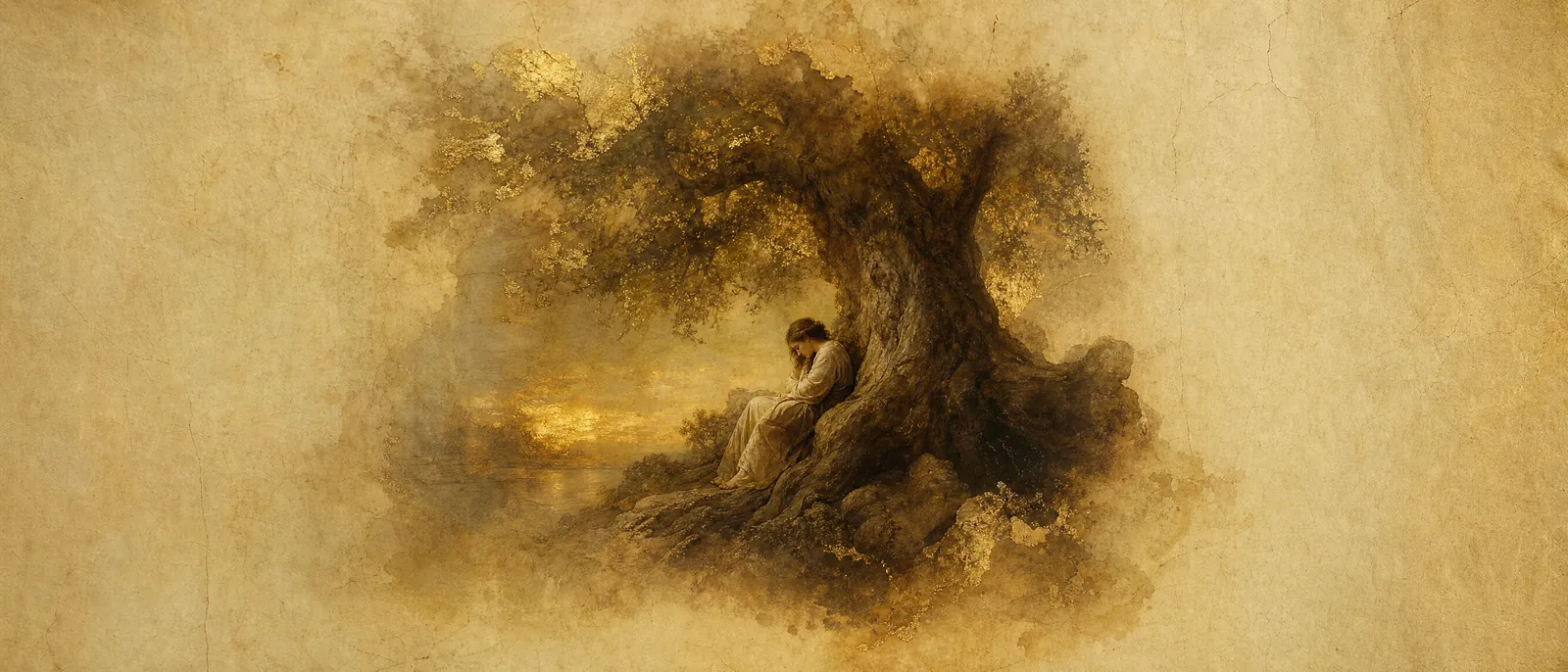
Alon — the deep-rooted witness
Alon is the oak: the Tanakh's tree of endurance, and the address where a family's grief was buried. Its strength is underground, in roots that outlast whatever weeps beneath the branches.
The Tree That Holds the Grief
Alon is a modern Israeli name, but the word is old as the landscape. It means oak — not the ornamental kind, but the massive, slow, immovable tree that becomes a landmark, the one you give directions by. In the Tanakh the oak is where things are buried and remembered. When Devorah, Rivkah's nurse, died, they laid her beneath an oak and named the place Alon Bachut, 'the oak of weeping.' The tree was strong enough to become the address of a household's sorrow.
This is the first thing to understand about the name: its strength is not decorative and it is not loud. An oak's power is underground, in a root system wider than the crown, older than the person standing beneath it. People named Alon tend to carry that shape — steady above, vast below. They are the ones others grieve against and grow against, the fixed point in a moving family.
Strength Measured by What Leans On It
There is a particular loneliness to being the stable one. The oak does not get to weep; it gets wept beneath. People with this name often find themselves cast as the load-bearing member — the sibling who absorbs, the friend who holds, the colleague whose calm is treated as infinite because it has never yet run out. That is a real gift and a real cost, and the honest version of this name names both.
The word carries strength's name inside it: אלון shares its first two letters with El. It is as if the tree were a quiet theology of the landscape — power planted, silent, doing its work in the dark of the soil. An Alon's task is rarely to perform strength. It is to be reliable long enough that reliability becomes a kind of shelter.
The Long View
Oaks are measured in decades, not seasons. This is the temperament the name describes: patience that can look like slowness, loyalty that can look like stubbornness, a refusal to be hurried by whatever is anxious around it. The shadow side is rigidity — roots so deep the tree cannot be moved even when moving would be wise, grief held so long it petrifies into silence.
The prophet Isaiah reframes exactly this. He promises that mourners will be called oaks of righteousness — that the ones who have held the most sorrow become the strongest trees, not despite the weeping but through it. For an Alon, that is the arc worth trusting: endurance is not the absence of grief. It is grief grown into a shape that shelters other people.
Alon in the Classical Sources
In the sources, the oak — אלון, alon, with a gematria of 87 — is never just scenery. It is the Tanakh's chosen image for endurance that has absorbed loss, the tree strong enough to be a burial place and, later, a prophet's metaphor for the redeemed. Three passages trace the name from grief to righteousness to the slow arithmetic of growth.
GENESIS 35:8 — ALON BACHUT, THE OAK OF WEEPING
When Devorah, Rivkah's nurse, dies, the Torah pauses to bury her beneath an oak below Beit-El, and the place is named Alon Bachut — 'the oak of weeping.' It is a striking choice: a tree becomes the marker of a household's sorrow, the fixed landmark that holds what was lost.
The verse gives the name its founding gesture. An oak is strong enough to be the address of grief without being consumed by it. People named Alon inherit that posture — the ones beneath whom others come to mourn, the steady place a family locates itself around.
ISAIAH 61:3 — OAKS OF RIGHTEOUSNESS
Isaiah promises that those who mourn in Zion will be given beauty for ashes, and that they shall be called eilei hatzedek — 'oaks of righteousness, the planting of the Lord.' The prophet takes the very tree of weeping and turns it into the emblem of the redeemed.
This is the redemptive turn inside the name. The oak does not become strong by avoiding sorrow; it becomes strong through having held it. For an Alon, the promise is that endurance under grief is not a burden to escape but the raw material of a righteousness others will lean on.
BERAKHOT 7b — SHEMA GARIM, THE NAME THAT SHAPES
The Talmud in Berakhot 7b teaches shema garim — that a name has causal weight, that what you are called shapes what you become. An oak-name is a slow name: it measures growth in decades and strength in what it can bear the weight of.
Read through this teaching, Alon is less a description than an assignment. The name asks its bearer to grow the long way, to become the kind of steady presence that others can rest against — strength defined not by height but by what it lets lean on it.
THE LETTERS AND THE NUMBER
The gematria of אלון is 87. The count matters less than what the letters spell before they add: the word opens with alef and lamed — the letters of El, one of the names of God. Strength's name sits inside the tree's own name, at its root.
That is the quiet theology of the oak as a name: power planted rather than displayed, the sacred hidden in the ordinary landmark of a landscape. An Alon carries El in the first syllable of who they are — steadiness that points past itself.
The Talmud's principle shema garim — "the name causes" (Berakhot 7b) — is the tradition's claim that a name gently inclines its bearer. In this library, Alon's nearest companions are Eitan and Tomer; the full index is at Hebrew names.
What does the name Alon mean?
Alon (אלון) means 'oak' — the Tanakh's tree of strength and long endurance. It is a modern Israeli name rooted in a biblical word for the massive, slow-growing tree that becomes a landmark and, in Genesis, a burial place and marker of grief.
What is the gematria of Alon?
The gematria of Alon (אלון) is 87. Notably, the word opens with the letters alef and lamed — the same two letters that begin El, a name of God, so that strength's name sits hidden inside the tree's own name.
Where does the word Alon appear in the Tanakh?
The oak appears at Genesis 35:8, where Devorah, Rivkah's nurse, is buried beneath one and the place is named Alon Bachut, 'the oak of weeping.' Isaiah 61:3 uses the same image, promising that mourners will be called eilei hatzedek — 'oaks of righteousness.'
What does the name Alon say about personality?
Alon describes a deep-rooted, load-bearing temperament — the steady one others grieve and grow against. Its strength is underground and patient, measured in decades; its shadow can be rigidity or grief held so long it hardens into silence.
What do the sources say about Alon?
Genesis 35:8 makes the oak the address of a family's grief; Isaiah 61:3 turns mourners into 'oaks of righteousness'; and Berakhot 7b's teaching of shema garim frames the oak-name as an assignment to grow the long way. Together they trace endurance from sorrow to shelter.
Why is Alon associated with grief as well as strength?
Because in Genesis 35:8 the first named oak is Alon Bachut, 'the oak of weeping,' where Devorah was buried. The name holds both truths at once: the tree is strong enough to be wept beneath, and Isaiah 61:3 promises that this very endurance becomes righteousness.