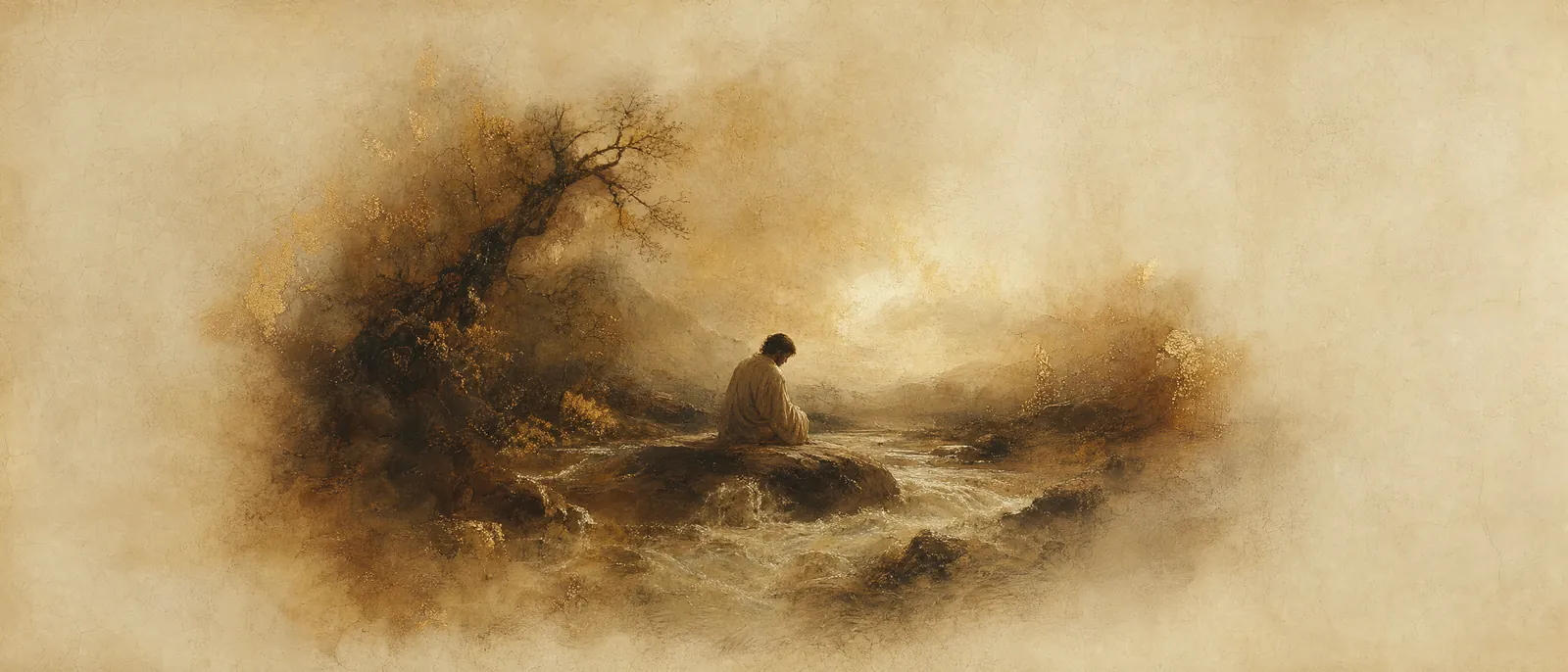
Eitan — the steady one the flood cannot move
Eitan is not a name that describes a person so much as a condition the person is asked to keep: to be the thing that lasts when everything around it thins out. It is a modern Israeli name built from an old Torah word — the word for a river that flows in drought, for the sages on whom everything after rests.
A Word Before a Name
Eitan is a modern Israeli name, but the word underneath it is ancient, and it carries a job description. In the Torah, eitan is not primarily a compliment about strength — it is a category of thing that lasts. The nachal eitan is the stream that keeps flowing when the seasonal riverbeds have cracked to dust. To be called Eitan, then, is to be named after the property of not drying up.
This is worth sitting with, because it separates Eitan from the many names that mean brave or mighty. Those are about force in a moment. Eitan is about presence across time. The mightiness here is the mightiness of the reliable — the person who is still there next season, next crisis, next decade, running at the same steady rate while flashier tributaries come and go.
The Fixed Point
People who carry this name tend to become the fixed point in their circle — the one whose consistency everyone else quietly organizes around. They are rarely the loudest voice in the room. They are the voice you check against when you want to know whether something is true, because they don't shade their answer to the weather of the day. Friends borrow their stability the way a town borrows the perennial stream: without much ceremony, and without always noticing they are doing it.
The Sages stretch eitan even further, using it for the patriarchs themselves — the 'mighty ones' on whom everything after rests. That is a foundation word, and Eitan wears a foundation word as a first name. A foundation does its work invisibly and takes the load. It is what everything is built on top of, and it is only really noticed when it fails.
The Cost of Being the Bedrock
The gift is obvious. The cost is quieter, and it is real. When you are the one who never dries up, people stop asking whether you are running low. Eitan's steadiness can become a demand that never turns off — the assumption that this person will absorb, hold, and keep flowing regardless of the season they are personally in. The perennial stream in Amos is a metaphor for justice, but a real stream is fed by a source, and even bedrock needs to be replenished.
The healthy version of this name learns that endurance is not the same as never resting. It flows in drought because it is fed underground, not because it refuses to acknowledge dry seasons. The unhealthy version confuses steadfastness with silence — carrying everyone's weight without ever admitting the weight is heavy, until the foundation quietly cracks where no one is looking. Eitan's work is to stay the stream that flows in summer without pretending summer isn't hard.
Endurance as a Key
There is a musical dimension to this name that shouldn't be missed. Eitan haEzrachi is credited by tradition with a psalm that opens by committing to sing of God's kindness forever. That is endurance rendered as a musical key — not a grim holding-on, but a sustained, generous note. The best of this name is not merely durable. It is durable and warm: the kind of constancy that others find themselves singing along to, because it gives them something to stand on.
Eitan in the Classical Sources
In the sources, the Hebrew איתן (eitan) is less a description than a standard — a word the tradition uses for whatever endures when other things fail. Its gematria is 461. Read across the Tanakh and the Talmud, eitan moves from the name of a singer, to the image of a river, to a standing instruction for how to live.
PSALMS 89:1 — THE STEADFAST SINGER
Tradition attributes this psalm to Eitan haEzrachi, and its opening line sets the tone for the whole name: a commitment to sing of God's kindness forever. The word forever is the point. This is not a burst of praise but a sustained one — endurance rendered as a musical key.
That the tradition attaches this enduring voice to a man literally named Eitan is fitting. The name and the psalm agree: the highest form of steadiness is not stubbornness but a long, warm note held past the moment it was easy to sing.
AMOS 5:24 — THE PERENNIAL STREAM
Amos delivers one of the Tanakh's great demands: 'Let justice roll like water, and righteousness like a nachal eitan — a perennial stream.' The prophet is precise in his image. He does not ask for a flash flood. He asks for the river that doesn't dry in summer.
This is the beating heart of the name. Eitan is the word for goodness that survives the dry season — the kindness that keeps running when it would be easy, and even reasonable, to stop. It sets the bar not at intensity but at constancy.
BERAKHOT 7b — A STANDING INSTRUCTION
In the spirit of the Talmud's teaching that shema garim — the name shapes the one who carries it — eitan reads as a standing instruction rather than a static label. To bear it is to be told, quietly and repeatedly: be the stream that flows in drought.
The kindness that doesn't depend on the season — that is the assignment folded into the name. It is not a prediction that its bearer will be steady, but an invitation to become the kind of person others can build on.
THE LETTERS AND THE NUMBER
The gematria of איתן is 461. The number is best read here not as a hidden code but as a fixed marker — a single, unchanging value for a word that means the unchanging.
The Sages also use eitan for the patriarchs themselves — the 'mighty ones' on whom everything after rests. That is the deepest layer of the name: it is a foundation word, a term for whatever bears the load beneath. Worn as a first name, it asks its bearer to be bedrock — present, load-bearing, and largely uncelebrated for it.
The Talmud's principle shema garim — "the name causes" (Berakhot 7b) — is the tradition's claim that a name gently inclines its bearer. In this library, Eitan's nearest companions are Alon and Boaz; the full index is at Hebrew names.
What does the name Eitan mean?
Eitan (איתן) means steadfast and enduring. Its root is the Torah's word for a perennial river — the nachal eitan — the stream that keeps flowing when seasonal riverbeds run dry, as in Amos 5:24.
What is the gematria of Eitan?
The gematria of איתן is 461. Fittingly for a word that means enduring, it stands as a single fixed value — a constant number for the idea of constancy.
Where does the word Eitan appear in the Tanakh?
Eitan is a modern Israeli name built from a Torah word. It appears as the name of Eitan haEzrachi, credited by tradition with Psalm 89, and as the image nachal eitan — a perennial stream — in Amos 5:24.
What does the name Eitan say about personality?
Eitan tends toward being the fixed point in a circle — the reliable one whose consistency others quietly build on. The strength is steadiness across time rather than force in a moment; the cost is that people stop checking whether the steady one is running low.
What do the sources say about Eitan?
Psalm 89 casts it as endurance rendered as song, Amos 5:24 as justice that flows like a river that never dries, and the spirit of Berakhot 7b (shema garim) reads it as a standing instruction: be the stream that flows in drought.
Why is Eitan connected to the patriarchs?
The Sages use eitan — 'mighty ones' — for the patriarchs themselves, the foundation on whom everything after rests. To carry Eitan is to wear a foundation word as a first name: to be asked, quietly, to be the bedrock others stand on.