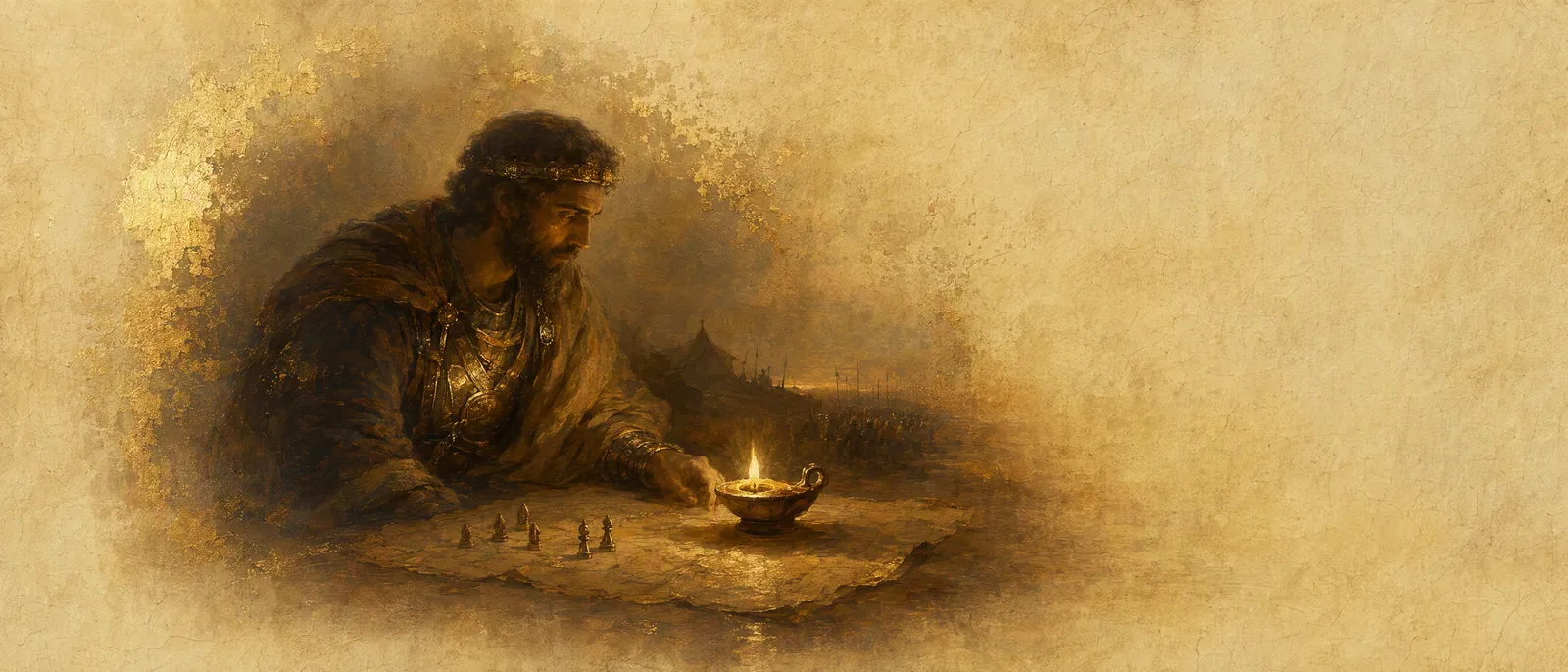
Avner — the loyal strategist
A name built from light and fatherhood, carried by the soldier who kept a falling house standing. Avner is the architecture of the person who holds the line for others — and who must one day learn whether the line is worth holding.
The Name and Its Light
Avner — אבנר — joins two of the oldest words in Hebrew: av, father, and ner, the lamp or flame. 'Father of light' is the accepted reading, and it is a strangely tender name for a man whose life was spent in the field of war. The light here is not radiance for its own sake; it is the steady lamp someone keeps burning so a household does not go dark.
That is the quiet promise of the name. An Avner is the one who keeps the flame for others, often at hours when everyone else has gone to sleep. The cost is hidden inside the gift: the keeper of the light rarely gets to sit in its warmth.
The Man Who Held the Kingdom
In the books of Samuel, Avner ben Ner is the captain of King Saul's army and his kinsman — the strongest sword in a collapsing house. When Saul and his sons fall on Mount Gilboa, it is Avner who refuses to let the dynasty die. He takes Saul's surviving son, Ish-bosheth, crowns him, and effectively runs the northern kingdom himself. He is not the king. He is the man holding the king up.
For years Avner sustains a regime that has already lost its mandate, while David's house grows stronger in the south. The narrative is honest about the strain: he is propping up a throne whose legitimacy he, of all people, must privately doubt. Eventually a quarrel with Ish-bosheth breaks the spell, and Avner makes the great decision of his life — he opens negotiations to bring the whole northern kingdom over to David.
He never sees it through. Yoav (Joab), David's own commander, lures Avner aside at Hebron and kills him — partly in revenge for a brother slain in battle, partly because a unified kingdom under Avner's brokering would have threatened Yoav's place. David mourns publicly: 'Should Avner die as a fool dies?' The man who tried to unite a nation was murdered for the attempt.
The Lived Pattern
Avner held a kingdom together — and was killed for trying to unite it. People who carry this name often feel responsible for holding things together that aren't actually theirs to hold: a family that won't reconcile, a team whose leadership has checked out, a friend's life that keeps falling apart. They become the structural beam in rooms they never agreed to support.
The loyalty is real and it is admirable. But it can calcify. An Avner can spend years defending a cause out of duty long after the cause has stopped deserving the defense — keeping the lamp lit in a house that should have been let go. The strategic mind that makes them so good at sustaining things can also keep them from asking the harder question: is this still mine to carry?
The Work of an Avner
The real work of this name is the transfer. Avner's most courageous act was not the years of holding Ish-bosheth's throne — it was the decision to move his loyalty to the cause that actually deserved it, even knowing the move would cost him. He chose the right kingdom over the comfortable one. That he was killed before completing it does not make the choice wrong; it makes it tragic.
For a living Avner, the lesson lands like this: loyalty is a virtue only when it is pointed at something worthy. Knowing when to stay and when to transfer — and being willing to pay for the transfer — is the difference between a steady flame and a beam that crushes the one holding it. The light was always meant to be carried somewhere, not just guarded in place.
Strategy as Temperament
With a gematria of 253, the name belongs to people who think two moves ahead almost involuntarily. Avners read rooms, anticipate collapse, and quietly position themselves where the structure is weakest — because that is where they assume they're needed. They are often the most reliable person in any system and the least thanked.
The gift matures when the strategist learns to aim that foresight at their own life, not only at everyone else's. The same mind that can save a kingdom can, turned inward, finally ask whether this particular kingdom is the one worth saving.
Avner in the Classical Sources
The name is אַבְנֵר (Avner), gematria 253, and it is a name you can read at sight: av + ner — "father of the lamp," or "my father is a lamp." In Scripture the reading is almost literal — Avner's father was actually named Ner, "lamp" — so the son carried a light in his name his whole life. The sources' interest in him is the interest reserved for strong men who stand next to thrones rather than on them.
Where the Tanakh Gives the Name
Avner enters the record in the census of Shaul's court: "and the name of the captain of his host was Avner, the son of Ner, Shaul's uncle." He is the kingdom's military spine — the man who brings young David to Shaul after Goliath falls, who guards the king's camp, and who, after Shaul's death, single-handedly holds a rival kingdom together for the fallen house. Nearly every scene he appears in is a scene of someone else's crown.
The Sages on Avner
When Avner was killed, David stood at the grave and cried out the line the Talmud never forgot: "Do you not know that a prince and a great man has fallen this day in Israel?" The Sages in Sanhedrin take his greatness as given — and then conduct the audit: a man of that stature, they say, is judged by the moments he stayed silent when his voice would have turned history. Their Avner is the tradition's permanent lesson on strength adjacent to power: the lamp in his name was real, and the question the Sages leave open is whether he raised it high enough.
The Letters and the Number
Alef–bet–nun–resh: the name opens with the alphabet's own first two letters — av, father, the word of origin — and closes with נֵר, the lamp. A name structured as inheritance: what the father is, the son carries forward as flame. Its gematria, 253, carries a quiet structural elegance: it is the sum of the numbers 1 through 22 — the count of every position in the twenty-two-letter alef-bet added together. A name that totals the whole alphabet's ladder, rung by rung, for a man whose life was spent holding a kingdom's whole structure on his shoulders.
What a Name Does
The Talmud in Yoma relates that Rabbi Meir would examine names — davak b'shma, he attended to what a person was called — because a name, rightly read, forecasts something of its bearer's road. Avner is a name Rabbi Meir could have taught from: the lamp-name of a man whose whole story is about where light gets pointed. His story runs beside two others in this library — David, who eulogized him, and Yonatan, the other great figure of Shaul's house. The full index is at Hebrew names.
What does the name Avner mean?
Avner (אבנר) combines av, 'father,' with ner, 'lamp' or 'light,' giving the accepted meaning 'father of light.' It evokes someone who keeps a steady flame burning for others — protection and constancy rather than spectacle.
What is the gematria of Avner?
The gematria of אבנר is 253. It marks a temperament of structure and foresight — the strategist who holds systems together and reads collapse before others see it.
Who was Avner in the Tanakh?
Avner ben Ner was the commander of King Saul's army and Saul's kinsman, in the books of Samuel. After Saul's death he sustained the northern kingdom through Saul's son Ish-bosheth, then moved to unite Israel under David — and was killed at Hebron by Yoav (Joab) before the union was complete. David mourned him openly.
What does the name Avner say about personality?
Avners tend to be loyal, strategic, and quietly indispensable — the ones who hold things together. Their growth lies in discerning which causes deserve that loyalty, and in being willing to transfer their devotion to what's truly worthy, even when the transfer costs them.
Where does the name Avner appear in the Tanakh?
Avner (אבנר) enters in I Samuel 14:50 as Avner ben Ner, captain of King Shaul's army. His father was literally named Ner ('lamp'), so the name reads as 'father of the lamp' — a light carried in the name itself.
What does the Talmud say about Avner?
Sanhedrin 20a preserves David's eulogy — 'a prince and a great man has fallen this day in Israel' — and the Sages' audit of his greatness: a man of that stature is judged by the moments he stayed silent when his voice could have changed history.