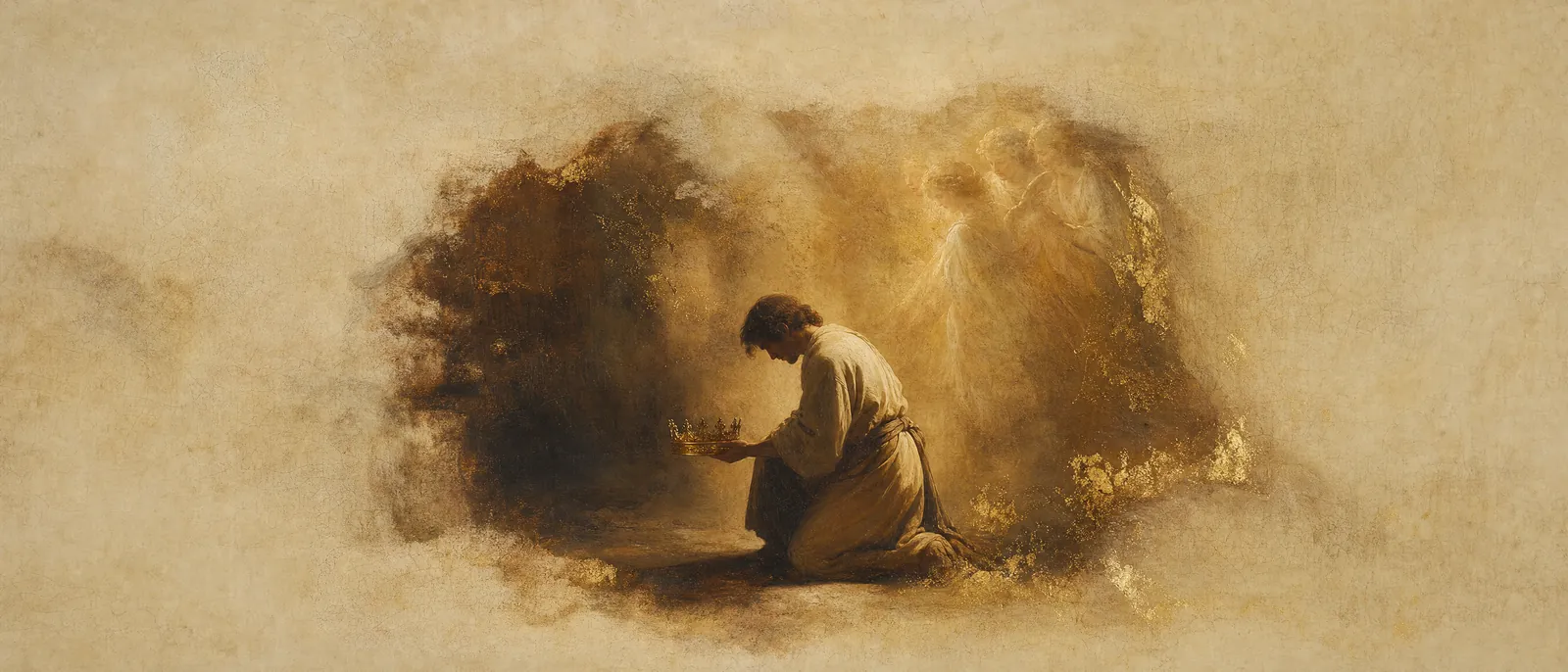
Yonatan — the friend who chooses love over crown
Yonatan was the rightful heir of Israel's first dynasty — and he loved David more than he loved the throne that was his by birth. The name carries a rare gift: the capacity to recognize another's greatness without needing to defeat it.
The Name and Its Root
Yonatan (יונתן) is built from the divine name and the verb natan — to give. It means, plainly, "God has given." It is the longer cousin of Natan and a sibling to Netanel and Mattaniah; the whole family of names circles the same idea, that a person is something received rather than seized.
That root quietly governs the whole life of the name. Giving is its native grammar. A Yonatan tends to understand love as something handed over, not held — and that instinct will cost him at least once, because the world is full of people who confuse a gift freely given with a weakness to exploit.
The Figure in the Tanakh
In the books of Samuel, Yonatan is the eldest son of Saul, Israel's first king. He is, by every ordinary expectation, the crown prince. He is also a genuine warrior — the daring raid on the Philistine garrison at Michmash (1 Samuel 14), where he climbs the cliff with only his armor-bearer and trusts that "nothing can hinder the LORD from saving by many or by few," is one of the most quietly heroic episodes in the Bible.
Then David enters the story, and everything that should have made Yonatan David's rival instead makes him David's friend. Scripture says "the soul of Yonatan was knit to the soul of David," and that he loved him as his own soul (1 Samuel 18). He strips off his own robe and gives it to David — a prince handing a shepherd the very garments of succession. When Saul's jealousy curdles into murder, Yonatan warns David, shields him, and openly accepts what it means: "You shall be king over Israel, and I shall be next to you" (1 Samuel 23).
He never gets to live that out. Yonatan falls beside his father on Mount Gilboa (1 Samuel 31). David's lament — "your love to me was wonderful, passing the love of women" (2 Samuel 1) — is the eulogy of the man who lost the friend who could have been his enemy and chose not to be.
The Soul-Architecture: Love Without Competition
Here is the rare thing about Yonatan, and about people who carry his name. He was the legitimate heir. The crown was his. And he watched it pass to the boy he loved — not with resentment slowly mastered, but with something that looks almost like relief, because David's gift was simply real to him and a real thing does not need to be defended against.
Most people cannot do this. Most of us, faced with someone who is better at the thing we wanted to be best at, feel the floor tilt. The Yonatan pattern is the ability to look directly at another person's brilliance and feel admiration where others feel threat. It is not that they lack ambition. It is that their love runs deeper than their ambition, and when the two collide, love wins.
This is rarer than the people who have it tend to realize. They assume everyone can be glad for a friend's success the way they are. They are often surprised, and a little wounded, to discover that their loyalty is not always met in kind.
The Cost of the Gift
A capacity for non-jealous love has a shadow side, and Yonatan's own death gestures toward it. He stayed loyal to a father whose cause was lost and whose throne was already promised elsewhere. Loyalty that beautiful can also be loyalty that does not know when to leave.
People with this name should watch for the pattern of pouring devotion into relationships and structures that have stopped deserving it — staying out of love when love has become a kind of self-erasure. The same heart that refuses to compete can also refuse to defend its own legitimate claims. Yonatan gave away the robe. The lesson is not to stop giving; it is to give from fullness, by choice, rather than from an inability to hold anything for oneself.
The healthiest Yonatans learn that wanting their own good does not betray the people they love. The crown was, in fact, his. He was allowed to want it. The greatness was in the freedom of letting it go — and that freedom only exists where the wanting was real.
Gematria: 516
The name's gematria is 516. We won't dress that number in borrowed coincidences; what matters is the weight it gives an already weighty name. Yonatan is among the longer theophoric names, and its numerical largeness suits a soul whose defining act was largeness of spirit — room enough inside to hold another person's destiny without crowding out their own.
A name like this describes an architecture, not a fate. It says: here is a soul built for fierce, clear-eyed, ungrudging love. What that soul does with the structure is still, as it was for Yonatan on the cliff at Michmash, a matter of courage.
Yonatan in the Classical Sources
The name is יוֹנָתָן (Yonatan), gematria 516, and it reads as a sentence of pure grace: Yo (the divine Name's prefix) + natan — "God gave." It belongs to the crown prince who gave his own crown away, and whom the Mishnah installed permanently as one half of its definition of love.
Where the Tanakh Gives the Name
The defining verse comes the day David returns from Goliath: "the soul of Yonatan was bound up with the soul of David, and Yonatan loved him as his own soul… and Yonatan stripped off the robe that was on him and gave it to David, and his garments, even his sword and his bow and his belt." The heir to the throne, meeting the boy prophesied to replace him — and his response is to dress him in the regalia. A name meaning "God gave," borne by a man whose signature act was giving away the one thing princes keep.
The Sages on Yonatan
The Mishnah in Avot needed an example of love that does not depend on anything — ahavah she'einah tluyah b'davar — love with no underlying asset that can crash. Its chosen case: "the love of David and Yonatan." Consider the audit: every structural force in their world — dynasty, a jealous father, the throne itself — argued for rivalry, and the Mishnah holds their bond up as the one that had no such dependency and therefore never lapsed. The Sages also record his battlefield theology at Michmash: "nothing prevents the Lord from saving by many or by few" — faith doing arithmetic and discarding it.
The Letters and the Number
The name is built from the theophoric prefix yud–vav — the Name's opening — welded to נָתַן, natan, the verb of giving, which is also the language's most famous palindrome: it reads identically forward and backward. The commentators love what that does inside this name: giving, spelled so that it comes back the way it went out — a fair schema for a friendship in which each swore to protect the other's future. The name ends in the long final nun, descending below the line: this giver reached down, from a throne, to lift someone else onto it.
What a Name Does
The Talmud teaches shema garim — a name inclines — and Yonatan's inclined him to his own disinheritance, gracefully: "God gave," so Yonatan gave, and the tradition made his generosity the textbook case of love without leverage. The friend he dressed in his own robe is at David; the father whose spear he stood between is remembered on Avner's page, where Shaul's house keeps its other soldier. The full index is at Hebrew names.
What does the name Yonatan mean?
Yonatan (יונתן) means "YHWH has given" or "God has given," from the Hebrew root natan, to give. It is closely related to the names Natan, Netanel, and Jonathan, all built on the idea of a person as something received as a gift.
What is the gematria of Yonatan?
The gematria of Yonatan (יונתן) is 516. It is one of the larger theophoric names — a numerical weight that suits a soul defined by its capacity to hold great love and another person's destiny without diminishing its own.
Who was Yonatan in the Bible/Tanakh?
Yonatan was the eldest son of King Saul and the rightful heir to Israel's first throne, appearing throughout 1 and 2 Samuel. A bold warrior at Michmash, he is best remembered for his covenant of love with David — protecting David from Saul's murderous jealousy even though David's rise meant the loss of his own crown. He died beside Saul on Mount Gilboa, and David mourned him in one of Scripture's most moving laments.
What does the name Yonatan say about personality?
The Yonatan pattern is an unusual capacity for non-jealous love — the ability to recognize and celebrate another's gift without competing with it. People with this name tend toward fierce loyalty and generosity. The cost to watch for is staying devoted to people or causes past the point they deserve it, and neglecting their own legitimate claims while championing everyone else's.
What does the name Yonatan mean?
Yonatan (יונתן) reads as a sentence: Yo (the divine prefix) + natan — 'God gave.' Its verb, natan, is Hebrew's most famous palindrome — giving spelled so it returns the way it went out — a fitting schema for the crown prince whose signature act was giving his own regalia to David.
Why does the Mishnah cite David and Yonatan?
Pirkei Avot 5:16 needed an example of love that depends on nothing — ahavah she'einah tluyah b'davar. Every structural force (dynasty, a jealous father, the throne) argued for rivalry; their bond had no underlying asset that could crash, and therefore never lapsed.