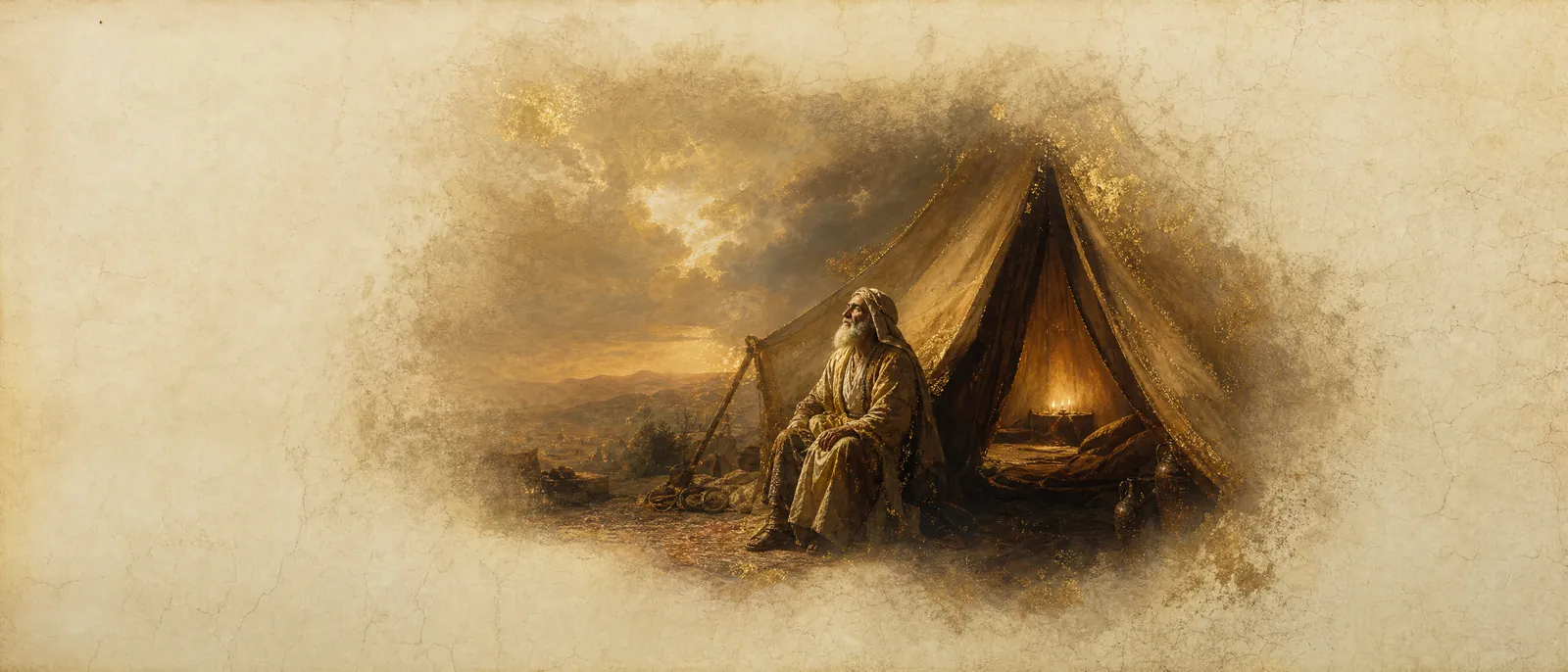
Avraham — the open tent
Avraham left everything familiar to follow a voice no one else could hear. People with this name are often born into families that don't fully understand them — and grow into the one whose home becomes a refuge for others.
The name and its root
The name begins as Avram — av ram, "exalted father" — and is changed by God in Genesis to Avraham, which the text itself reads as av hamon goyim, "father of a multitude of nations." The added letter is a single hei, and the rabbis made much of that small breath of a letter: a name expanded to hold more people than the man who carried it ever expected.
That expansion is the whole architecture of the name. Avraham does not mean "great man." It means "father of many" — a self defined by how many others it can take in. The meaning points outward by design.
What the gematria carries
Avraham's name carries a gematria of 248. The classical tradition attaches a striking association to that number: 248 is counted as the number of limbs in the human body and, correspondingly, the number of positive commandments — the mitzvot phrased as "do," not "do not."
Read against the name, the number says something quiet and demanding. A life of 248 is a life of active obligation: not mainly the things you refrain from, but the things you get up and do. People drawn to this name often feel their worth measured in deeds rather than restraint — in whether they showed up, opened the door, made the call.
The man in Genesis
The Torah introduces Avraham mid-life, already settled, when a voice tells him Lech lecha — go, leave your land, your birthplace, your father's house, for a place I will show you. He goes without an itinerary. No one in his family hears what he hears.
The defining image, though, is not the journey but the tent. In Genesis, Avraham sits at the entrance of his tent in the heat of the day, and when three strangers appear he runs to meet them, washes their feet, slaughters a calf, and serves them himself. The rabbis built an entire portrait of hospitality from that scene — a tent open on all sides so no traveler could pass without being fed.
And yet the same man argues with God over Sodom, sends away Hagar and Ishmael, and binds his son Isaac on an altar. The hospitality and the severity live in one person. Avraham's kindness is real, and it is not soft.
The lived pattern
People with this name are often born into families that don't fully understand them. There is frequently an early sense of hearing a frequency no one around them registers — a conviction, a calling, a discomfort with the inherited arrangement that they can't fully explain to the people who raised them.
Over time, many grow into the role of the one whose home becomes the refuge. Friends in trouble end up at their kitchen table. They are the ones who absorb the strays, host the holidays, take the calls at 2 a.m. The open tent is not a metaphor for them; it is a logistical reality, and it is usually unpaid.
The kindness is their inheritance and their test. The cost shows up when the tent has no walls — when openness becomes an inability to say "not tonight," when caring for everyone leaves no one caring for them. Avraham could run to strangers because he was rooted in something; the failure mode of this name is generosity without that root, hospitality that becomes self-erasure.
The tension to watch
The work of this name is learning that an open tent still needs corner posts. Avraham was not boundaryless — he negotiated, refused, and held lines when it mattered. The people who carry his name well are the ones who keep the door open without losing the structure that makes the door worth walking through.
Their challenge is rarely learning to give. It is learning that giving from depletion isn't generosity — it's a slow leak. The healthiest version of this name treats its own rootedness as the thing that makes the welcome possible, not an indulgence to be skipped.
Avraham in the Classical Sources
The name is אַבְרָהָם (Avraham), gematria 248 — and it is the most consequential renaming in Scripture. No name in the Tanakh carries a heavier paper trail: a covenant, an added letter, a Talmudic prohibition on using the old name, and a number the Sages mapped onto the human body itself.
Where the Tanakh Gives the Name
The name is conferred by God directly, mid-covenant: "No longer shall your name be called Avram; your name shall be Avraham, for I have made you the father of a multitude of nations." The Torah spells out the mechanics — av hamon goyim, father of many — compressed into a single inserted heh. One letter, and a man's scope changes from a household to humanity. It is the Tanakh's founding demonstration that a name is not a record of who you have been but a claim about what you are for.
The Sages on Avraham
The Talmud takes the renaming with complete seriousness: in Berakhot it rules that one who calls him "Avram" transgresses — the old name is not shorthand, it is a contradiction of the covenant. And in Nedarim the Sages unseal the number: at first, they say, God gave him mastery over 243 of his organs; when the heh was added, the count rose to 248 — every limb of the body in the tradition's anatomy — complete self-rule, down to the last sinew. The name's gematria is the Sages' way of saying his transformation left no part of him unconverted.
The Letters and the Number
The added letter is a heh — the lightest sound in the language, a breath — and the tradition notes it is the same letter with which, the Sages teach, this world was formed. Avram plus a breath of the Creator equals Avraham. The number 248 became one of the tradition's load-bearing figures: 248 limbs, and 248 positive commandments — so that the first believer's name counts out to the full anatomy of both a body and a life of practice. Few names in any language do that much arithmetic.
What a Name Does
When the Talmud in Rosh Hashanah lists the things that tear up an evil decree, it includes shinui hashem — a change of name — and the tradition's prooftext is this very story: Avram, the Midrash says, could not father a child; Avraham could. The renamed man walked out of his own astrology. His family fills the neighboring pages of this library: Sarah, renamed in the same covenant, and Yitzchak, the son the new name made possible. The full index is at Hebrew names.
What does the name Avraham mean?
Avraham comes from av hamon goyim, "father of a multitude of nations" — the meaning the Torah itself gives when it renames Avram ("exalted father") by adding the letter hei. The name defines a person by how many others he can hold.
What is the gematria of Avraham?
Avraham (אברהם) has a gematria of 248. Jewish tradition famously links 248 to the number of limbs in the human body and to the count of positive ("do") commandments — tying the name to a life measured in active deeds.
Who was Avraham in the Tanakh?
Avraham is the first patriarch in the Book of Genesis. Called by God with the words Lech lecha, he leaves his homeland on faith, and is remembered above all for hospitality — running to welcome three strangers at his tent — alongside harder episodes like the binding of Isaac and his plea over Sodom.
What does the name Avraham say about personality?
It suggests someone who often feels misunderstood by their family of origin and grows into the role of host and refuge — the one whose home takes others in. Their kindness is both their gift and their test: the work is keeping the tent open without losing the structure that holds it up.
Why was Avram's name changed to Avraham?
In Genesis 17:5, God renames him mid-covenant: 'your name shall be Avraham, for I have made you the father of a multitude of nations (av hamon goyim).' The Talmud in Berakhot 13a rules that calling him 'Avram' afterward transgresses — the old name contradicts the covenant.
What is the meaning of Avraham's gematria of 248?
The Talmud in Nedarim 32b teaches that with the added letter heh, Avraham was given mastery over all 248 limbs of the body — complete self-rule. 248 is also the count of the Torah's positive commandments, so the first believer's name counts out to a full life of practice.