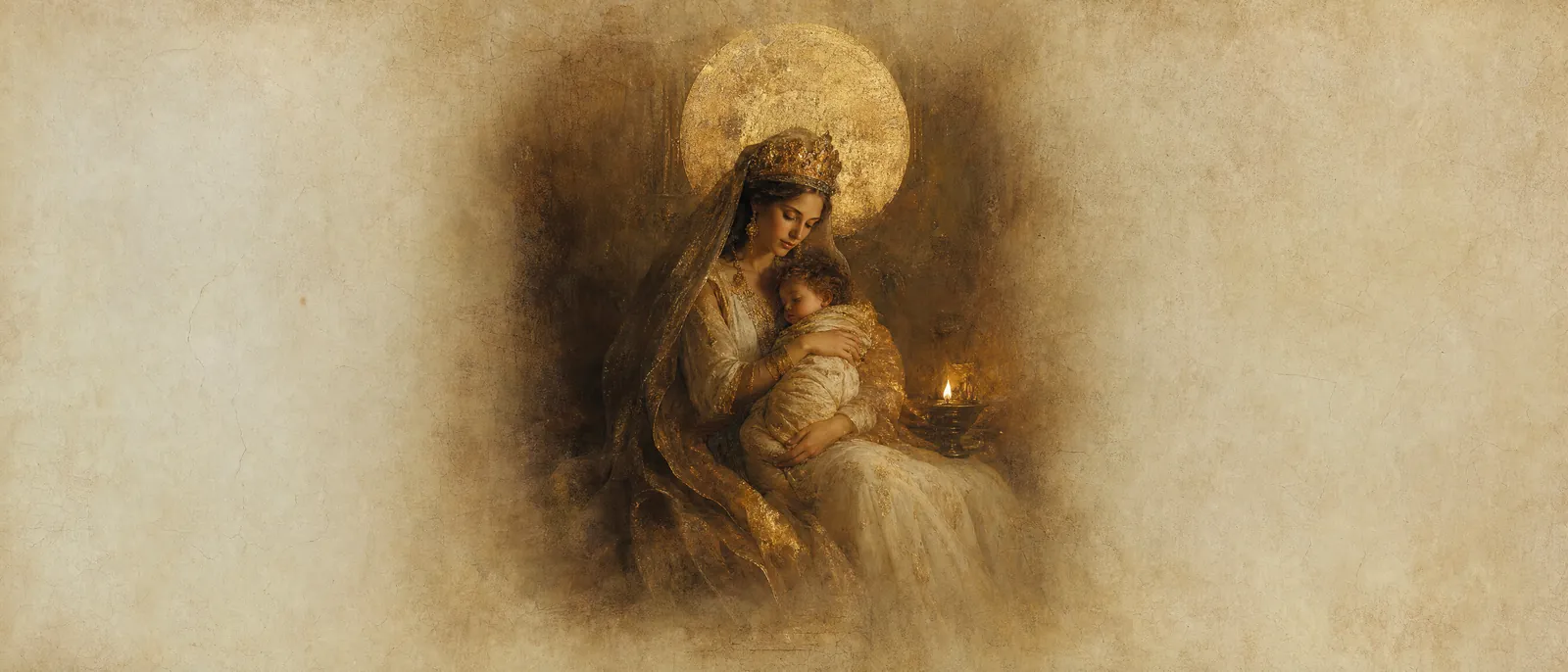
Sarah — the royal mother
A name that means princess and behaves like one — not in entitlement, but in the quiet certainty of someone who sees the room before anyone else does.
The Name and Its Root
Sarah comes from the root שׂר — ruler, commander, one who holds authority. The name means princess, or more precisely a woman of noble standing, not by inheritance but by bearing. It is the first name in the Torah that God personally changes: she begins as Sarai and becomes Sarah in Genesis 17, the renaming marking a covenant rather than a coronation.
The shift is small on the page and enormous underneath it. The name does not promise comfort or ease. It names a kind of presence — the person who carries weight in a room without needing to announce it, whose authority registers before she speaks.
The Gematria: 505
The name carries a gematria of 505. It is a number that resists tidy symbolism, and we will not invent neat coincidences for it. What it does is anchor the name's weight — a fullness, a completeness that sits behind the syllables.
People who carry this name often feel that fullness as a quiet pressure: a sense that they are meant to be substantial, to matter, to hold a place that others rely on. The number does not decree this. It describes the shape of a soul already inclined toward it.
Sarah in the Tanakh
Sarah is the first matriarch, wife of Avraham, mother of Yitzchak. Her story runs through the heart of Genesis: the journey from Ur, the long childlessness, the laughter at the tent door when she overhears the promise of a son in old age, and finally Yitzchak's birth — a name that itself means laughter.
The Midrash makes a striking claim about her: that Sarah's prophecy was superior to Avraham's. She saw clearly when he wavered. The Torah records the moment plainly — when Sarah insists that Hagar and Ishmael must leave, and Avraham is distressed, God tells him, in all that Sarah says to you, listen to her voice (Genesis 21:12). The clarity was hers. The instruction to trust it was given to the man beside her.
That is the episode that defines the name. Not the laughter, not even the long-awaited son — but the moment a woman saw the situation truly and was told, by the highest authority in the story, that her sight was the one to follow.
The Lived Pattern
People with this name often have unusual perceptive clarity. They see what others are still trying to soften — the real reason behind the polite explanation, the crack in the plan everyone is pretending is fine, the answer that is obvious and unwelcome at once.
This is a gift that arrives with a cost. Clear sight makes you the person who says the thing no one wanted said. It can read as harshness when it is really just accuracy delivered early. And because the clarity is uncomfortable, people around you will often ask you to second-guess it — to be less sure, to wait, to consider that maybe you are imagining things.
The work of this name is not learning to see. The seeing comes easily. The work is trusting that clarity when others ask you to dim it, and learning to deliver what you see in a way that can actually be received.
The Royal Mother
The archetype here is the Royal Mother — authority and care held in the same hands. It is a demanding combination. The royal part wants to decide, to protect the line, to act on what it knows. The mother part wants everyone safe, included, unhurt.
Sarah lived that tension exactly. Her insistence about Ishmael was both fierce and protective, both a ruling and a mother's defense of her son. People who carry this name often feel pulled between governing and nurturing — between saying the hard true thing and keeping the peace. Both impulses are real. The name does not resolve them; it asks you to hold them without abandoning either.
Sarah in the Classical Sources
The name is שָׂרָה (Sarah), gematria 505 — the second half of Scripture's great double renaming. Sarai became Sarah in the same covenant that made Avram Avraham, and the Talmud's reading of her letter-swap is one of the most beautiful pieces of name-commentary in the tradition.
Where the Tanakh Gives the Name
God renames her directly, and — uniquely — forbids the old name in the same breath: "As for Sarai your wife, you shall not call her name Sarai, for Sarah is her name. And I will bless her, and moreover I will give you a son from her." As with her husband, the renaming and the impossible child arrive in one sentence: the new name is the instrument of the new fact. She is the only woman in the Torah renamed by God — and the only person of either sex whose age at death the Torah itemizes, a verse the Midrash unfolds into praise of a life whole at every stage.
The Sages on Sarah
The Talmud in Berakhot explains the change: Sarai means "my princess" — a nobility scoped to one household; Sarah means princess absolutely — "a princess to all the world." The renaming did not promote her; it removed her limits. The Sages elsewhere rank her prophecy above her husband's — God's own instruction to Avraham is "whatever Sarah says to you, listen to her voice" — and the Midrash credits her tent with the three standing miracles (lamp, dough, cloud) that became the matriarchal signature. In Megillah she opens the list of the seven prophetesses.
The Letters and the Number
The mechanics of the renaming fascinate the commentators: the yud of Sarai (worth 10) was exchanged for a heh (worth 5). The Midrash tells that the displaced yud complained before the Throne for generations — until it was set at the head of another name: when Moshe renamed Hoshea, he added that yud, making Yehoshua. No letter of a holy name is ever discarded; it waits. The swap also halved her name's count by five — and the tradition reads the missing five as distributed: the same covenant put a heh into her husband's name, the pair now sharing the Creator's letter between them.
What a Name Does
Sarah's renaming is one of the Talmud's own prooftexts for the power of a changed name — Sarai does not bear, the Midrash says, but Sarah bears. Where her husband's page tells the decree torn, hers tells the scope enlarged: from one house to all of it. Her page faces Avraham, renamed beside her, and the son of her laughter is at Yitzchak. The full index is at Hebrew names.
What does the name Sarah mean?
Sarah (שרה) means princess or noblewoman, from the Hebrew root שׂר, meaning ruler or one who holds authority. In Genesis she is renamed from Sarai to Sarah by God, marking the covenant — a name describing standing and bearing rather than mere inheritance.
What is the gematria of Sarah?
The name Sarah (שרה) carries a gematria of 505. Rather than forcing tidy symbolism onto the number, we read it as a marker of fullness and weight — the substantial presence the name tends to carry.
Who was Sarah in the Tanakh?
Sarah was the first matriarch, wife of Avraham and mother of Yitzchak, in the book of Genesis. The Midrash teaches that her prophecy surpassed Avraham's; in Genesis 21:12 God tells Avraham to listen to Sarah's voice in all she says regarding Hagar and Ishmael, affirming the clarity of her sight.
What does the name Sarah say about personality?
People with this name often have unusual perceptive clarity — they see what others are still trying to soften. They tend to carry authority naturally and feel a pull between ruling and nurturing. The challenge is trusting their own clear sight when others ask them to second-guess it.
Why was Sarai's name changed to Sarah?
The Talmud in Berakhot 13a explains: Sarai means 'my princess' — nobility scoped to one household; Sarah means princess absolutely, 'a princess to all the world.' The renaming (Genesis 17:15) did not promote her; it removed her limits — and the promised son arrives in the same sentence.
What happened to the yud removed from Sarai's name?
The Midrash tells that the displaced yud complained before the Throne for generations — until Moshe set it at the head of another name, turning Hoshea into Yehoshua. No letter of a holy name is ever discarded; it waits.