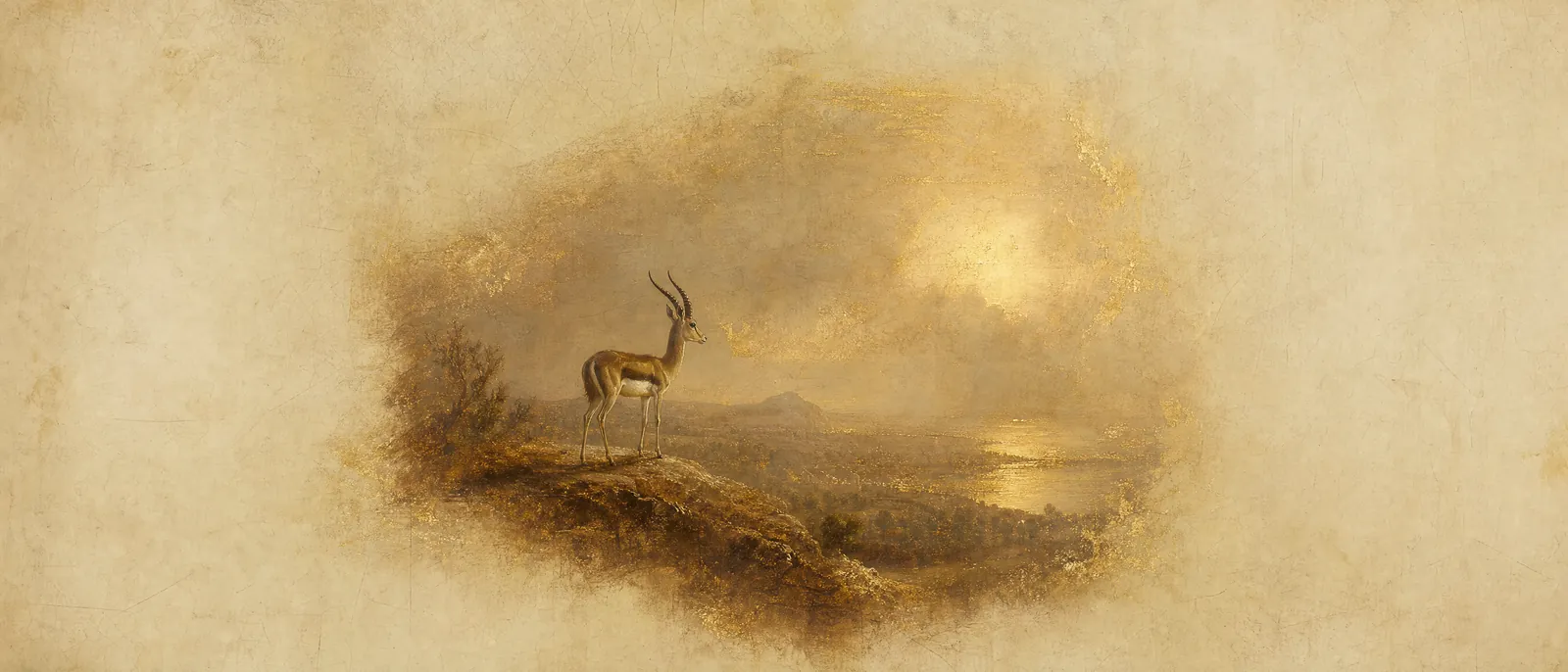
Tzvi — the swift splendor
One word carries two glories: the gazelle bounding across a ridge, and the splendor of a land named for beauty. Tzvi lives in the space between them — a name for the person who moves fast toward what they love.
A Word With Two Glories
Tzvi is a modern Israeli name built on an ancient double meaning. The Hebrew צבי names the gazelle — the desert animal whose whole reputation is speed, the creature that clears distance before you have finished watching it. But the same word means splendor, glory, the kind of beauty that stops a person mid-sentence. Hebrew did not choose between these. It let them live in one syllable.
That refusal to choose is the name's teaching. When David lamented Yonatan he called him 'the tzvi of Israel' — not the strong one, not the wise one, but the swift and splendid one, a person whose beauty was inseparable from his motion. And when the prophets named the Land itself, they called it eretz ha-tzvi, the land of splendor. The gazelle and the glory are the same word because, in this name, real beauty is never static. It is beauty caught in the act of moving.
Swift Toward What You Love
People who carry this name tend to move fast toward the things they care about. Not restlessly — a gazelle is not anxious — but decisively. When a Tzvi has decided that something matters, the distance between wanting it and pursuing it collapses. Pirkei Avot frames this exact instinct as a virtue: 'be swift as a gazelle to do the will of your Father in heaven.' Velocity, consecrated. Speed pointed at the good.
The pattern shows up as a kind of eager readiness. A Tzvi is often the first to say yes, the first to leave the starting line, the one already halfway there while others are still weighing options. There is grace in it — the gazelle does not lumber — and there is warmth, because the speed is almost always in service of a person or a cause, not an escape from one.
The Cost of the Gazelle
Every strength carries its shadow. The gazelle's gift is starting fast; its trial is that it can also flee fast. A Tzvi who feels cornered — by conflict, by a slow negotiation, by an obligation that has gone stale — may bolt before staying would have served better. The same legs that carry you toward what you love can carry you away from what you have outgrown, and telling the two apart is the lifelong discipline of the name.
There is also the matter of splendor. Because the word means glory, a Tzvi can grow attached to being seen as impressive — quick, capable, ahead. The correction is built into the source: eretz ha-tzvi is not splendid because it is admired. It is splendid because, the Sages say, its hide stretches to hold everyone who belongs to it. The mature Tzvi learns that the finest speed is the kind spent making room for others, not outrunning them.
Tzvi in the Classical Sources
In the sources, the Hebrew צבי (Tzvi) — gematria 102 — is remarkable for holding two meanings in a single word: the gazelle and splendor. To trace the name through Tanakh and Mishnah is to watch these two senses braid together, until swiftness and glory become indistinguishable.
II SAMUEL 1:19 — THE TZVI OF ISRAEL
In David's lament over Saul and Yonatan, he cries, 'The tzvi of Israel, slain on your heights.' Here the word is a title of honor for a fallen person — Yonatan, the friend David loved, named for the gazelle. It is the Tanakh's word for someone who was both swift and splendid, whose beauty and whose motion could not be separated.
The verse gives the name its emotional weight. To be called a tzvi is to be called quick and glorious in the same breath — and the lament reminds us that this glory is fragile, precious precisely because it is caught mid-motion, on the heights, alive and fleet before it is lost.
DANIEL 11:16 — ERETZ HA-TZVI, THE LAND OF SPLENDOR
In Daniel, the Land of Israel is called eretz ha-tzvi — the land of splendor — using the very same word that names the gazelle. This is where the name's second glory lives openly: tzvi as beauty, as the honored and cherished thing.
The Sages read the doubled meaning closely: like a gazelle's hide, they teach, the Land stretches to hold its people. The animal and the land share a word because both are defined by an elastic, living beauty — a splendor that expands to make room rather than a splendor that stands still to be admired.
PIRKEI AVOT 5:20 — SWIFT AS A GAZELLE
The Mishnah in Pirkei Avot instructs: 'Be bold as a leopard, light as an eagle, swift as a tzvi, and strong as a lion, to do the will of your Father in heaven.' Here the gazelle is the image of consecrated velocity — speed pointed at the good.
This is the source that turns the name from a description into an instruction. To be a tzvi is not merely to be fast; it is to be fast toward what matters, to close the distance between intention and action for the sake of heaven. The Mishnah takes the animal's defining trait and makes it a spiritual discipline.
THE LETTERS AND THE NUMBER
The gematria of צבי is 102. The number is less the point here than the word's own doubling — the single teaching folded inside the name.
That teaching is this: gazelle and splendor are one word. Speed and beauty are not two qualities that happen to share letters; they are the same quality seen from two angles. The name insists that real beauty is the kind caught mid-motion — never the still portrait, always the creature clearing the ridge.
The Talmud's principle shema garim — "the name causes" (Berakhot 7b) — is the tradition's claim that a name gently inclines its bearer. In this library, Tzvi's nearest companions are Ayala and Aryeh; the full index is at Hebrew names.
What does the name Tzvi mean?
Tzvi (צבי) means 'gazelle' and also 'splendor.' The two senses are inseparable in Hebrew: the same word that names the swift desert animal also names glory and beauty, which is why the Land of Israel is called eretz ha-tzvi, the land of splendor.
What is the gematria of Tzvi?
The gematria of צבי is 102. More than the number, the name's teaching lives in its doubled meaning — gazelle and splendor at once — the idea that real beauty is the kind caught mid-motion.
Where does the word Tzvi appear in the Tanakh?
Tzvi is a modern Israeli name, but its root runs deep in Tanakh. In II Samuel 1:19 David laments Yonatan as 'the tzvi of Israel,' and in Daniel 11:16 the Land is called eretz ha-tzvi, the land of splendor — the same word for gazelle and for glory.
What does the name Tzvi say about personality?
Tzvi people tend to move fast toward what they love, collapsing the distance between wanting something and pursuing it. Pirkei Avot names this as a virtue — 'swift as a gazelle' — but the shadow is real: the same speed that carries you toward the good can also make you flee when staying would serve better.
What do the sources say about Tzvi?
Three sources shape the name: II Samuel 1:19 uses tzvi as a title of honor for Yonatan, Daniel 11:16 calls the Land eretz ha-tzvi, and Pirkei Avot 5:20 instructs 'be swift as a tzvi to do the will of your Father in heaven.' Together they braid swiftness and splendor into one identity.
Why is the Land of Israel called eretz ha-tzvi?
Because tzvi means both gazelle and splendor, eretz ha-tzvi means 'the land of beauty.' The Sages add that like a gazelle's hide, the Land stretches to hold its people — a splendor defined not by standing still to be admired, but by expanding to make room.