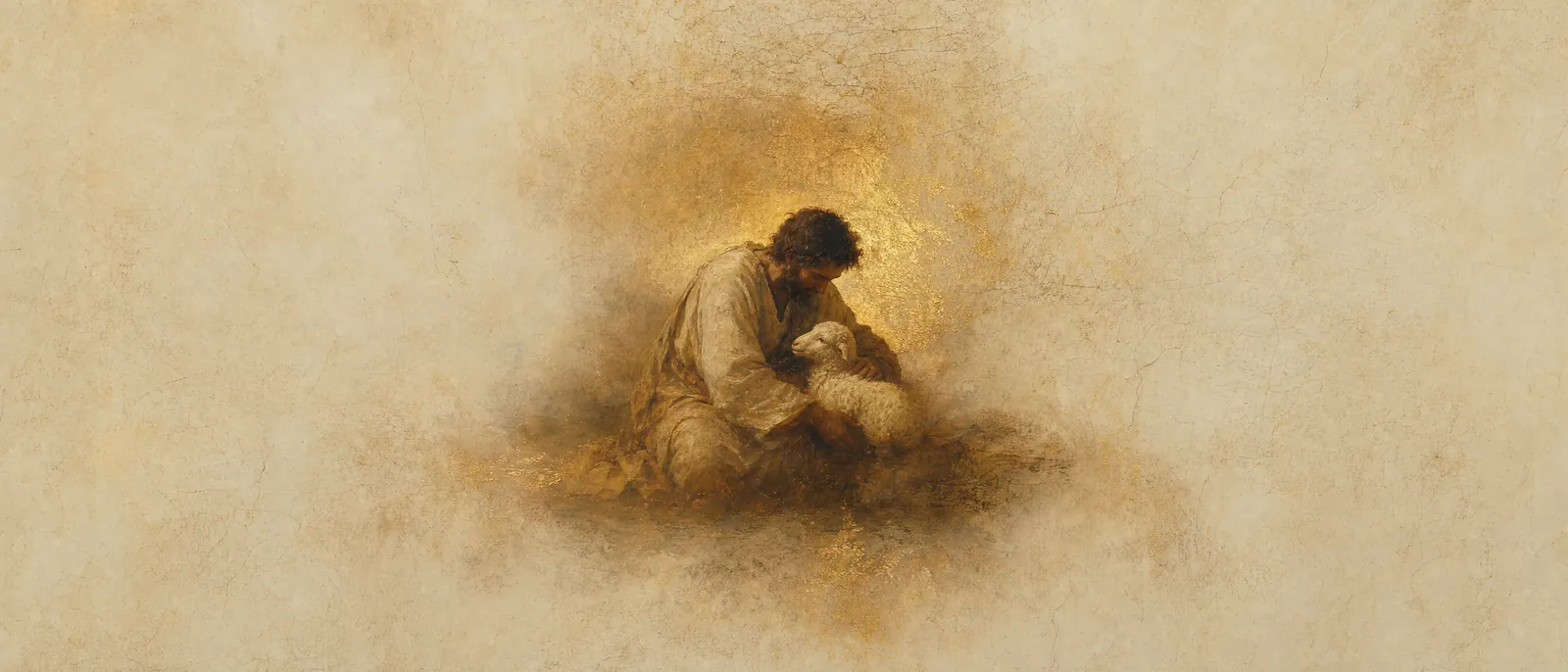
Boaz — the strong man whose strength was kindness
Boaz is a name that reads as a sentence: bo oz, 'in him, strength.' But watch where the strength goes. It does not swing a sword or command an army — it bends down to a foreign gleaner in a barley field and rewrites the harvest rules in her favor. This is a name for the load-bearing ones, whose quiet generosity turns out to be holding up the doorway everyone else walks through.
A Name That Is a Sentence
Most names describe. Boaz declares. בועז breaks open into bo oz — 'in him, strength' — and the grammar itself is the whole teaching. The strength is not out front, not brandished; it is located inside, where you have to come close to find it. The field workers found it there. The widow found it there. The name is an address, and what lives at that address is power that has learned to hold still.
This is the paradox the name carries into every life that bears it. Strength is the easy word; the hard word is where. A person named Boaz is rarely the loudest presence in the room. The strength is interior, structural, discovered only by those who lean on it.
The Man in the Field
The Book of Ruth introduces Boaz as a wealthy landowner — and the first thing he does with his wealth is notice. A foreign woman, a Moabite widow with no legal claim on him, is gleaning at the edges of his field. The law required only that he leave the corners unharvested. Boaz does more: he tells his workers to let her glean among the sheaves, to leave extra behind on purpose, to let no one shame her. He builds her dignity into the harvest itself.
That is the archetype in a single gesture. Boaz's strength was not that he could have kept everything — it was that he chose to make room, quietly, without being asked, in a way that cost him something real. People with this name tend toward the same instinct: they read the room for who is at the edges, and they engineer the situation so that person can walk in with their head up.
Cast in Bronze at the Door
Generations later, when Shlomo built the Temple, he set two great bronze pillars at the entrance and gave them names. One was Yachin — 'He will establish.' The other was Boaz. His great-great-grandfather's name, cast in metal, standing at the door of the house of God, holding up the threshold everyone crossed to come in.
This is the truest picture of the Boaz temperament: load-bearing and unnoticed. A pillar does not perform. It does not ask whether you saw it. It simply stands where the weight is, so the door stays open. The cost of this life is real — the strong one is easy to take for granted, easy to lean on until they crack, praised only in absence. Boaz names the soul who has decided that the doorway staying open matters more than being seen holding it.
The Hinge of the Line
And here is what the kindness became. The Sages teach that this one man's decency in a barley field was the hinge on which the royal line turned — Ruth to David, and from David the whole future of the kingdom. A single act of provision, undramatic in the moment, opened into monarchy and messianic hope.
That is the promise inside the name and the warning both. Boaz did not know he was founding anything. He was just doing right by the woman in front of him. The name suggests a soul whose quiet, correct choices compound — but only if the strength stays turned toward the vulnerable, and does not curdle into mere accumulation.
Boaz in the Classical Sources
In the sources, בועז is read as a sentence more than a word — bo oz, 'in him is strength.' The gematria of the name is 85. The classical texts do not treat this strength abstractly; they follow it into a field, up to a Temple door, and forward into a dynasty. What follows unpacks the three places the tradition locates the meaning of the name.
RUTH 2:1 — ISH GIBOR CHAYIL
Boaz is introduced as an ish gibor chayil — a man of strength and worth, a phrase that could describe a warrior or a magnate. But the text immediately redirects the word. His first recorded act is not conquest; it is protection and provision toward Ruth, a foreign gleaner who has no legal hold on him.
The law of the corners required only that he leave the field's edges. Boaz goes beyond the requirement — instructing his workers to leave extra, to shield her from harm, to let her glean with dignity. The 'strength and worth' of his title is defined, in the very next verses, as the strength to be generous past the minimum.
I KINGS 7:21 — THE PILLAR AT THE DOOR
When Shlomo completes the Temple, he sets two bronze pillars at its entrance and names them. One he calls Yachin; the other he calls Boaz. The name of the man from the barley field is cast in bronze and stands at the threshold of the house of God.
The image is exact for the name's meaning: a pillar is pure load-bearing strength, unmoving, unglamorous, holding up the doorway through which everyone passes. Boaz the man becomes Boaz the structure — strength that serves as support, positioned precisely where people enter.
BERAKHOT 7b — THE NAME AND THE LINE
Berakhot 7b teaches the principle that a name can shape or signify what a person becomes — that names are not arbitrary labels but carry consequence. Boaz, 'in him is strength,' is a name that the man's own life fills out precisely.
On the same daf, the tradition connects Ruth to David: the line of the monarchy runs through the union that Boaz's kindness made possible. His decency in the field becomes the hinge of the royal line — proof that quiet, lawful generosity in one obscure moment can carry the weight of a dynasty.
THE LETTERS AND THE NUMBER
The gematria of בועז is 85. But the deeper reading the sources offer is not the number alone — it is that the name is a sentence. Bo oz: 'in him, strength.' The letters do not describe a quality Boaz possesses; they locate it. In him. Inside.
That interior placement is the whole architecture of the name. The strength is not on display at the surface where it could be admired or feared. It is held within, where the field workers and the widow found it — those who came close enough to lean on it discovered it was there all along.
The Talmud's principle shema garim — "the name causes" (Berakhot 7b) — is the tradition's claim that a name gently inclines its bearer. In this library, Boaz's nearest companions are Ruth and Naomi; the full index is at Hebrew names.
What does the name Boaz mean?
Boaz (בועז) means 'in him is strength' — the name reads as a sentence, bo oz. In the Book of Ruth he is introduced as an ish gibor chayil, a man of strength and worth, whose strength expresses itself as generosity toward a vulnerable gleaner.
What is the gematria of Boaz?
The gematria of בועז is 85. More than the number, the tradition emphasizes that the name is a sentence — bo oz, 'in him, strength' — strength located inside, where those who came close could find it.
Where does Boaz appear in the Tanakh?
Boaz is the central male figure of the Book of Ruth, introduced in Ruth 2:1 as a wealthy landowner and kinsman. His name also appears in I Kings 7:21, where Shlomo names one of the two bronze pillars at the Temple's entrance Boaz.
What does the name Boaz say about personality?
Boaz points to a load-bearing temperament — strength held quietly inside rather than displayed. People with this name tend to notice who is at the edges and engineer situations so the vulnerable can enter with dignity, often holding up structures others take for granted.
What do the sources say about Boaz?
Ruth 2:1 defines his 'strength and worth' as generosity past the law's minimum; I Kings 7:21 casts his name in bronze as a Temple pillar; and Berakhot 7b teaches both the significance of names and the Ruth-to-David line, making Boaz's kindness the hinge of the royal dynasty.
Why is one of the Temple pillars named Boaz?
In I Kings 7:21, Shlomo names the two entrance pillars Yachin and Boaz — Boaz being the name of his great-great-grandfather. The image fits perfectly: a pillar is pure load-bearing strength standing at the threshold, holding up the doorway everyone crosses to enter the house of God.