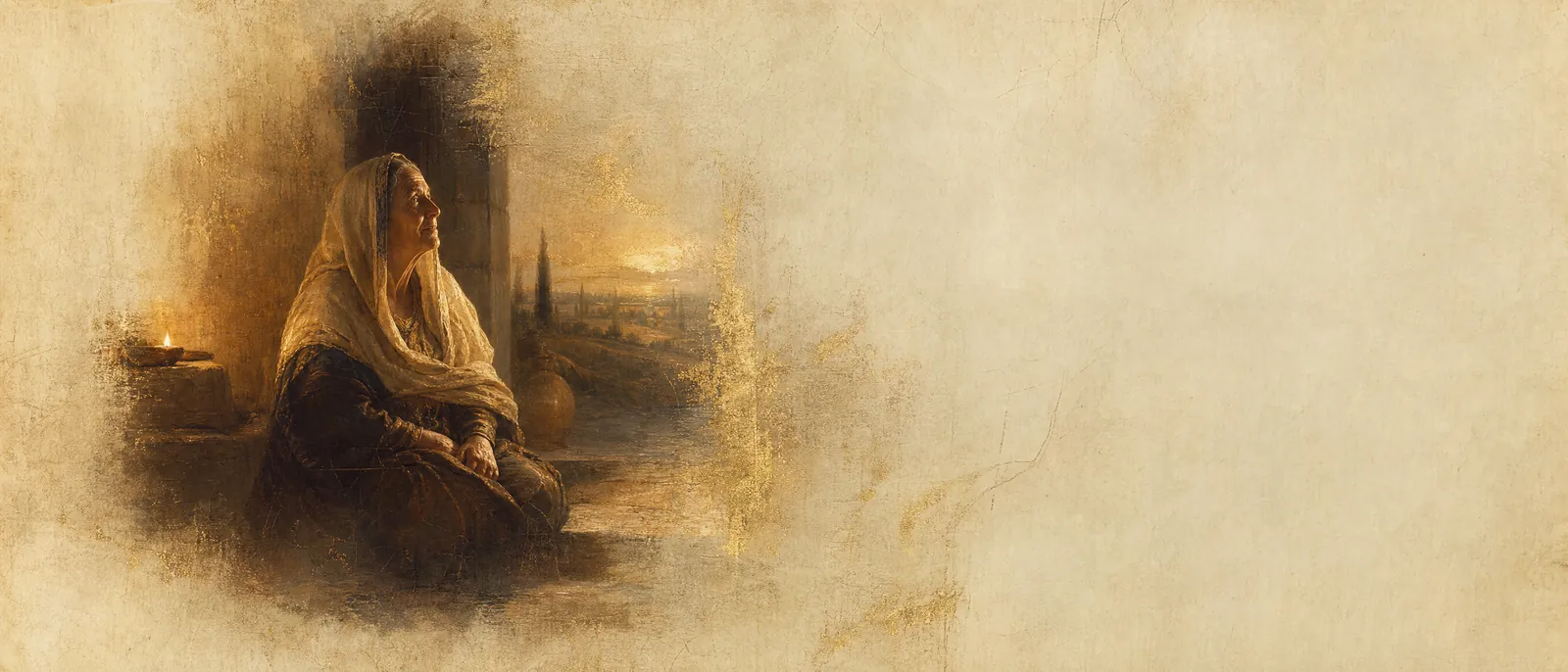
Naomi — the one who returns after loss
Naomi means pleasantness — and the Book of Ruth spends four chapters teaching her how to want that name again after life took everything that made it true. This is a name about coming home with empty hands and learning, slowly, that empty hands can still receive.
The Name Itself
Naomi comes from the root נעם — pleasantness, sweetness, the quality of being agreeable to be near. It is the same root behind na'im, pleasant, and the related word no'am, the gentle delight that makes a person easy to love. To be named Naomi is to be named for warmth itself.
Which is why the Book of Ruth lands the way it does. The whole arc of her story is the distance between a name that promises sweetness and a life that, for a stretch, delivers the opposite. The name is not ironic. It is a question the story slowly answers.
The Woman in the Book of Ruth
Naomi leaves Bethlehem during a famine with her husband Elimelech and two sons, Mahlon and Chilion. They settle in Moab. There, in foreign country, her husband dies. Then both sons die. She is left with two widowed daughters-in-law and nothing else — no men, no security, no future in a world that measured a woman's safety in exactly those terms.
When she turns back toward Bethlehem, one daughter-in-law, Ruth, refuses to leave her. They arrive together, and the women of the town call out her name: Is this Naomi? Her answer is one of the most honest lines in Tanakh. 'Do not call me Naomi,' she says. 'Call me Mara' — bitter — 'for the Almighty has dealt very bitterly with me. I went out full, and the Lord has brought me back empty.'
She does not pretend. She does not perform faith she doesn't feel. She names the loss out loud, in public, to the people who knew her before.
Full, and Then Empty
People who carry this name often live some version of that sentence: I went out full and came back empty. Frequently the loss arrives in midlife — a death, a marriage that ends, a move that strips away an entire identity, a long-built life that comes apart faster than it was made. The before and the after are clearly marked.
What's distinctive about the Naomi pattern is not the loss itself — loss is universal. It's the refusal to gloss it. A Naomi will not let you skip to the silver lining. She insists the bitterness be acknowledged before any repair is allowed. This can read as heaviness to people who want her to cheer up. It is actually a kind of integrity: she will not call herself pleasant while she is empty.
The Work: Learning to Receive Again
The genius of the Book of Ruth is that Naomi's return doesn't happen through her own striving. It happens because she lets Ruth stay, lets Boaz act, lets a child be placed in her lap. Her redemption comes through receiving — and for someone defined by competence and care, receiving is the hardest skill of all.
This is the central labor for people with this name. They are excellent givers, organizers, holders of other people's lives. The loss often exposes how little practice they've had at being held. The door back to 'pleasant' is not found by powering through alone; it's found by allowing help to reach them — which feels, at first, like weakness, and turns out to be the whole point.
By the book's end the women say a child has been born to Naomi. She becomes great-grandmother to King David. The sweetness returns — not by erasing what happened in Moab, but by letting new life arrive on top of the grief without canceling it.
The Tension to Watch
The risk for a Naomi is staying in Mara too long — letting the bitter name become the permanent one, so identified with what was lost that the arriving good goes unnoticed. The story warns against this gently: the same woman who said 'call me Mara' ends up with a grandchild on her knees and never has to renounce her honesty to get there.
The work is holding both. Naming the loss truthfully and letting pleasantness back in. Most people with this name spend a season discovering that those two things were never opposites — that you can be a person who was emptied and a person who is, again, full.
Naomi in the Classical Sources
The name is נָעֳמִי (Naomi), gematria 170, from the root no'am — pleasantness, sweetness. It is the only name in the Tanakh whose bearer publicly tried to resign it — and the book she stars in is the story of the name winning her back.
Where the Tanakh Gives the Name
The book of Ruth turns on the verse where Naomi, returning widowed and bereaved from Moav, refuses her own name at the gates of Bethlehem: "Do not call me Naomi ('pleasant'); call me Mara ('bitter'), for the Almighty has dealt very bitterly with me." It is the rawest scene of name-theology in Scripture: a woman auditing her name against her life and declaring the account false. And the text's quiet answer is that no one ever calls her Mara — the narrator, the neighbors, and the book itself keep saying Naomi, until the women of the town lay her grandson in her lap and name the child "a son born to Naomi." The name outlasted the argument against it.
The Sages on Naomi
The Sages read the book of Ruth as a treatise on chesed — loyal kindness — and Naomi as its quiet engine: it is her conduct in Moav that makes a Moabite princess cling to her, her strategy that brings Ruth to Boaz's field, her counsel that midwifes the house of David. The Midrash lingers on the town's gasp when she returns — "Is this Naomi?" — and on the answer the book supplies: yes, and her pleasantness, tested by famine and triple bereavement, is the thing that converts. Ruth's famous vow was sworn to Naomi's God, but it was learned from Naomi's kitchen.
The Letters and the Root
The root nun–ayin–mem is one the liturgy reserves for its highest requests: "vihi no'am Hashem aleinu" — "may the pleasantness of the Lord be upon us" — the psalm-line recited at the close of Shabbat, and the word the Psalmist uses for what he wants to gaze at in God's own house (no'am Hashem). Naomi is that word with a personal suffix: "my pleasantness." The name ends in yud — the possessive — as if to insist the quality is not circumstantial but owned, which is exactly what her book proves: the sweetness survived the seasons that argued against it.
What a Name Does
The Talmud teaches shema garim — the name causes — and Rabbi Meir, in Yoma, read names as destiny's shorthand. Naomi's page is the tradition's proof that the reading runs deep: she contested her own name at the city gate, and the book overruled her. Her daughter-in-law's page faces hers — Ruth, whose loyalty the Talmud rewarded with David — and the psalm-name of pleasantness echoes in David, "the sweet singer of Israel." The full index is at Hebrew names.
What does the name Naomi mean?
Naomi (נעמי) comes from the Hebrew root נעם, meaning pleasant, sweet, or agreeable. It carries the sense of someone whose presence is gentle and delightful to be near — which gives her story in the Book of Ruth its weight, when she asks to be called Mara, 'bitter,' instead.
What is the gematria of Naomi?
The gematria of נעמי is 170.
Who was Naomi in the Tanakh?
Naomi is the central figure of the Book of Ruth. She leaves Bethlehem during a famine with her husband Elimelech and two sons, and in Moab loses all three. She returns home empty, accompanied by her devoted daughter-in-law Ruth, and is eventually restored through Ruth's marriage to Boaz and the birth of Obed — making Naomi an ancestor of King David.
What does the name Naomi say about personality?
Naomi describes a soul shaped by a clear before-and-after, often a profound loss in midlife. People with this name tend to be honest about grief rather than glossing it, capable givers who struggle to receive. Their deep work is finding the door back to 'pleasant' without pretending the loss didn't happen — and learning to let new good arrive without canceling the truth of what was lost.
Why did Naomi ask to be called Mara?
Returning widowed and bereaved (Ruth 1:20), she audited her name against her life: 'Do not call me Naomi (pleasant); call me Mara (bitter).' The book's quiet answer is that no one ever calls her Mara — the name outlasted the argument against it, and the story ends with a grandson laid in her lap.
What does the name Naomi mean?
Naomi (נעמי) is built on no'am — pleasantness — the word of the psalm-line 'may the pleasantness of the Lord be upon us' (Psalms 90:17). The ending yud makes it possessive: 'my pleasantness' — a sweetness owned, not circumstantial, which is what her book proves.