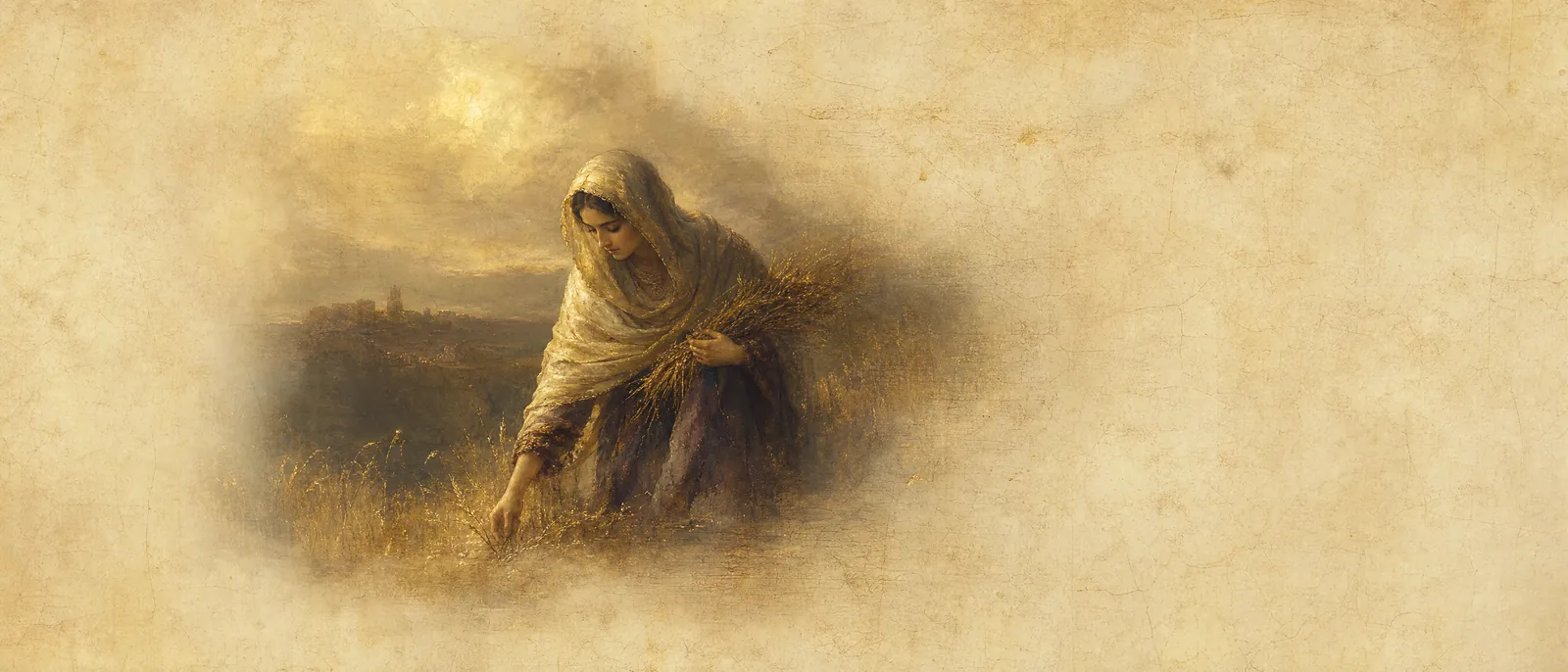
Ruth — the one who chooses
Ruth chose her people over her birth, her mother-in-law over her own mother, a difficult truth over an easy life. People with this name often feel they had to find their tribe rather than be born into it — and the tribe they choose, they keep.
The Name and Its Root
The meaning of Ruth is not as settled as the warmth of the name suggests. The most common reading links רות to the root ר-ע-ה, giving a sense of 'companion,' 'friend,' or 'the one who provides nourishment and care.' Some sources connect it to a softer idea of saturation or fullness — being filled, being satisfied. The honest answer is that the etymology is debated, and the Book of Ruth itself never pauses to define it.
What the text does instead is enact it. Ruth becomes the meaning of her own name through what she does, not through what she is called. She is the companion who stays when staying costs her everything. The name, in the end, is less a label than a record of a decision.
Ruth in the Tanakh
Ruth's story sits in its own short book, set in the days of the judges. She is a Moabite — an outsider, from a people the Israelites regarded with suspicion. She marries into an Israelite family that had come to Moab fleeing famine. Then the men die: first Naomi's husband, then both sons. Three widows are left with nothing.
Naomi, Ruth's mother-in-law, tells her daughters-in-law to go home, to return to their mothers' houses and find new lives. Orpah weeps and goes. Ruth refuses. Her words — 'Where you go, I will go; your people shall be my people, and your God my God' — are among the most quoted lines of loyalty in all of scripture, and they are spoken not to a husband or a child but to an aging woman with nothing to offer in return.
Ruth follows Naomi to Bethlehem, gleans in the fields of Boaz, and through a careful sequence of risk and dignity becomes his wife. Their great-grandson is David. The Moabite outsider becomes the ancestor of Israel's most beloved king — a lineage built not on birthright but on a choice freely made.
The One Who Chooses
Ruth had every reason to leave. Custom, common sense, and Naomi's own urging all pointed back toward Moab. Choosing Naomi meant choosing poverty, foreignness, and an uncertain welcome among a people not her own. She chose it anyway, with her eyes open.
This is the architecture the name carries. People named Ruth often sense, early, that the family or community they were born into was not quite the one they belonged to. They go looking. They assemble a tribe out of decisions rather than inherit one, and they tend to feel the difference keenly — sometimes as loneliness, sometimes as freedom.
What they build by choosing, they hold with extraordinary tenacity. A bond Ruth chose is not casual; it has already survived the moment she could have walked away. That is why the loyalty reads as fierce. It was tested before it began.
The Cost of Choosing
There is a price hidden in this gift. The person who learns that belonging must be chosen can struggle to believe that anyone will simply stay. Ruth-types may over-prove, over-give, and over-commit — testing every relationship against the standard of total devotion they themselves were willing to offer.
There is also the matter of the people left behind. To choose Naomi, Ruth had to walk away from Moab, from her own mother's house, from the gods and the rhythms she was raised in. Those named for her sometimes carry a quiet grief about what choosing cost them: a homeland, a family of origin, an easier version of life they could have had if they had simply stayed put.
What the Gematria Holds
The name's gematria is 606. We draw no numerical equivalences here that the math does not strictly support — only the weight of the figure itself.
What matters more than any equivalence is the shape of Ruth's number against her story: a foreigner whose choice is counted, recorded, and folded into the genealogy of kings. The name belongs to someone whose worth was never assumed by birth and had to be established by act. The number, like the name, is a ledger of decision rather than inheritance.
Ruth in the Classical Sources
The name is רוּת (Ruth), gematria 606 — and it is the name the Talmud itself chose as its showcase for what a name can contain: a Moabite princess whose four letters, the Sages taught, already held the music of the great-grandson she could not yet imagine.
Where the Tanakh Gives the Name
Ruth's verse is the most famous vow of loyalty in Scripture, sworn on the road between two countries: "Wherever you go, I will go; where you lodge, I will lodge; your people is my people, and your God is my God." Everything she had — nationality, religion, prospects — she traded for a destitute mother-in-law's company. The book rewards the vow with the quietest of endings: a genealogy. The Moabite stranger closes the book as the great-grandmother of David.
The Sages on Ruth
The Talmud in Berakhot asks directly: "What is Ruth? … because she merited that David would descend from her, who saturated (rivah) the Holy One with songs and praises." Her name, in the Sages' reading, is a seed of the Psalms — Ruth from rivah, to fill to overflowing: the woman whose loyalty overfilled the measure, named for the descendant whose music would do the same. It is the Talmud's clearest statement that a name can carry freight its bearer never lives to see. The tradition adds the arithmetic of her conversion: the gematria of Ruth, 606, is exactly the count of commandments she took on at the border — added to the seven laws all humanity carries, the sum is 613, the Torah entire.
The Letters and the Number
Resh–vav–tav: three letters, spare as her circumstances. The name ends in tav — the alphabet's final letter — a name that walks to the very end of the line, which is what loyalty is. The 606-to-613 arithmetic above made her name a standing lesson in conversion law and love alike: what Ruth "lacked" was exactly what she chose. The commentators also hear ravah, saturation, in her name's root — a life poured full, and pouring over.
What a Name Does
Ruth's page is where the tradition's name-doctrine proves itself: the Talmud read her four letters and found David's harp inside them — shema garim, the name causes, sometimes across four generations. Her mother-in-law faces her in this library — Naomi, the woman she refused to abandon — and the great-grandson himself is at David. The full index is at Hebrew names.
What does the name Ruth mean?
Ruth (רות) is most commonly understood to mean 'companion' or 'friend,' from a root associated with care and nourishment. The etymology is genuinely debated, and the Book of Ruth never defines it — instead, Ruth lives out the meaning through her loyalty to Naomi.
What is the gematria of Ruth?
The gematria of רות is 606. We treat this as the authoritative value and avoid asserting numerical equivalences the math does not strictly support.
Who was Ruth in the Tanakh?
Ruth was a Moabite woman whose story fills its own book, set in the days of the judges. After her husband's death, she refused to leave her widowed mother-in-law Naomi, declaring 'your people shall be my people.' She followed Naomi to Bethlehem, married Boaz, and became the great-grandmother of King David.
What does the name Ruth say about personality?
Ruth points to someone who feels they had to find their tribe rather than be born into it — choosing belonging rather than inheriting it. Such people hold chosen bonds with fierce loyalty, but may struggle to trust that others will simply stay, and can carry quiet grief over what their choices cost them.
How does the Talmud explain the name Ruth?
Berakhot 7b: she was named Ruth 'because she merited that David would descend from her, who saturated (rivah) the Holy One with songs and praises.' Her four letters, in the Sages' reading, already held the Psalms — a name carrying freight its bearer never lived to see.
What is the meaning of Ruth's gematria of 606?
The tradition notes that Ruth (רות) totals 606 — exactly the number of commandments she took on at conversion, added to the seven universal laws she already carried: 606 + 7 = 613, the Torah entire. What she 'lacked' was exactly what she chose.