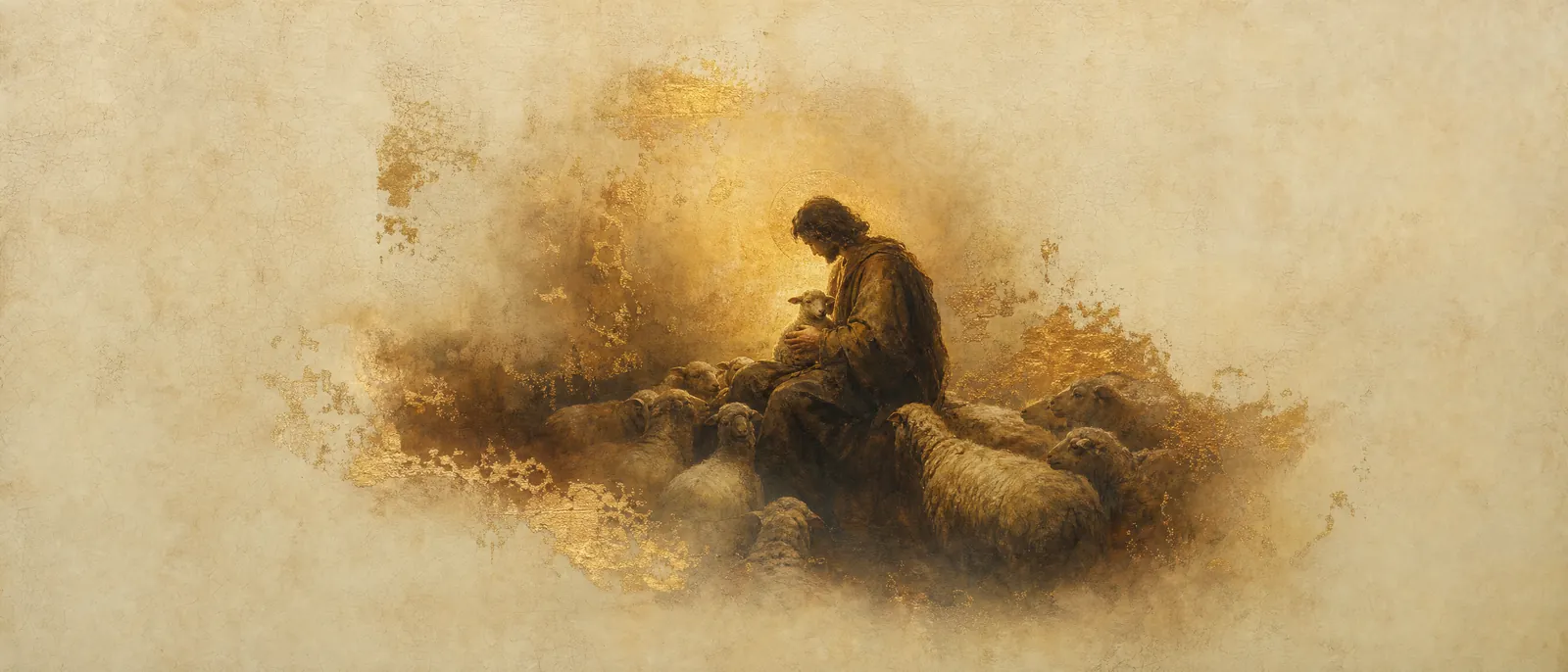
Roi — the tended one who learns to tend
Roi is a modern Israeli name, but it is not a modern word. It is a fragment lifted straight from the opening of Psalm 23 — 'the Lord is my shepherd' — a citation carried as a first name, so that whoever says it aloud has begun the most trusted sentence in the Psalter whether they meant to or not.
A Name That Is Half a Verse
Most names point to a person. Roi points to a sentence. רועי is not a character from Tanakh — it is the second and third syllables of the line every Jew has murmured at gravesides and Shabbat tables and in the dark: *Hashem ro'i, lo echsar* — 'the Lord is my shepherd, I shall not lack.' To be named Roi is to walk through the world carrying an unfinished quotation. Say the name and you have opened Psalm 23; the rest of the verse hangs in the air, waiting.
This is a particular kind of inheritance. The name does not describe its bearer — it describes the bearer's relationship to something larger. 'My shepherd' presumes a shepherd. Built into the word is the admission that someone is being led, watched, kept from lacking. It is one of the few names that is a statement of trust rather than a claim of power.
The Two Ends of the Crook
But a shepherd, in Tanakh, is never only the tended one. The flock is the standard apprenticeship for leadership. Moshe was pulled from Yitro's sheep to lead a nation; David was taken from the pasture to the throne. The Torah keeps making the same quiet argument — that whoever can be faithful over animals who cannot thank him can be faithful over a people who often won't.
So the name lives on both ends of the crook. There is Roi the sheep — held, provided for, unanxious, resting in green pastures. And there is Roi the shepherd — the one who counts the flock at dusk, who goes out after the one that strayed, who stays awake so others can sleep. People who carry this name tend to alternate between those two positions, often within the same week: deeply cared for, and quietly caring; leaning on someone, and being leaned upon.
The Lived Pattern
The cost of the name is that both roles are hard to hold at once. The one who is used to tending can forget how to be tended — can find it nearly unbearable to be the sheep, to admit a lack, to say *I need to be led here*. And the one who is used to being provided for can be slow to pick up the crook, waiting for a shepherd who has, in this season, become them.
The gift is a temperament calibrated toward trust. *Lo echsar* — 'I shall not lack' — is not a promise of abundance but a refusal of panic. Roi at his steadiest carries an internal setting that says: what I have is enough for the next stretch of the valley. That composure is contagious. It is why people hand this Roi the flock without quite deciding to — because he does not flinch when the path narrows.
The work of a life named Roi is learning to move fluently between the two positions: to receive tending without shame, and to give it without martyrdom. The name insists both are the same psalm.
Roi in the Classical Sources
In the sources, Roi — spelled רועי, gematria 286 — is read not as an invented modern name but as a citation. The word is a construct: ro'eh, 'shepherd,' with the possessive suffix, 'my.' Its home is a single half-verse that the tradition treats as the distilled grammar of trust.
PSALMS 23:1 — 'THE LORD IS MY SHEPHERD, I SHALL NOT LACK'
The name lives inside the psalm's opening breath: *Hashem ro'i, lo echsar*. Of all the images David could have chosen for God, he chose the shepherd — not king, not judge, not fire, but the figure who walks with the flock, knows each animal, and provides so steadily that the sheep never learns the word 'lack.' To be named Roi is to be named after the object of that trust: someone's shepherd, in a sentence whose whole point is that being shepherded means being safe.
The tradition returns to this psalm at its most vulnerable moments — mourning, illness, the valley of the shadow. That the name is drawn from precisely this line gives it a gravity most names lack. It carries not a trait but a posture: the settled confidence that one will not go without.
I SAMUEL 16:13 — THE SHEPHERD ANOINTED
David, the very author of the psalm, is the Tanakh's proof that the shepherd's field is a training ground for the crown. In I Samuel 16, Shmuel comes to anoint a king and passes over the tall, obvious brothers; the chosen one is out with the sheep, and must be sent for. The oil is poured on the youngest, the shepherd — and the spirit of God rests on him from that day.
This is the recurring biblical claim folded into the name: faithfulness over a flock qualifies a person for faithfulness over a nation. The shepherd is not a lesser role waiting to be outgrown but the apprenticeship itself. Roi inherits this arc — the one being tended is, in the same breath, being prepared to tend.
BERAKHOT 7b — A NAME KEEPS ITS BEARER ON BOTH ENDS OF THE CROOK
The Talmud in Berakhot 7b teaches *shema garim* — that a name exerts a pull on the one who carries it, that names are not neutral labels but forces. A possessive name like Roi — 'my shepherd' — does something particular: it never lets its bearer settle into one side. The word simultaneously names the shepherd and implies the one being shepherded.
So the name keeps its bearer moving between the two positions of the psalm — tended and tending, held and holding. Under the logic of *shema garim*, this is not accident but design: the name itself is the tension it describes, and living well means learning to inhabit both ends of the crook without dropping either.
THE LETTERS AND THE NUMBER
The gematria of רועי is 286. The most striking fact about the name is not arithmetic but grammatical: it is half a verse. Roi is not a whole word standing alone — it is the construct 'my shepherd,' a fragment that only completes itself when the sentence around it is spoken. Whoever says the name aloud has begun Psalm 23 whether they meant to or not.
That incompleteness is the letters' quiet teaching. A name that is a fragment is a name that points beyond itself — toward the shepherd it presumes, toward the verse it opens, toward the trust it can neither prove nor abandon. To be Roi is to be a syllable in someone else's sentence of faith, and to spend a life discovering whose.
The Talmud's principle shema garim — "the name causes" (Berakhot 7b) — is the tradition's claim that a name gently inclines its bearer. In this library, Roi's nearest companions are David and Rachel; the full index is at Hebrew names.
What does the name Roi mean?
Roi (רועי) means 'my shepherd.' It is drawn directly from the opening of Psalm 23 — *Hashem ro'i*, 'the Lord is my shepherd' — so the name is literally a fragment of that verse of trust.
What is the gematria of Roi?
The gematria of Roi in its modern spelling רועי is 286. Beyond the number, the name is notable for being half a verse: to say it aloud is to begin Psalm 23.
Where does the word Roi appear in the Tanakh?
Roi is a modern Israeli name, but its root is biblical: it comes from Psalms 23:1, 'the Lord is my shepherd, I shall not lack.' The shepherd image is central to Tanakh, most famously in David, the shepherd anointed king in I Samuel 16:13.
What does the name Roi say about personality?
The name lives on two ends of the crook — the tended and the tending. People named Roi tend to alternate between being deeply cared for and quietly caring for others, and their steadiest gift is the psalm's refusal of panic: the settled sense that what they have is enough for the next stretch of the valley.
What do the sources say about Roi?
Psalms 23:1 grounds the name in trust; I Samuel 16:13 shows the shepherd's field as the apprenticeship for leadership through David; and Berakhot 7b, teaching *shema garim*, suggests a possessive name like 'my shepherd' keeps its bearer moving between being led and leading.
Why is Roi considered an unfinished name?
Because grammatically it is a construct — 'my shepherd' — that presumes a shepherd and completes itself only when the rest of Psalm 23 follows. The name points beyond itself, which is why the tradition reads it as a posture of trust rather than a claim of self-sufficiency.