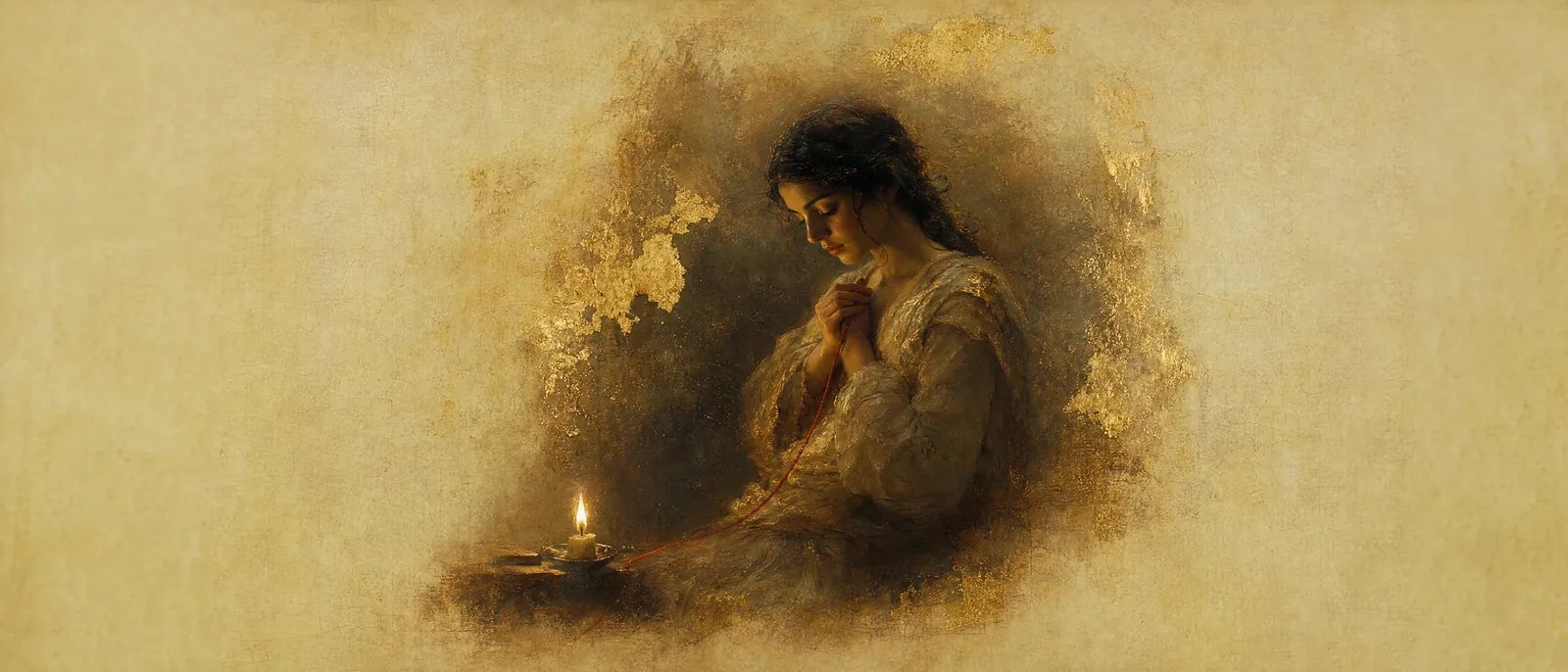
Tikva — the rope that holds before the proof arrives
Tikva means hope, but the Hebrew is stubbornly physical: a tikva is a cord, a rope, something you tie and leave hanging where you can see it. This is a name about weight-bearing — hope not as a mood, but as equipment.
A Word That Is Also an Object
In English, hope is weather — it comes and goes, it lifts and it sinks, and you cannot hold it in your hand. In Hebrew, the same idea has a rope in it. A tikva, in its oldest use, is a cord: the scarlet thread Rachav tied in her window in Yericho, the sign agreed upon in advance, the physical thing that held her family's whole future before a single wall came down.
This is the quiet marvel buried inside a name most people meet as the title of an anthem. HaTikvah, the hope — yes. But the word itself teaches something the anthem only sings: that hope, in this grammar, is not a feeling you wait to arrive. It is something you knot, secure, and leave visible. Tikva is hope you can lean your weight against.
The Anchor Point
People who carry this name tend to become the household's fixed point — the one everyone else ties themselves to when the ground shifts. Not because they are the loudest optimist in the room, but because they are structurally reliable. A cord is not hopeful because it is cheerful; it is hopeful because it will hold.
The pattern shows up as steadiness under strain. Tikva is often the person who says the plan out loud when everyone else has gone quiet, who names the future before there's evidence for it, who ties the thread in the window while the siege is still going on. There is a kind of faith in this that has nothing to do with denial — it's the faith of someone doing the practical work of hope: securing the knot, checking the fastening, staying in place.
The Cost of Being the Rope
Being the thing others hold onto is not free. A cord under constant load frays. Tikva can spend so much of herself being the anchor that no one thinks to ask what she is tied to — the one who holds everyone may quietly be holding no one.
The correction is inside the meaning. A cord is only hope if it is fastened to something more solid than itself. The name's deepest instruction is not 'be the rope for everyone' but 'stay tied to something that can bear you, too.' Hope that only flows outward eventually snaps. The Tikva who lasts is the one who lets herself be held as often as she holds.
Hope on a Schedule
There is a second grammar of tikva worth naming: in Jeremiah's letter to the exiles, hope is something granted with a timeline — a future and a tikva, promised to people who could not yet see it. This is hope as appointment, not accident. It teaches the bearer of the name that patience and expectation are the same posture: you tie the thread now, and you trust the schedule you cannot read.
At its best, Tikva lives in that tension — between the rope already tied and the wall not yet fallen. She holds the interval. That is the whole art of the name: to keep the cord in the window through the long middle, before the proof arrives.
Tikva in the Classical Sources
In the sources, תקוה (Tikva) is one of the great Hebrew double-words — a term for hope that is also, literally, a rope. Its gematria is 511. To read this name well is to watch a single word travel from a physical cord in a besieged city, to a promise mailed to exiles, to a rabbinic teaching about what a name is for.
JOSHUA 2:18 — THE CORD IN THE WINDOW
The word makes its Tanakh debut not as an emotion but as an object. Rachav is told: 'Bind this cord (tikvat) of scarlet thread in the window' — the sign agreed with the spies, the thing that will mark her house for salvation when Yericho falls. Hope here is a physical fastening, tied in advance of any rescue.
This is the root image of the name. Salvation was secured by a knot before there was any evidence it would matter — the wall still stood, the army had not come. Tikva is that scarlet thread: hope you can see, hope that bears weight, hope tied while the outcome is still in doubt.
JEREMIAH 29:11 — HOPE WITH A SCHEDULE
In the letter to the Babylonian exiles, the word turns from rope to promise: 'plans of peace and not of evil, to give you a future and a tikva.' Hope is granted here on a timeline — an appointment God keeps for people who cannot yet see the day.
For the bearer of the name, this verse pairs with the cord in Yericho to complete the picture. The thread is tied now; the fulfillment comes later. Tikva is asked to hold the interval between the knot and the proof — to trust a schedule she cannot read while keeping the cord visible in the window.
BERAKHOT 7b — THE NAME AS EQUIPMENT
Berakhot 7b teaches that a name shapes its bearer — shema garim, the name influences the person. Read through Tikva, this becomes a piece of practical instruction: a cord is only hope if it is tied to something. Left loose in a drawer, it is just string.
So the name is equipment, not decoration. It asks its bearer to be the knot — the fastening others can rely on — and, just as urgently, to stay fastened herself. Hope that anchors everyone but is anchored to nothing does not hold. The name's whole teaching is in that double demand: bear weight, and be borne.
THE LETTERS AND THE NUMBER
The gematria of תקוה is 511. The number is worth less here than the etymology it sits beside, because the true marvel of this name is not arithmetic but grammar: in Hebrew, the word for hope is a thing that bears weight. A tikva is a cord.
From this same word comes HaTikvah, the anthem — the hope. But the anthem borrows what the word already carried: that hoping, in Hebrew, is an act of tying, fastening, securing. To name a child Tikva is to hand her a rope and ask her to be trustworthy under load.
The Talmud's principle shema garim — "the name causes" (Berakhot 7b) — is the tradition's claim that a name gently inclines its bearer. In this library, Tikva's nearest companions are Naomi and Ruth; the full index is at Hebrew names.
What does the name Tikva mean?
Tikva (תקוה) means hope — but literally a cord or rope. Its earliest use is the scarlet thread Rachav bound in her window in Yericho (Joshua 2:18), making hope a physical thing tied in advance of rescue rather than a passing mood.
What is the gematria of Tikva?
The gematria of תקוה is 511. More telling than the number, though, is the word's own construction: hope in Hebrew is a thing that bears weight — the same word that gives us HaTikvah, the anthem.
Where does the word Tikva appear in the Tanakh?
It appears in Joshua 2:18 as an actual cord — the scarlet thread in Rachav's window — and again in Jeremiah 29:11, where God promises the exiles 'a future and a tikva,' hope granted with a schedule. Tikva is a modern Israeli name drawn from this biblical word.
What does the name Tikva say about personality?
Bearers tend to be the household's anchor point — steady under strain, the one who names the future before there's evidence for it. The risk is being so reliable for others that they forget to ask what, or who, is holding them.
What do the sources say about Tikva?
Joshua 2:18 gives hope as a literal rescue-cord; Jeremiah 29:11 gives it as a scheduled promise to exiles; and Berakhot 7b (shema garim) frames the name as equipment — a cord is only hope if it is tied to something, so the name asks its bearer to be the knot.
Why is Tikva connected to the Israeli anthem HaTikvah?
HaTikvah simply means 'the hope' and is built from this very word. But the name predates the borrowing in spirit: the anthem sings a feeling, while the word itself carries a rope — hope you can tie, see, and lean your weight against.