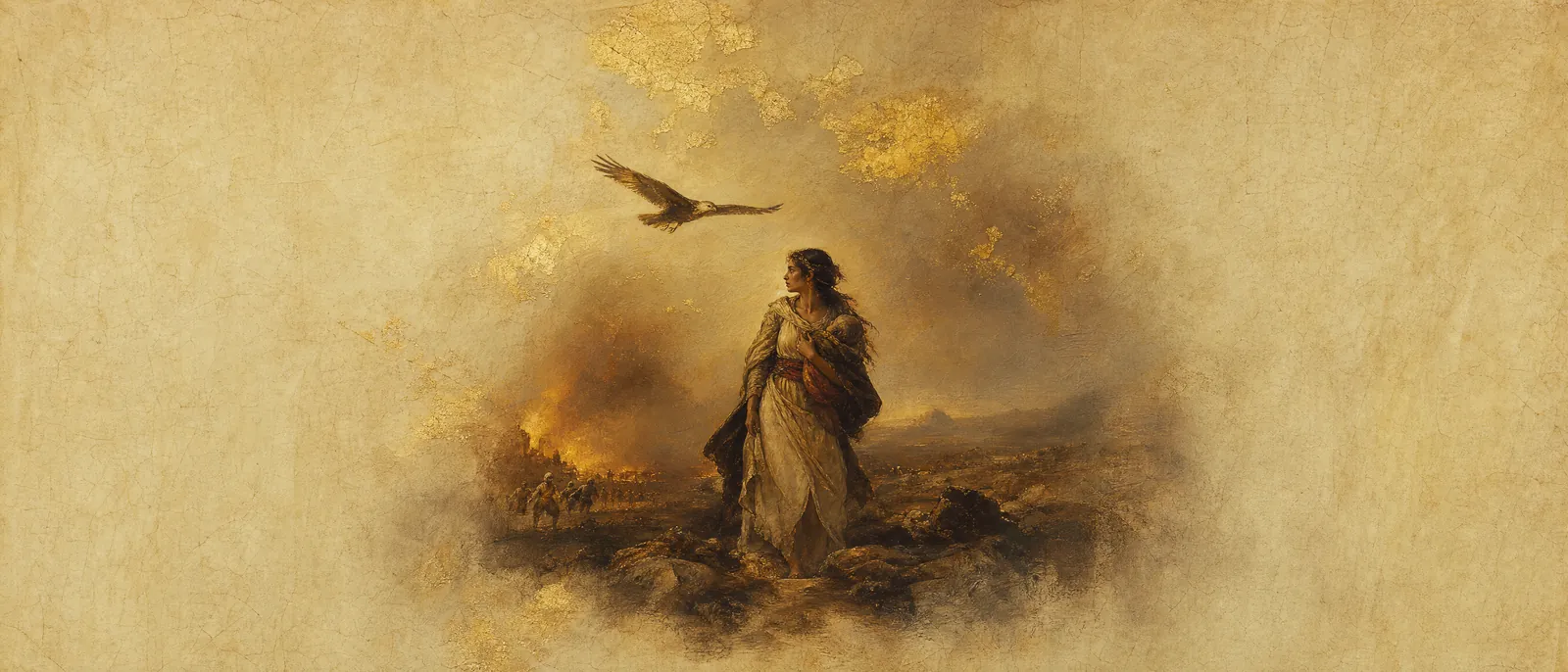
Tzipporah — the decisive stranger who saved the deliverer
Tzipporah is the ordinary Hebrew word for bird raised into a person — a Midianite shepherdess who married a fugitive at a well and, on the one night everything hung in the balance, moved first. Her name carries the architecture of the small, quick creature that acts before the larger figures around it have finished deciding.
A Bird at the Well
Tzipporah enters the story sideways. She is not a matriarch summoned by an angel, not a prophetess with a named calling — she is a shepherd's daughter at a Midianite well, one of seven sisters, when a stranger fleeing a death sentence in Egypt drives off the bullying herdsmen and waters their flock. The runaway is Moshe. The family takes him in, and the swift daughter is given to him in marriage (Exodus 2:21). It is easy to read her as scenery in someone else's epic.
That reading is the mistake the text is built to correct. Her name is tzippor — bird — the smallest, quickest creature in the Torah's vocabulary of motion. She is named not for grandeur but for speed and alertness: the thing that sees the danger and is already moving while the larger animals are still lifting their heads. People who carry this name tend to be filed under 'minor' by everyone around them — until the moment that filing becomes catastrophically wrong.
The One Who Moved First
The turning point is Exodus 4:25, a passage so compressed and strange that commentators have argued over it for centuries. On the road back to Egypt, at a night lodging, something goes lethally wrong — the text says God sought to kill, and the crisis hangs on an uncircumcised son. Moshe, the man commissioned to deliver a nation, does nothing. Tzipporah takes a flint, circumcises the child herself, and touches it to his feet. The danger passes. The Torah credits the rescue to her hand, not his.
This is the whole of her architecture in a single verse. She is the bird who moves while others freeze — not braver, exactly, but faster to the point of action, unwilling to wait for permission or clarity when the price of hesitation is a life. The deliverer of Israel was, on that night, delivered by his wife.
Underestimated Exactly Once
The lived pattern of a Tzipporah is legible to anyone who has watched one operate. She is quiet in the room, easy to overlook, often treated as the practical one who handles logistics while the visionaries talk. She rarely corrects this impression — and that restraint is itself a kind of strategy, because it means the underestimation is genuine and therefore devastating when it breaks.
The break comes when everything is at stake and everyone else is paralyzed by the size of the problem. That is when she acts — immediately, without a speech, with whatever instrument is at hand. Afterward the room recalibrates permanently. This is the cost, too: a Tzipporah can spend years being read as small, and can grow tired of proving otherwise only in emergencies. The gift and the burden are the same reflex — the one who moves first often moves alone.
The stranger from Midian never fully belonged to Israel's story, and yet without her one quick act the story ends at a roadside lodge. That is the shape of the name: the outsider whose decisiveness the insiders could not do without.
Tzipporah in the Classical Sources
In the sources, Tzipporah — ציפורה — is the ordinary word for bird lifted into a name, and its gematria of 391 sits over a life defined by speed. The classical texts do not soften her into a supporting role; read closely, they hand her the decisive act of one of the Torah's most dangerous nights.
EXODUS 2:21 — THE MARRIAGE AT THE WELL
The verse is spare: Moshe is content to dwell with the man, and he gives Tzipporah his daughter to Moshe. The deliverer-to-be of Israel is, at this moment, a fugitive with a price on his head, and the shelter he finds is entirely foreign — a Midianite priest's household and its swift daughter. The rescue economy of the Exodus begins here, with the outsiders taking in the runaway.
It matters that she is given at a well, the classical biblical site of covenantal meeting. But Tzipporah is no matriarch of the Genesis pattern; she is a Midianite shepherdess whose story is measured almost entirely by what she does, not by lineage or promise. The verse plants her quietly, which makes what follows land harder.
EXODUS 4:25 — THE NIGHT AT THE LODGING
Here the name earns its meaning. At the night lodging, with a lethal danger pressing and Moshe inert, Tzipporah takes a flint, circumcises her son, and touches it to his feet — and the threat lifts. The Torah gives her the verbs of rescue: she acts, immediately and decisively, in a passage where the great prophet does not.
The bird moved while others froze. This is the single most concentrated portrait of her soul in Scripture — not a woman of long speeches or visible authority, but one whose instinct to act in the exact moment of crisis outran everyone else's. The Exodus continues because she did not wait.
YOMA 83b — R. MEIR READS THE NAME
The Talmud in Yoma 83b preserves R. Meir's practice of reading meaning out of names, and the name Tzipporah rests on tzippor, the bird — the Torah's own emblem of quickness and escape. The bird is the creature that flies before the trap closes, that is small and alert and impossible to cage.
Worn by the woman whose one quick act kept the Exodus alive, the emblem is exact. Her name is not decorative; it is a description of the reflex that saved the deliverer. The bird's speed and the shepherdess's decisiveness are the same trait, read once in the wing and once in the hand.
THE LETTERS AND THE NUMBER
The gematria of Tzipporah in its modern spelling, ציפורה, is 391. There is no ancient numerical drama to invent here and none is needed: the number simply sits over a name that is, at root, the plainest word imaginable — bird — raised into a person.
That is the whole force of the letters. Tzipporah is small, alert, and impossible to cage, exactly as the word tzippor describes. The name does not reach for majesty; it takes the ordinary creature that moves first and makes it a soul, which is why the woman who bears it is so easily underestimated and so decisive when it counts.
The Talmud's principle shema garim — "the name causes" (Berakhot 7b) — is the tradition's claim that a name gently inclines its bearer. In this library, Tzipporah's nearest companions are Moshe and Yocheved; the full index is at Hebrew names.
What does the name Tzipporah mean?
Tzipporah (ציפורה) means 'bird' — specifically the small, swift, alert creature. It belonged to the Midianite shepherdess who married Moshe at the well (Exodus 2:21), and the name captures a soul built for quick, decisive action rather than grandeur.
What is the gematria of Tzipporah?
The gematria of Tzipporah in its modern spelling, ציפורה, is 391. The number sits over a name that is simply the ordinary Hebrew word for bird lifted into a person — small, alert, and impossible to cage.
Where does Tzipporah appear in the Tanakh?
Tzipporah is the wife of Moshe, first named in Exodus 2:21 when the Midianite priest gives her to the fugitive Moshe in marriage. Her decisive moment comes in Exodus 4:25, at the night lodging, where she performs the circumcision that lifts a lethal danger.
What does the name Tzipporah say about personality?
The name marks someone easily overlooked as 'minor' who acts first and fastest exactly when everyone else freezes. Like the bird of her name, a Tzipporah is quiet, alert, and decisive under pressure — underestimated, as the pattern goes, exactly once.
What do the sources say about Tzipporah?
Exodus 2:21 places her as the foreign shepherdess who shelters the runaway Moshe; Exodus 4:25 credits her with the night rescue that keeps the Exodus alive; and Yoma 83b, through R. Meir's name-reading, roots her name in tzippor, the bird — the Torah's emblem of quickness and escape.
Why is Tzipporah called the one who saved the deliverer?
At the night lodging in Exodus 4:25, with a deadly threat pressing and Moshe inert, Tzipporah alone takes the flint and acts, and the danger passes. The man commissioned to deliver Israel was, on that night, delivered by his wife — which is why the name carries the archetype of the decisive stranger who saved the deliverer.