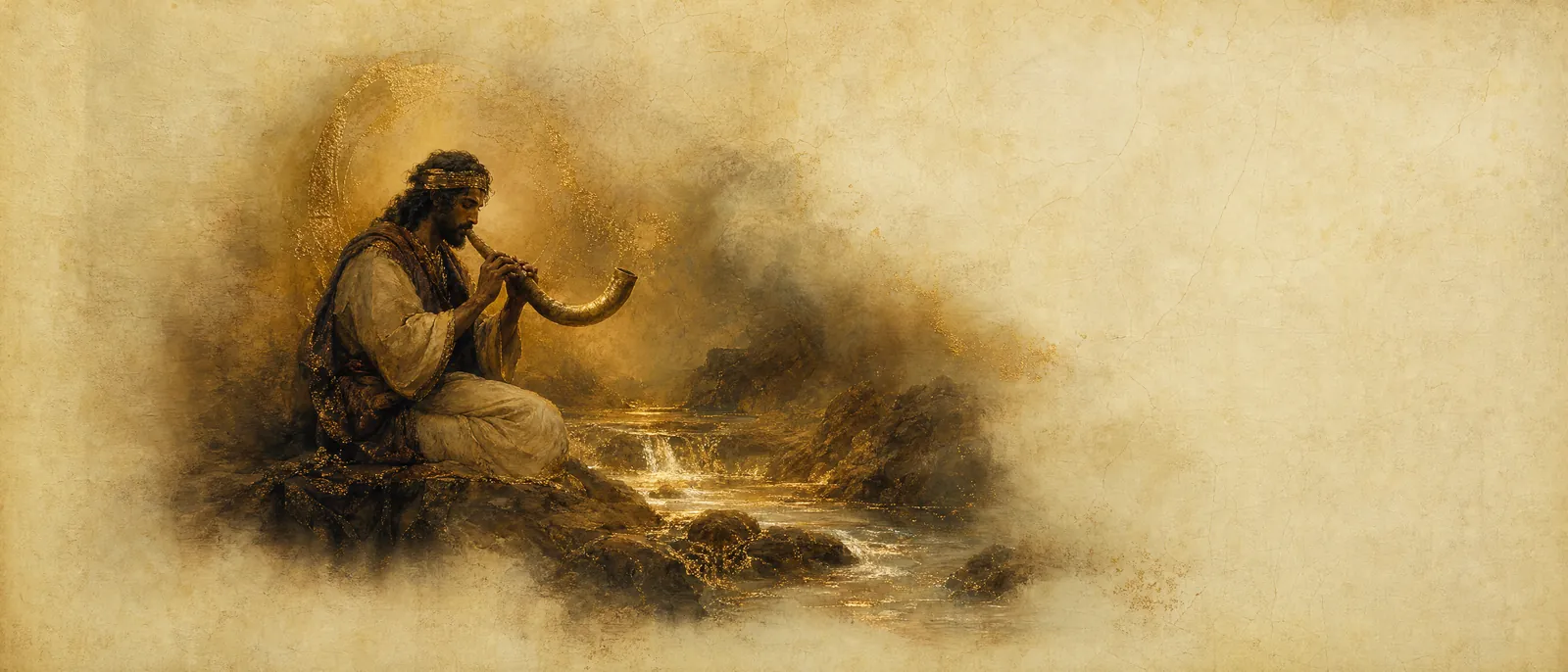
Yuval — the one through whom things flow
Yuval is a modern Israeli name resting on one of the Torah's oldest words — a word that means a stream, a jubilee, and the founding of music all at once. Everything it touches is about release and flow.
A Name Made of Currents
Yuval is a rarity: a modern Israeli name that happens to sit on a very old root, and that root refuses to hold still. In Hebrew, יובל does at least three things at once. It names a stream of water. It names the yovel — the jubilee year, announced by the ram's horn. And, in the Torah's first genealogy of human civilization, it names a person: Yuval, the first musician. Three meanings, one word — and every one of them is about something moving that could otherwise stay stuck.
So the person carrying this name is carrying a theme, not a single story. Water, sound, freedom: each is a form of release. A stream is water that will not pool. Music is breath and vibration that will not stay inside the chest. Jubilee is property and person let go back to their origin. Yuval, at its center, is not about holding — it is about passage.
The Conduit
People named for flow tend to become conduits. Things move through Yuval that would otherwise sit inert — an idea that needed a voice, a tension in a room that needed sound, a stalled situation that needed someone willing to let it go. This is a real gift and a real exposure. The conduit's strength is that they don't clench; their weakness is the same. What passes through can leave a person feeling used as a channel rather than valued as a source.
There is a cost worth naming. A stream that is always giving passage can forget it also has banks — a shape, a limit, a self. Yuval's temptation is to keep the current moving for everyone else and never dam anything up long enough to keep it. The healthiest version of this name learns when to be a stream and when to be a reservoir: when to release, and when release would just be leakage.
Music as the First Sign
It matters that the original Yuval was a musician — the Torah's very first. Not a warrior, not a king, but the father of everyone who plays the lyre and the pipe. Music is the purest picture of what this name does: it takes something invisible and internal and lets it out into the shared air, where it can move other people too. Yuval's instinct, again and again, is to make the inner thing audible.
And music, unlike a possession, cannot be hoarded — the moment you stop playing it, it's gone. That is the deep logic of the name. What Yuval offers is real precisely because it flows. Held too tightly, it stops being music at all.
Yuval in the Classical Sources
In the sources, יובל opens like a river delta — the same word branching into music, water, and freedom. The gematria of Yuval is 48, and what the classical texts hand us is not one meaning but a single word carrying three currents at once. Here is where each one runs.
GENESIS 4:21 — THE FATHER OF ALL MUSIC
In the Torah's first account of how civilization takes shape, one line reads: 'Yuval — he was the father of all who grasp the lyre and pipe.' Seven generations from Adam, before nations or kingdoms, the text pauses to record the origin of music. It is a striking priority: among the founders of metalwork and herding, one man is remembered as the one who first made the invisible audible.
This is the human root of the name. Yuval is not a title or a place but a person credited with a whole domain of human life — sound made for its own sake, released into the air to move others. The name carries that founding role: the instinct to give inner things a voice.
LEVITICUS 25:10 — PROCLAIM LIBERTY
The same word names the yovel, the jubilee. Leviticus commands: 'proclaim liberty throughout the land' — the fiftieth year, announced by the horn, when slaves go free and every field returns to its original family. What was pledged, sold, or lost flows back to its source.
Here the theme of release becomes law. The yovel is a national act of letting go, built into the calendar so that nothing stays permanently stuck. It is the same current as the stream and the music, made structural: a whole society designed around the moment things must be set free.
JEREMIAH 17:8 — THE TREE BY THE STREAM
Jeremiah gives the third current its clearest image. He describes a life like a tree planted by water 'that sends out its roots to the yuval — the stream': in drought it does not fear, its leaf stays green, and it does not cease to bear fruit. Here yuval simply means the flowing water itself.
The prophet's picture completes the name. To live by the yuval is to be fed by something that keeps moving — never dependent on standing pools, never afraid of dry years, because the source keeps flowing through. It is the reward, in Jeremiah's vision, of a life rooted near what does not stop.
THE LETTERS AND THE NUMBER
The gematria of Yuval is 48. One word, three currents — a stream, a jubilee, and the first music. That is the whole architecture of the name in a single figure: everything יובל touches is about release and flow.
There is no need to reach for more. The name's power is in how one small word branches: water that will not pool, a horn that frees what was bound, and a founder who let the first music out into the air. Held together, they describe a soul built for passage rather than possession.
The Talmud's principle shema garim — "the name causes" (Berakhot 7b) — is the tradition's claim that a name gently inclines its bearer. In this library, Yuval's nearest companions are David and Maayan; the full index is at Hebrew names.
What does the name Yuval mean?
Yuval (יובל) means a stream of flowing water, and the same word names the yovel — the jubilee year announced by the ram's horn. In Genesis 4:21 it is also the name of the Torah's first musician, so the name gathers three ideas of release: music, water, and freedom.
What is the gematria of Yuval?
The gematria of Yuval is 48. Fittingly for a single word that carries three currents — a stream, a jubilee, and the first music — the name is entirely built around themes of release and flow.
Where does the word Yuval appear in the Tanakh?
Yuval is a modern Israeli name resting on an old root that appears several times. As a person it names the first musician in Genesis 4:21; as the jubilee it appears in Leviticus 25:10; and as a stream of water it appears in Jeremiah 17:8.
What does the name Yuval say about personality?
Yuval tends toward being a conduit — someone through whom things move that would otherwise stay stuck, whether ideas, sound, or a stalled situation. The gift is fluency and generosity; the cost is forgetting one's own banks, giving passage to everything and keeping little for oneself.
What do the sources say about Yuval?
Genesis 4:21 makes Yuval the father of all who play the lyre and pipe; Leviticus 25:10 uses the same word for the jubilee that proclaims liberty; and Jeremiah 17:8 pictures a tree rooted by the yuval, the stream. Together they frame a life defined by flow and release.
Why is Yuval connected to both music and freedom?
Because Hebrew binds them in one word: יובל is the musician of Genesis, the jubilee horn of Leviticus, and the flowing stream of Jeremiah. All three are forms of release — sound leaving the chest, property returning to its source, water refusing to pool — which is why the name reads as a single theme of things moving through.