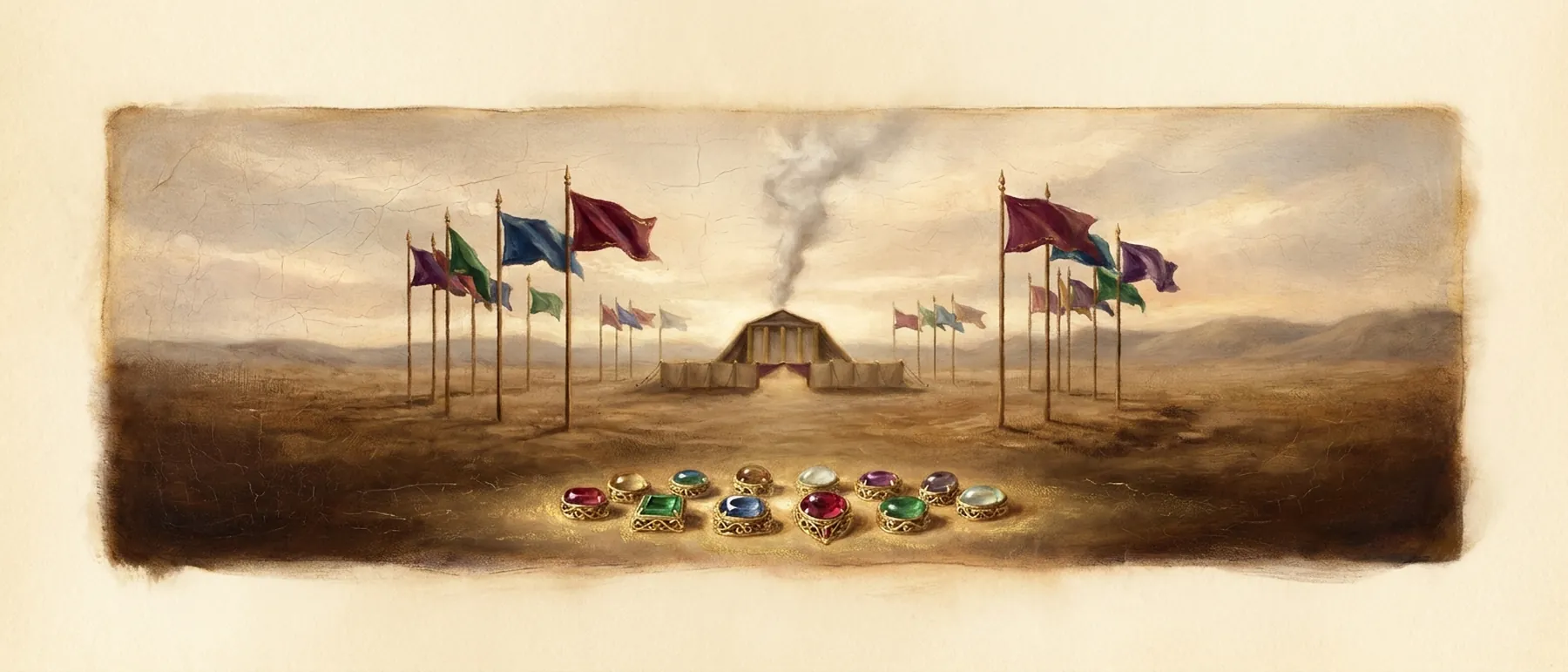
The 12 Tribes of Israel — names, mothers, banners, stones and months
The 12 tribes of Israel are the families descended from the twelve sons of Jacob: Reuben, Simeon, Levi, Judah, Dan, Naphtali, Gad, Asher, Issachar, Zebulun, Joseph and Benjamin. Their mothers were Leah, Rachel, and the two maids Bilhah and Zilpah. In later lists Joseph counts as two tribes, Ephraim and Manasseh, and Levi, which received no land, stands apart, so the number stays at twelve.
The twelve sons at a glance
The table follows the order in which Genesis narrates the births. "Meaning" is what the mother says when she names the child, in the JPS translation. The emblem is the picture on each tribe's banner as described in the Midrash Bamidbar Rabbah 2:7, which is a rabbinic tradition, not a verse of the Torah. The month is the later pairing that follows the marching order of the banners.
| # | Tribe | Hebrew | Mother | What the name means (naming verse) | Banner emblem (Bamidbar Rabbah 2:7) | Month (banner order) |
|---|---|---|---|---|---|---|
| 1 | Reuben (Re'uven) | רְאוּבֵן | Leah | "GOD has seen my affliction" (Genesis 29:32) | Mandrakes, on red | Tammuz |
| 2 | Simeon (Shimon) | שִׁמְעוֹן | Leah | "GOD heard" (Genesis 29:33) | The city of Shechem, on green | Av |
| 3 | Levi | לֵוִי | Leah | "My husband will become attached to me" (Genesis 29:34) | The Urim and Thummim, on white, black and red | None |
| 4 | Judah (Yehudah) | יְהוּדָה | Leah | "This time I will praise GOD" (Genesis 29:35) | A lion, on sky color | Nisan |
| 5 | Dan | דָּן | Bilhah | "God has vindicated me" (Genesis 30:6) | A serpent, on sapphire color | Tevet |
| 6 | Naphtali (Naftali) | נַפְתָּלִי | Bilhah | "A fateful contest I waged with my sister" (Genesis 30:8) | A hind, on pale wine color | Adar |
| 7 | Gad | גָּד | Zilpah | "What luck" (Genesis 30:11) | An encampment, on black and white | Elul |
| 8 | Asher | אָשֵׁר | Zilpah | "What fortune" (Genesis 30:13) | An olive tree | Shevat |
| 9 | Issachar (Yissachar) | יִשָּׂשכָר | Leah | "God has given me my reward" (Genesis 30:18) | Sun and moon, on blue-black | Iyar |
| 10 | Zebulun (Zevulun) | זְבֻלוּן | Leah | "A choice gift... my husband will exalt me" (Genesis 30:20) | A ship, on white | Sivan |
| 11 | Joseph (Yosef) | יוֹסֵף | Rachel | "God has taken away my disgrace"; "May GOD add another son" (Genesis 30:23–24) | Egypt, on black; Ephraim an ox, Manasseh an aurochs | As Ephraim: Tishrei. As Manasseh: Cheshvan |
| 12 | Benjamin (Binyamin) | בִּנְיָמִין | Rachel | Rachel named him Ben-oni as she died; his father called him Benjamin (Genesis 35:18) | A wolf, on all twelve colors | Kislev |
Three names carry more than one pun. Leah gives Reuben two explanations, "GOD has seen my affliction" for the start of the name and "now my husband will love me" for its end; Zebulun's verse plays on both zevadani ("gave me a gift") and yizbeleni ("will exalt me"); and Rachel's words at Joseph's birth use both asaf ("has taken away") and yosef ("may add"). Benjamin is the only son whose naming verse gives no explanation for the name his father chose.
Twelve tribes, two ways of counting
There are two different lists of twelve, and both are biblical.
The sons of Jacob. Genesis 35:22–26 counts twelve sons by their mothers, and Genesis 49:28 closes Jacob's blessings with "All these were the tribes of Israel, twelve in number." This list includes Levi and Joseph.
The tribes of the census, the camp and the land. Late in life, Jacob tells Joseph: "Ephraim and Manasseh shall be mine no less than Reuben and Simeon." So when Moses counts the people in Numbers 1, the twelve chieftains include one from Ephraim and one from Manasseh, and none from Levi. God tells Moses, "Do not on any account enroll the tribe of Levi," because the Levites are to carry and guard the Tabernacle and camp around it (Numbers 1:47–53).
The second census, in Numbers 26, repeats the pattern. The twelve tribes total 601,730 men, and the Levites are counted separately, 23,000 males from one month up, "since no share was assigned to them among the Israelites." In the first census the total was 603,550.
Joshua 14:3–4 states the arithmetic of the land directly: "the descendants of Joseph constituted two tribes, Manasseh and Ephraim," while "the Levites were assigned no share in the land, but only some towns to live in." Joshua 13:14 gives the reason: Levi's portion was the offerings. The Levite towns came to 48 in all, spread through the other tribes' holdings (Joshua 21:41).
The four camps and their banners (Numbers 2)
In the wilderness the twelve land tribes camped in four groups of three around the Tent of Meeting, "each with its standard, under the banners of their ancestral house." The Levites camped in the middle, around the Tabernacle itself.
| Side | Lead tribe | Camped with | Total enrolled | Marched |
|---|---|---|---|---|
| East | Judah | Issachar, Zebulun | 186,400 | First |
| South | Reuben | Simeon, Gad | 151,450 | Second |
| Center | Levites, with the Tent of Meeting | — | Not counted with Israel | Between the divisions |
| West | Ephraim | Manasseh, Benjamin | 108,100 | Third |
| North | Dan | Asher, Naphtali | 157,600 | Last |
Numbers 10:14–27 gives the same marching order when the camp first sets out from Sinai: Judah, Issachar, Zebulun; Reuben, Simeon, Gad; Ephraim, Manasseh, Benjamin; Dan, Asher, Naphtali. That sequence matters later, because it is the order the month tradition follows.
The Torah does not say what the banners looked like. The colors and pictures come from Bamidbar Rabbah 2:7, which says each chieftain's banner matched the color of his tribe's stone on the high priest's breastpiece, and adds a picture for each: Judah's lion, Dan's serpent, Benjamin's wolf. Several of the pictures are drawn from Jacob's blessings in Genesis 49, and the Midrash often quotes the verse it draws on.
The breastplate stones (Exodus 28:17–21)
The high priest's breastpiece held twelve stones in four rows, each engraved with the name of one of the sons of Israel. The Hebrew names are certain. What minerals they were is not, and translations disagree.
| Row | Hebrew (Exodus 28:17–20) | JPS translation |
|---|---|---|
| 1 | אֹדֶם, פִּטְדָה, בָּרֶקֶת | carnelian, chrysolite, emerald |
| 2 | נֹפֶךְ, סַפִּיר, יָהֲלֹם | turquoise, sapphire, amethyst |
| 3 | לֶשֶׁם, שְׁבוֹ, אַחְלָמָה | jacinth, agate, crystal |
| 4 | תַּרְשִׁישׁ, שֹׁהַם, יָשְׁפֵה | beryl, lapis lazuli, jasper |
An example of the uncertainty: the JPS Tanakh renders yahalom as "amethyst" and achlamah as "crystal," while Sefaria's English Midrash Rabbah renders yahalom as "clear quartz" and achlamah as "amethyst."
Which name went on which stone is also a matter of interpretation. Rashi says the stones followed the order of the sons' births, "a sardius for Reuben, a topaz for Simeon, and so in the case of all of them." Bamidbar Rabbah 2:7 gives its own list. The two agree for Reuben, Simeon, Levi, Judah, Joseph and Benjamin, but not for the six middle sons.
The "lost tribes" of Israel
After King Solomon, the kingdom split. The rest of Israel made Jeroboam king, and "only the tribe of Judah remained loyal to the House of David"; Solomon's son Rehoboam then mustered "all the House of Judah and the tribe of Benjamin."
The northern kingdom fell to Assyria. Second Kings 17:6 records that in the ninth year of King Hoshea the king of Assyria captured Samaria and deported the Israelites to Halah, the Habor, the River Gozan and the towns of Media. Verse 18 sums up: "none was left but the tribe of Judah alone." These are the tribes popularly called lost. The verses say where they were deported. They do not say what became of them afterward.
One result shows up in the language. Klein's dictionary explains that yehudi first meant a member of the tribe of Judah, then of the kingdom of Judah, and after the Assyrian conquest of the northern kingdom in 722 B.C.E. it came to mean "Jew."
Which tribe am I from?
For almost every Jew alive today, the honest answer is that there is no record that would tell you.
The exception is two hereditary roles. The Kohanim (priests) are the descendants of Aaron, who was himself from the tribe of Levi, and the Levites are the rest of that tribe. In synagogue the Torah is read in a fixed order: "a priest reads first, and after him a Levite, and after him an Israelite." Even this status is accepted today largely on a family's word. The Shulchan Arukh rules that a man who says "I am a Kohen" is not believed on his own word, and the gloss of the Rema records the custom of accepting him for the first Torah reading and the priestly blessing. A Jew who is neither Kohen nor Levite is called up as a Yisrael, with no tribe named.
No quiz, birth date or name can tell you which tribe you descend from. The pairing of tribes with Hebrew months on this site is a symbolic tradition about the months. It is not a statement about anyone's ancestry.
The tribes and the twelve months
The link between tribes and months is late, and it is a matter of interpretation.
Sefer Yetzirah, chapter 5, which lines up the twelve months with the twelve signs of the Jewish zodiac, names twelve letters, faculties and parts of the body, but no tribes. The tribal pairing comes from Rabbi Tzvi Elimelech of Dinov's Bnei Yissaschar, which assigns each month "according to the order of the banners": Nisan to Judah, "from whom comes the rod of kingship"; Tishrei to Ephraim, "seventh in the setting-out of the banners"; Kislev to Benjamin and Tevet to Dan. Counting the banner order of Numbers 10:14–27 from Nisan gives the full list in the table above.
Not every commentator does it this way. The commentary printed under the name of the Ra'avad on Sefer Yetzirah 5:1 (Sefaria's catalog attributes it to Joseph ben Shalom Ashkenazi) pairs the tribes with the twelve faculties instead of the months: sight with Reuben, speech with Judah, sleep with Benjamin, and so on, and records alternatives for several of them. Levi and Joseph appear in that list. In the banner order they have no month, because Levi camped around the Tabernacle and Joseph marched as Ephraim and Manasseh.
For how the months themselves work, see the Hebrew months. For how this tradition relates to the Bible's own references to stars and signs, see the zodiac in the Bible.
Frequently asked questions
What are the names of the 12 tribes of Israel?
As sons of Jacob they are Reuben, Simeon, Levi, Judah, Dan, Naphtali, Gad, Asher, Issachar, Zebulun, Joseph and Benjamin (Genesis 35:22–26). In the census of Numbers 1 and in the division of the land, Joseph is counted as two tribes, Ephraim and Manasseh, and Levi is counted separately because it received no territory.
Who were the mothers of the twelve tribes?
Leah bore Reuben, Simeon, Levi, Judah, Issachar and Zebulun. Rachel bore Joseph and Benjamin. Rachel's maid Bilhah bore Dan and Naphtali, and Leah's maid Zilpah bore Gad and Asher. Genesis 35:23–26 lists the twelve sons in exactly these four groups.
Why are Ephraim and Manasseh tribes but Joseph is not?
Jacob adopted Joseph's two sons as his own, saying they would be his "no less than Reuben and Simeon" (Genesis 48:5). From then on Joseph's descendants count as two tribes. Joshua 14:3–4 sets the two facts side by side: Joseph's descendants were two tribes, and the Levites received towns to live in rather than a territory.
What are the symbols of the 12 tribes?
The Torah does not describe them. Midrash Bamidbar Rabbah 2:7 gives each banner a color matching its stone and a picture: mandrakes for Reuben, Shechem for Simeon, the Urim and Thummim for Levi, a lion for Judah, a ship for Zebulun, a serpent for Dan, a hind for Naphtali, an olive tree for Asher, and a wolf for Benjamin, among others.
What happened to the ten lost tribes of Israel?
Second Kings 17:6 says the king of Assyria captured Samaria and deported the Israelites to Halah, the Habor, the River Gozan and the towns of Media, and verse 18 says only the tribe of Judah was left. The biblical text records the deportation but not what later became of the exiles.
Which tribe am I from?
Unless your family has a tradition of being Kohanim or Levites, there is no reliable way to know. Most Jews have no tribal lineage beyond that family tradition, and even priestly status is accepted today largely on a family's word. Any month-to-tribe pairing, including the one on this site, is symbolic and says nothing about your actual descent.
Is there a tribe for each zodiac sign?
Not in Sefer Yetzirah, which pairs months, signs and letters but names no tribes. The later Bnei Yissaschar assigns tribes to months by the order of the banners, which makes Judah the tribe of Nisan (Aries) and Benjamin the tribe of Kislev (Sagittarius). Levi and Joseph have no month in that scheme.
To see the Hebrew month you were born in, its sign and the tribe this tradition pairs with it, you can request a free Jewish zodiac reading.
In the sources
Every text below was read in the linked edition while this page was written.
- Genesis 35:22-26 (with 29:31-35; 30:1-24; 35:16-18) — sefaria.org
- Numbers 1:5-15; 1:47-53 — sefaria.org
- Joshua 14:3-4; 13:14 — sefaria.org
- Genesis 29:32-35 — sefaria.org
- Genesis 30:6, 8, 11, 13, 18, 20, 23-24 — sefaria.org
- Genesis 35:16-18 — sefaria.org
- Bamidbar Rabbah 2:7 — sefaria.org
- Bnei Yissaschar, Nisan 1:4; Tishrei 1:1; Kislev and Tevet 3:38 — sefaria.org
- Genesis 49:28 — sefaria.org
- Genesis 48:5 — sefaria.org
- Numbers 26:51; 26:62 — sefaria.org
- Numbers 1:46 — sefaria.org
- Joshua 21:41 — sefaria.org
- Numbers 2:2-33 — sefaria.org
- Numbers 3:23, 29, 35, 38 — sefaria.org
- Numbers 10:14-27 — sefaria.org
- Exodus 28:17-21 (repeated 39:10-14) — sefaria.org
- Rashi on Exodus 28:21:1 — sefaria.org
- Rashi on Exodus 28:21; Bamidbar Rabbah 2:7; Genesis 29:31-30:24 — sefaria.org
- I Kings 12:20-21 — sefaria.org
- II Kings 17:6; 17:18 — sefaria.org
- Klein Dictionary, יְהוּדִי — sefaria.org
- Exodus 28:1; Exodus 6:16-20; Numbers 18:1-2 — sefaria.org
- Mishnah Gittin 5:8; Shulchan Arukh, Orach Chayim 135:3 — sefaria.org
- Shulchan Arukh, Even HaEzer 3:1 with Rema — sefaria.org
- Sefer Yetzirah (Gra Version) 5:1-10; Sefer Yetzirah 5:1-2 — sefaria.org
- Ra'avad on Sefer Yetzirah 5:1 — sefaria.org
All twelve months, with the tribe and sign tradition pairs with each.
The Hebrew zodiac signs, month by month.
Your Hebrew birth date and its month.