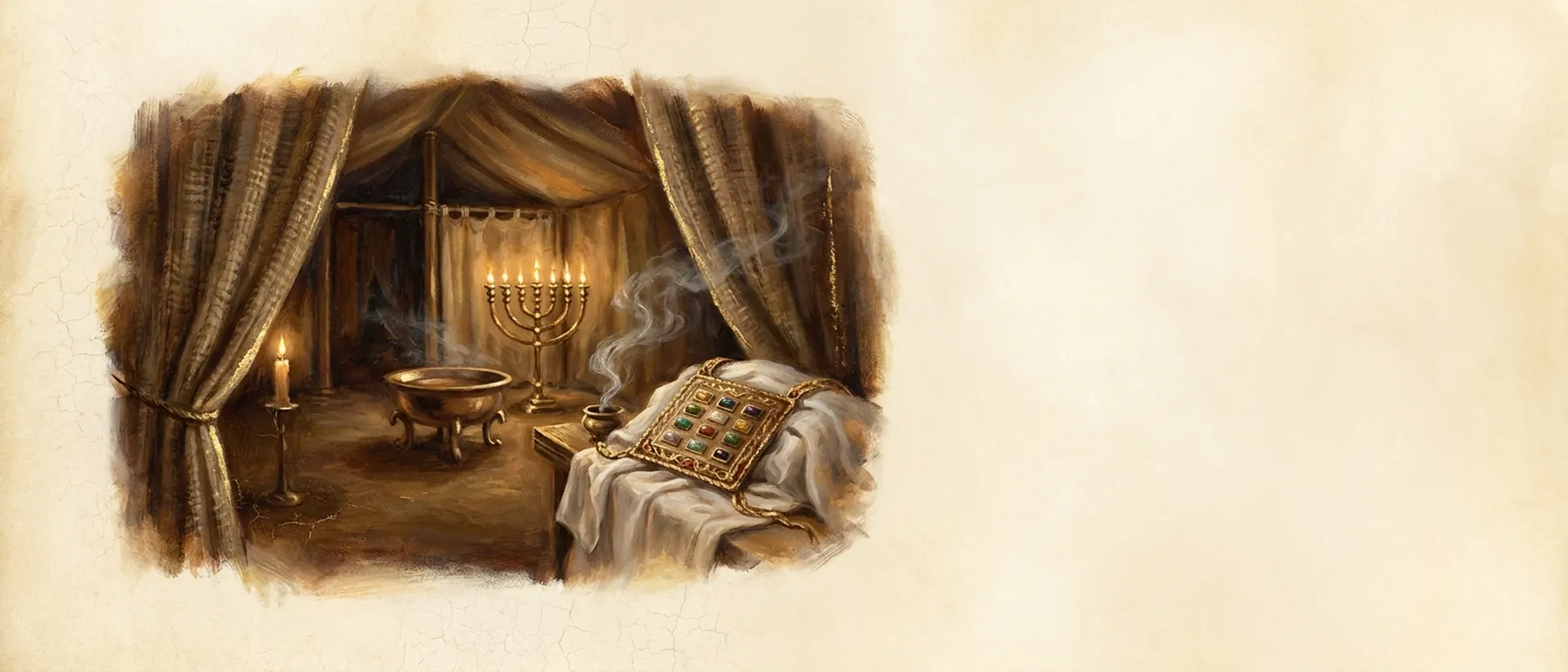
The Tribe of Levi — the tribe with no land and no month
The tribe of Levi descends from Levi, the third son of Jacob and Leah, named for her hope "This time my husband will become attached to me." Its banner in the Midrash shows the Urim and Thummim on white, black and red. Levi received no territory and, in the month tradition, no month.
It is the tribe of Moses and Aaron. Aaron's descendants became the priests, the Kohanim, and the rest of the tribe served as Levites. Both roles are still recognized in synagogue today.
The name and the birth
Leah named her first two sons for what God had seen and heard. With her third son she named a hope about Jacob: "This time my husband will become attached to me, for I have borne him three sons." The verb yilaveh, "will become attached," gives the name Levi.
The verse ends differently from the others. For most of Jacob's sons the Hebrew says "she called his name." For Levi it says kara shemo, "he called his name," which JPS renders "he was named Levi." Rashi notices the change and quotes a midrash that God himself named Levi, giving him the twenty-four gifts of the priesthood as an accompaniment, livuy.
The first story told about Levi as a grown man is violent. In Genesis 34, in the episode of their sister Dinah, "Simeon and Levi, two of Jacob's sons, brothers of Dinah, took each his sword, came upon the city unmolested, and slew all the males."
Jacob's blessing (Genesis 49)
Jacob speaks to Simeon and Levi together, and his words are closer to a rebuke than a blessing:
Readers often set the last line beside what later happened to Levi in the land: the tribe received no territory of its own, only 48 towns spread through the holdings of the other tribes.
Moses' blessing (Deuteronomy 33)
Moses' blessing for Levi is the opposite in tone:
Compare the golden calf in Exodus 32. When Moses called for whoever was "for GOD" to come to him, "all the men of Levi rallied to him," and afterward Moses told them, "each of you has been against blood relations." Jacob condemned Levi's sword at Shechem; Moses blesses a tribe whose sword served God. That contrast is a reading of the passages side by side, not a statement made by either one.
Symbol, flag and stone
According to Midrash Bamidbar Rabbah 2:7, each tribe's banner matched the color of its stone on the high priest's breastpiece. Levi's stone was the bareket, and its banner was "dyed one-third white, one-third black, and one-third red, and the urim and tumim were depicted on it." The Urim and Thummim were placed inside the high priest's breastpiece, over Aaron's heart, which fits the tribe of the priesthood and Moses' words "Let Your Thummim and Urim be with Your faithful one." The banner itself is rabbinic tradition. The Torah does not describe it.
The bareket is the third stone of the first row (Exodus 28:17). Rashi's rule that the stones follow birth order gives Levi, the third son, the third stone, and Bamidbar Rabbah agrees. Both the JPS Tanakh and Sefaria's English Midrash Rabbah translate bareket as "emerald," but the identification of the ancient stone is uncertain.
In the wilderness and in the land
| Tribe of Levi | |
|---|---|
| First census | Not counted with Israel (Numbers 1:47–49). Counted separately from one month old: 22,000 (Numbers 3:39) |
| Second census | 23,000 males from one month old (Numbers 26:62) |
| Camp | Around the Tabernacle: Gershon west, Kohath south, Merari north; Moses, Aaron and his sons east (Numbers 3) |
| On the march | Gershon and Merari after Judah's division, Kohath after Reuben's (Numbers 10:17, 21) |
| Head chieftain | Eleazar son of Aaron the priest (Numbers 3:32) |
| Territory | None. 48 towns with pastures among the other tribes (Joshua 21:41) |
The Levites were counted differently because they had a different job. God takes them "in place of all the male first-born" of Israel to serve at the Tabernacle. The general census counted men "from the age of twenty years up, all those in Israel who are able to bear arms"; the Levites were left out of it and counted from one month old instead.
Instead of land, the Torah gives Levi the tithes: "to the Levites I hereby give all the tithes in Israel as their share in return for the services that they perform." Joshua 13:33 puts it another way: "the ETERNAL, the God of Israel, is their portion."
Notable Levites. Moses and Aaron were sons of Amram, son of Kohath, son of Levi. Aaron and his sons were set apart as priests.
Kohanim and Levites today
Today the two roles show up in a few specific practices.
- The Torah reading. "A priest reads first, and after him a Levite, and after him an Israelite" (Mishnah Gittin 5:8). The Shulchan Arukh codifies the same order.
- The priestly blessing. Kohanim bless the congregation with the words God gave Aaron and his sons: "GOD bless you and protect you..." (Numbers 6:22–27). Before the blessing, the Shulchan Arukh says, "the Levi pours water on their hands."
- Redeeming the first-born. The Torah assigns the redemption of a first-born son, "five shekels by the sanctuary weight," to Aaron's line, and the Shulchan Arukh still counts redeeming a first-born son with five sela'im as a positive commandment.
How does anyone know they are a Kohen or a Levite today? By family tradition. The Shulchan Arukh rules that a man who simply says "I am a Kohen" is not believed for priestly status, and the gloss of the Rema records the custom of accepting him for the first Torah reading and the priestly blessing. A Jew who is neither is called to the Torah as a Yisrael, with no tribe named.
The tribe and the Hebrew month
Levi has no month. The month tradition, recorded in Bnei Yissaschar, assigns the twelve months "according to the order of the banners" in Numbers 10:14–27. Levi had no banner of its own in that march. Its clans traveled between the divisions, carrying the Tabernacle. So the twelve months go to the twelve land tribes, with Joseph counted as Ephraim and Manasseh, from Judah in Nisan to Naphtali in Adar.
Sefer Yetzirah, the source of the month and zodiac sign pairings, names no tribes at all. The commentary printed under the Ra'avad's name, which pairs tribes with faculties instead of months, does include Levi and records more than one view of which faculty is his.
Like every part of this tradition, the absence of a Levi month is about how the calendar is read. It is not a statement about Levites or anyone else.
Frequently asked questions
Why did the tribe of Levi not receive land?
The Torah says the Levites' portion was God and the offerings rather than territory. Numbers 18 gives them the tithes "in return for the services that they perform" at the Tent of Meeting, and Joshua 13:14 says their portion was the fire offerings. They received 48 towns with pastures among the other tribes (Joshua 21:41).
What is the symbol of the tribe of Levi?
According to Midrash Bamidbar Rabbah 2:7, Levi's banner was divided into three bands, white, black and red, with the Urim and Thummim depicted on it. The Urim and Thummim belonged to the high priest's breastpiece. The design is a rabbinic tradition; the Torah does not describe the banners.
What is the difference between a Kohen and a Levite?
Both belong to the tribe of Levi. Kohanim are the descendants of Aaron, set apart as priests (Exodus 28:1). The other Levites assisted them and cared for the Tabernacle (Numbers 3 and 18). Today a Kohen is called first to the Torah and gives the priestly blessing; a Levite is called second.
What stone represents the tribe of Levi?
The bareket, the third stone in the first row of the high priest's breastpiece (Exodus 28:17). Rashi's birth-order rule and Bamidbar Rabbah 2:7 both give it to Levi, Jacob's third son. It is usually translated "emerald," but which mineral the ancient word named is uncertain.
Who was Levi's mother?
Leah, Jacob's first wife. Levi was her third son, after Reuben and Simeon, and before Judah, Issachar and Zebulun (Genesis 29:34; 35:23). She named him with the words "This time my husband will become attached to me, for I have borne him three sons."
What month is the tribe of Levi?
None. The tradition in Bnei Yissaschar pairs the months with the tribes in the marching order of the banners (Numbers 10:14–27). Levi carried the Tabernacle between the divisions rather than marching under a banner, so the twelve months go to the other tribes, with Joseph counted as Ephraim and Manasseh.
Levi is one of the twelve tribes of Israel; the hub page explains how the twelve are counted with and without Levi. To see which Hebrew month you were born in and the tribe tradition pairs with it, you can request a free Jewish zodiac reading.
In the sources
Every text below was read in the linked edition while this page was written.
- Genesis 29:32-34 — sefaria.org
- Bamidbar Rabbah 2:7 — sefaria.org
- Numbers 1:3, 47-50; Joshua 13:14, 33 — sefaria.org
- Bnei Yissaschar, Tishrei 1:1; Nisan 1:4; Kislev and Tevet 3:38 — sefaria.org
- Exodus 6:16-20; 28:1 — sefaria.org
- Rashi on Genesis 29:34:3 — sefaria.org
- Genesis 34:25 — sefaria.org
- Genesis 49:5-7 — sefaria.org
- Joshua 14:4; 21:41 — sefaria.org
- Deuteronomy 33:8-11 — sefaria.org
- Exodus 32:26-29 — sefaria.org
- Exodus 28:30 — sefaria.org
- Exodus 28:17 — sefaria.org
- Rashi on Exodus 28:21:1 — sefaria.org
- Numbers 3:12, 23, 29, 32, 35, 38, 39; 26:62 — sefaria.org
- Numbers 2:17; 10:17, 21; 3:15 — sefaria.org
- Numbers 18:20-24 — sefaria.org
- Mishnah Gittin 5:8; Shulchan Arukh, Orach Chayim 135:3 — sefaria.org
- Numbers 6:22-27; Shulchan Arukh, Orach Chayim 128:6 — sefaria.org
- Numbers 18:15-16; Shulchan Arukh, Yoreh De'ah 305:1 — sefaria.org
- Shulchan Arukh, Even HaEzer 3:1 with Rema — sefaria.org
- Numbers 10:14-27 — sefaria.org
- Sefer Yetzirah 5 (both recensions); Ra'avad on Sefer Yetzirah 5:1 — sefaria.org
Names, mothers, emblems, stones and months in one table.
Name, blessings, emblem and month.
Name, blessings, emblem and month.