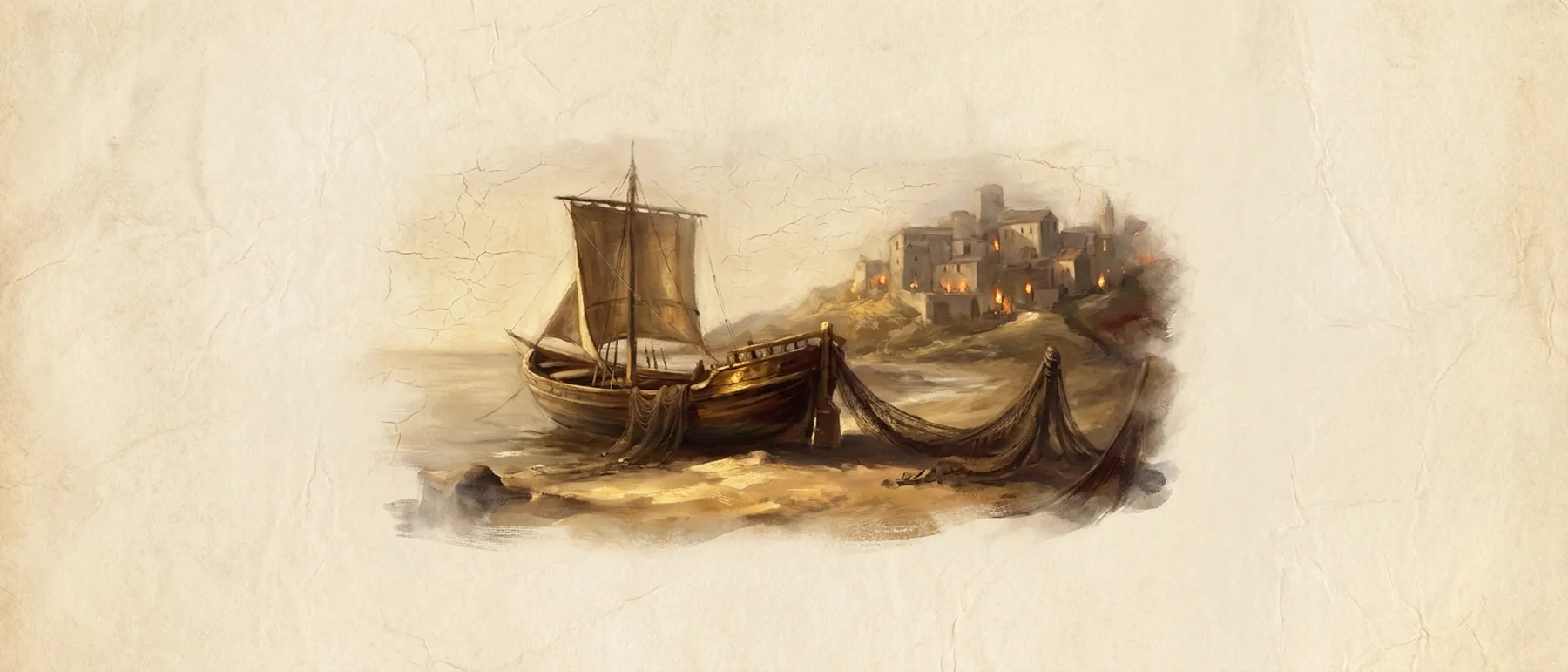
The Tribe of Zebulun — the seashore, the ship, and the month of Sivan
The tribe of Zebulun descends from Zebulun, the sixth son Leah bore Jacob; she named him for a "choice gift" (zeved) and the hope that her husband would "exalt" her. Jacob placed him by the seashore, the Midrash puts a ship on his banner, and the later banner-order tradition pairs it with Sivan.
Zebulun (Hebrew Zevulun) is best known for a partnership. Rashi, drawing on the Midrash, says Zebulun traded by sea and supported the tribe of Issachar, who studied Torah. That reading comes from one verse in Moses' blessing, and it is explained below.
The name and the birth
Genesis 30:19–20 tells it: "When Leah conceived again and bore Jacob a sixth son, Leah said, 'God has given me a choice gift; this time my husband will exalt me, for I have borne him six sons.' So she named him Zebulun" (JPS translation on Sefaria).
The verse holds two word plays. Zevadani… zeved tov (זְבָדַנִי… זֵבֶד טוֹב) means "has given me a good gift." Yizbeleni (יִזְבְּלֵנִי), from the same sounds as the name Zebulun (זְבוּלֻן), is rendered "will exalt me"; the JPS note adds that other translations render it "will dwell with me." Both renderings are on the record, so the name's sense is not fixed to one English word.
Genesis 35:23 lists the sons of Leah as Reuben, Simeon, Levi, Judah, Issachar and Zebulun. Zebulun is named last, and Rashi notes that Issachar was the older of the two.
Jacob's blessing (Genesis 49)
"Zebulun shall dwell by the seashore; he shall be a haven for ships, and his flank shall rest on Sidon" (Genesis 49:13, JPS).
In Hebrew: Zevulun le-chof yamim yishkon, ve-hu le-chof oniyot, ve-yarchato al Tzidon (זְבוּלֻן לְחוֹף יַמִּים יִשְׁכֹּן וְהוּא לְחוֹף אֳנִיֹּת וְיַרְכָתוֹ עַל־צִידֹן). The verse is about place, not character: a coast, a harbor, and a border near Sidon.
Rashi reads it the same way. He says Zebulun's land would be on the shore, that he would be found at the port where ships bring merchandise, and that the end of his territory would come close to Sidon. He adds that Zebulun was engaged in trade and provided food for the tribe of Issachar while they studied Torah, and that Moses alludes to this in Deuteronomy 33:18.
Moses' blessing (Deuteronomy 33)
Moses blesses Zebulun and Issachar in one breath: "Rejoice, O Zebulun, on your journeys, and Issachar, in your tents. They invite their kin to the mountain, where they offer sacrifices of success. For they draw from the riches of the sea and the hidden hoards of the sand" (Deuteronomy 33:18–19, JPS).
The Hebrew for "on your journeys" is be-tzetecha, literally "in your going out."
That partnership is a rabbinic reading of the verse. The verse itself only sets the two side by side, one going out and one in tents, and says both draw from "the riches of the sea."
Symbol, flag and stone
The Torah does not describe the tribal banners. The description comes from Bamidbar Rabbah 2:7, which says each prince's banner was the color of his tribe's stone on the High Priest's breastplate.
For Zebulun it gives:
- Stone: yahalom (יָהֲלֹם)
- Banner color: white
- Emblem: a ship, "based on: 'Zebulun will dwell at the seashore'" (Genesis 49:13)
Exodus 28:21 says the stones were engraved "each with its name, for the twelve tribes," without saying which name went on which stone. Rashi on that verse says the stones followed the brothers' birth order and names only Reuben's and Simeon's. The Midrash's list is a separate tradition, so different sources can give Zebulun a different stone.
In the wilderness and in the land
| Zebulun | Source | |
|---|---|---|
| First census (men 20 and over able to bear arms) | 57,400 | Numbers 1:30–31 |
| Second census | 60,500 | Numbers 26:26–27 |
| Camp side | East, in the division of Judah, with Judah and Issachar | Numbers 2:3–9 |
| Marching order | First division to set out; Zebulun is its third troop | Numbers 2:9; 10:14–16 |
| Prince (chieftain) | Eliab son of Helon | Numbers 1:9; 2:7 |
| Day of the Tabernacle offering | Third day | Numbers 7:24 |
| Territory | The third lot: 12 towns, with a boundary starting at Sarid | Joshua 19:10–16 |
Numbers 26:26–27 names three Zebulunite clans: the Seredites, Elonites and Jahleelites. The towns listed for Zebulun in Joshua 19:15 include Nahalal, Shimron and Bethlehem.
Elon the Zebulunite. Judges 12:11–12 says Elon the Zebulunite led Israel for ten years and was buried in Aijalon, in the territory of Zebulun.
With Naphtali against Sisera. In Judges 4:6 Deborah tells Barak to take ten thousand men "of Naphtali and Zebulun" to Mount Tabor, and in the Song of Deborah Judges 5:18 says "Zebulun is a people that mocked at death." The JPS note gives the literal sense: "belittled its life to die." See the tribe of Naphtali for that story.
The tribe and the Hebrew month
A later Jewish tradition pairs the twelve Hebrew months with the twelve tribes by the order in which the tribal banners set out in Numbers 10:14–27. Bnei Yissaschar, a Hasidic work arranged by the months of the year, states the principle at the start of its Tishrei section: Tishrei "according to the order of the banners" is ascribed to Ephraim, seventh in the march.
Counting from Nisan, the first three troops are Judah, Issachar and Zebulun, so Zebulun falls on the third month, the month of Sivan. Sefer Yetzirah 5:2 pairs Sivan with Teomim, the twins (Gemini). Issachar, Zebulun's partner in Rashi's reading, falls on the month of Iyar, just before it.
This pairing is interpretation, not a statement of the Torah, and it says nothing about anyone's actual ancestry. Sefer Yetzirah itself names no tribes. For the twelve signs, see the Jewish zodiac signs.
Frequently asked questions
What does the name Zebulun mean?
Genesis 30:20 explains it with two word plays. Leah said "God has given me a choice gift" (zevadani… zeved) and "this time my husband will exalt me" (yizbeleni), and named the child Zebulun. The JPS note says some translations render yizbeleni as "will dwell with me" instead. Either way, the name records Leah's hope after her sixth son.
What is the symbol of the tribe of Zebulun?
A ship. Bamidbar Rabbah 2:7 says Zebulun's banner was white with a ship depicted on it, based on Jacob's blessing "Zebulun will dwell at the seashore" in Genesis 49:13. The Torah itself does not describe the tribal flags; this description comes from the Midrash.
What stone represents Zebulun?
Bamidbar Rabbah 2:7 assigns Zebulun the yahalom, a stone of the second row of the High Priest's breastplate (Exodus 28:18). What that stone was is uncertain: the Sefaria translation of the midrash says clear quartz, the JPS translation of Exodus says amethyst, and the JPS note warns that several of the stones cannot be identified.
What is the Zebulun and Issachar partnership?
It is Rashi's reading of Deuteronomy 33:18, "Rejoice, O Zebulun, on your journeys, and Issachar, in your tents." Citing Genesis Rabbah, Rashi says Zebulun lived by the harbor, traded by ship, and provided food for Issachar, who studied Torah. That is why, he says, Moses names Zebulun first although Issachar was older.
Who was Zebulun's mother?
Leah. Genesis 30:19–20 says Leah bore Jacob a sixth son and named him Zebulun, and Genesis 35:23 lists him last among the sons of Leah: Reuben, Simeon, Levi, Judah, Issachar and Zebulun. Leah's own words at his birth, "I have borne him six sons," mark him as the sixth. Issachar, his partner in Moses' blessing, was a full brother.
What month is the tribe of Zebulun?
Sivan, in the tradition that pairs months with tribes by the order of the banners in Numbers 10:14–27. Zebulun is the third troop named there, and Sivan is the third month counting from Nisan. The pairing is later interpretation, found in works such as Bnei Yissaschar, not a statement of the Torah.
Zebulun is one of the twelve tribes of Israel. To see which Hebrew month, sign and tribe tradition pairs with your own birthday, the free Jewish zodiac reading works it out from your Hebrew birth date, and the Hebrew birthday calculator finds the date itself.
In the sources
Every text below was read in the linked edition while this page was written.
- Genesis 30:19-20 — sefaria.org
- Genesis 35:23 — sefaria.org
- Genesis 49:13 — sefaria.org
- Rashi on Genesis 49:13:1-2 — sefaria.org
- Deuteronomy 33:18-19 — sefaria.org
- Rashi on Deuteronomy 33:18:2 — sefaria.org
- Bamidbar Rabbah 2:7 — sefaria.org
- Exodus 28:17-21 — sefaria.org
- Exodus 39:10-14 — sefaria.org
- Rashi on Exodus 28:21:1 — sefaria.org
- Numbers 1:30-31 — sefaria.org
- Numbers 26:26-27 — sefaria.org
- Numbers 2:3-9 — sefaria.org
- Numbers 1:9 — sefaria.org
- Numbers 7:24 — sefaria.org
- Numbers 10:14-27 — sefaria.org
- Bnei Yissaschar, Tishrei 1:1 — sefaria.org
- Joshua 19:10-16 — sefaria.org
- Judges 12:11-12 — sefaria.org
- Judges 4:6 — sefaria.org
- Judges 5:18 — sefaria.org
- Sefer Yetzirah 5:2 — sefaria.org
- Klein Dictionary, s.v. יַהֲלוֹם — sefaria.org
Names, mothers, emblems, stones and months in one table.
Name, blessings, emblem and month.
Name, blessings, emblem and month.