The Tribe of Gad — good fortune, the camp, and the month of Elul
**The tribe of Gad descends from Gad, Jacob's son by Zilpah, Leah's maid; at his birth Leah said ba gad, which Rashi explains as "good luck has come."** The Midrash puts a military camp on Gad's banner, and the banner tradition pairs Gad with Elul.
The name and the birth
When Leah saw she had stopped bearing, she gave Jacob her maid Zilpah. "And when Leah's maid Zilpah bore Jacob a son, Leah said, 'What luck!' So she named him Gad."
The Hebrew has a famous spelling question. The written text (ketiv) has one word, בגד, begad; the reading tradition (qere) has two, בָּא גָד, ba gad, "luck has come." The JPS translation notes both.
Rashi on Genesis 30:11 explains ba gad as "good luck has come," in Hebrew ba mazal tov, with the same two words as the greeting mazal tov. He adds two other readings. A midrash says Gad was born circumcised, from a root meaning "cut." And on why the text writes it as one word, begad, he suggests it may come from the root for "betrayed," as if Leah said to Jacob, "You proved faithless to me when you married my handmaid." For more on the word mazal itself, see what is mazal.
Gad was Jacob's seventh son, born after Leah's four sons and Bilhah's two. His full brother is Asher, Zilpah's second son.
Jacob's blessing (Genesis 49)
In Hebrew the verse is almost all one sound: Gad gedud yegudenu, ve-hu yagud akev, גָּד גְּדוּד יְגוּדֶנּוּ וְהוּא יָגֻד עָקֵב. The name Gad is played against gedud, a raiding band. The picture is a tribe that is attacked and strikes back.
Moses' blessing (Deuteronomy 33)
JPS marks the meaning of verse 21 as uncertain. Rashi reads it closely. Gad took land in the kingdoms of Sihon and Og, "the beginning of the conquest of the Land." The "portion of the lawgiver" is the burial place of Moses, which lay in Gad's territory and is hidden, "no man knows his burial place." And Gad's men "marched before the armed men at the conquest of the Land, because they were mighty," keeping their promise to cross the Jordan.
Symbol, flag and stone
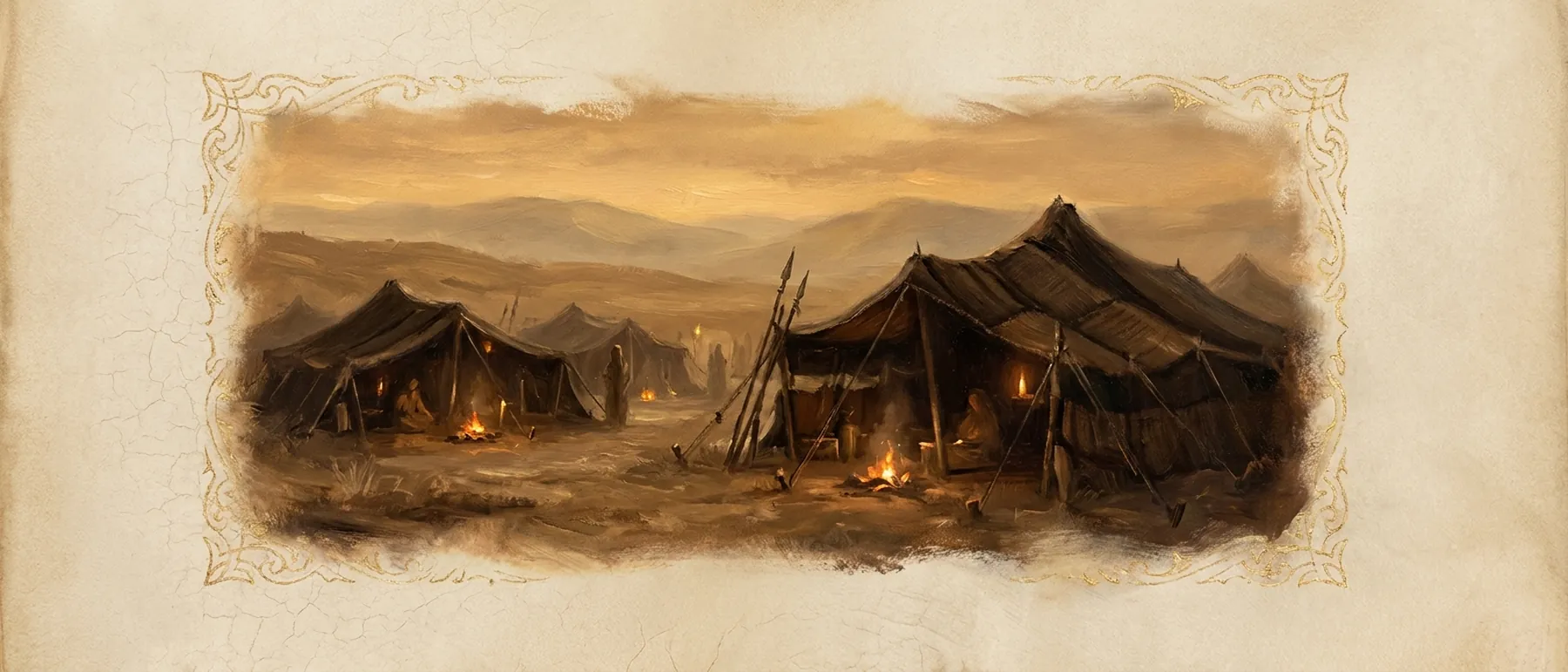
The symbol of the tribe of Gad is a military camp. Bamidbar Rabbah 2:7 says: "Gad, [its stone was] an agate, and the color of its banner was neither white nor black, but rather white and black intermingled, and an encampment was depicted on it, based on: 'Gad will wage war by regiment' (Genesis 49:19)." The Hebrew word for the emblem is machaneh, a camp.
The breastplate of Exodus 28:17–21 had twelve stones "corresponding to the names of the sons of Israel." Sources differ on Gad's:
| Source | Gad's stone (Hebrew) | How it is translated |
|---|---|---|
| Bamidbar Rabbah 2:7 | shevo שְׁבוֹ | agate |
| Rashi on Exodus 28:21 (stones follow birth order) | the seventh stone, leshem לֶשֶׁם | jacinth |
Rashi says the stones follow the sons' birth order. Gad was the seventh son, so on that reading his stone is the seventh in the list, leshem. No one can say with certainty which modern gems these Hebrew names meant, and translations differ.
In the wilderness and in the land
| Tribe of Gad | |
|---|---|
| First census (Numbers 1:25) | 45,650 |
| Second census (Numbers 26:18) | 40,500 |
| Camp | South side, in Reuben's division with Simeon, 151,450 in all, marching second |
| Chieftain | Eliasaph son of Deuel (Numbers 1:14; 7:42; 10:20), called son of Reuel in Numbers 2:14; offering on the sixth day |
| Territory | East of the Jordan: Jazer, the towns of Gilead, Heshbon to Ramath-mizpeh, Mahanaim, Succoth, up to the Sea of Chinnereth (Joshua 13:24–28) |
| Notable figures | The Gadite warriors who joined David, "like lions" (1 Chronicles 12:9) |
The chieftain's father is spelled two ways in the Torah: Deuel in Numbers 1:14, 7:42 and 10:20, and Reuel in Numbers 2:14. In Hebrew the two names differ only in the first letter, ד or ר.
East of the Jordan. Numbers 32 explains why Gad lived across the river. "The Reubenites and the Gadites owned cattle in very great numbers," and the lands of Jazer and Gilead were "a region suitable for cattle." They asked Moses, "do not move us across the Jordan." Moses asked, "Are your brothers to go to war while you stay here?" The two tribes promised to build sheepfolds and towns for their families and to go ahead of the other Israelites as shock troops until everyone had their land. Moses then assigned the kingdoms of Sihon and Og to Gad, Reuben and half the tribe of Manasseh.
Warriors of David. Chronicles describes Gadites who joined David at his wilderness stronghold as "valiant warriors ... they had the appearance of lions, and were as swift as gazelles upon the mountains." The lion matches Moses' blessing, "poised is he like a lion."
The tribe and the Hebrew month
A later tradition pairs each Hebrew month with a tribe, following the order in which the tribes marched in Numbers 10:14–27. Rabbi Tzvi Elimelech of Dinov states the principle in Bnei Yissaschar: Tishrei goes to Ephraim "according to the order of the banners," because Ephraim was seventh. Gad marched sixth, closing Reuben's division, so Gad is paired with the sixth month from Nisan: the month of Elul. On this site Elul's sign is Betulah (Virgo); see the Virgo page and the Jewish zodiac signs.
The pairing is interpretation, a way of reading the months. It says nothing about anyone's ancestry or fortune.
Frequently asked questions
What is the symbol of the tribe of Gad?
A military camp. Bamidbar Rabbah 2:7 says Gad's banner, black and white mixed together, showed an encampment, based on Jacob's blessing "Gad shall be raided by raiders, but he shall raid at their heels" (Genesis 49:19). Moses' blessing adds a second image: Gad "poised like a lion" (Deuteronomy 33:20).
What does the name Gad mean?
At his birth Leah said ba gad (Genesis 30:11). JPS translates "What luck!" and Rashi explains "good luck has come," in Hebrew ba mazal tov. The written text joins the two words as begad; Rashi also offers a reading from the root for "betrayed," and a midrash about Gad's birth.
Who was Gad's mother?
Zilpah, Leah's maid. When Leah stopped bearing children she gave Zilpah to Jacob, and Zilpah bore Gad and then Asher (Genesis 30:9–13). Leah named both boys. Gad was Jacob's seventh son.
Why did the tribe of Gad live east of the Jordan?
Numbers 32 says Gad and Reuben had very large herds and saw that Jazer and Gilead were good cattle country. They asked to settle there and promised to cross the Jordan armed and fight until the other tribes held their land. Moses agreed and gave them the kingdoms of Sihon and Og.
What stone represents the tribe of Gad?
Bamidbar Rabbah 2:7 gives Gad the shevo, usually translated agate. Rashi on Exodus 28:21 says the stones follow birth order, which would give Gad, the seventh son, the seventh stone, leshem, translated jacinth. The ancient stones cannot be identified with certainty.
What month is the tribe of Gad?
Elul. The tradition recorded in Bnei Yissaschar matches the months, from Nisan, to the order of the banners in Numbers 10. Gad's troop set out sixth, at the end of Reuben's division, and Elul is the sixth month. This is a later interpretive tradition, not a biblical statement.
Gad is one of the twelve tribes of Israel, and shared the land east of the Jordan with Reuben and half of Manasseh. If you want to see which month and tribe your own Hebrew birthday falls under, the free Jewish zodiac reading starts from your Hebrew birth date.
In the sources
Every text below was read in the linked edition while this page was written.
- Genesis.30.9-11 — sefaria.org
- Genesis.30.11 — sefaria.org
- Rashi on Genesis.30.11 — sefaria.org
- Genesis.29.32-30.13 — sefaria.org
- Genesis.49.19 — sefaria.org
- Deuteronomy.33.20-21 — sefaria.org
- Rashi on Deuteronomy.33.21 — sefaria.org
- Bamidbar Rabbah.2.7 — sefaria.org
- Exodus.28.17-21 — sefaria.org
- Rashi on Exodus.28.21 — sefaria.org
- Numbers.1.24-25 — sefaria.org
- Numbers.26.15-18 — sefaria.org
- Numbers.2.10-16 — sefaria.org
- Numbers.7.42 — sefaria.org
- Joshua.13.24-28 — sefaria.org
- I Chronicles.12.9 — sefaria.org
- Numbers.32.1-6 — sefaria.org
- Bnei Yissaschar, Tishrei.1.1 — sefaria.org
- Numbers.32.16-18 — sefaria.org
- Numbers.32.33 — sefaria.org
- Numbers.10.14-27 — sefaria.org
Names, mothers, emblems, stones and months in one table.
Name, blessings, emblem and month.
Name, blessings, emblem and month.