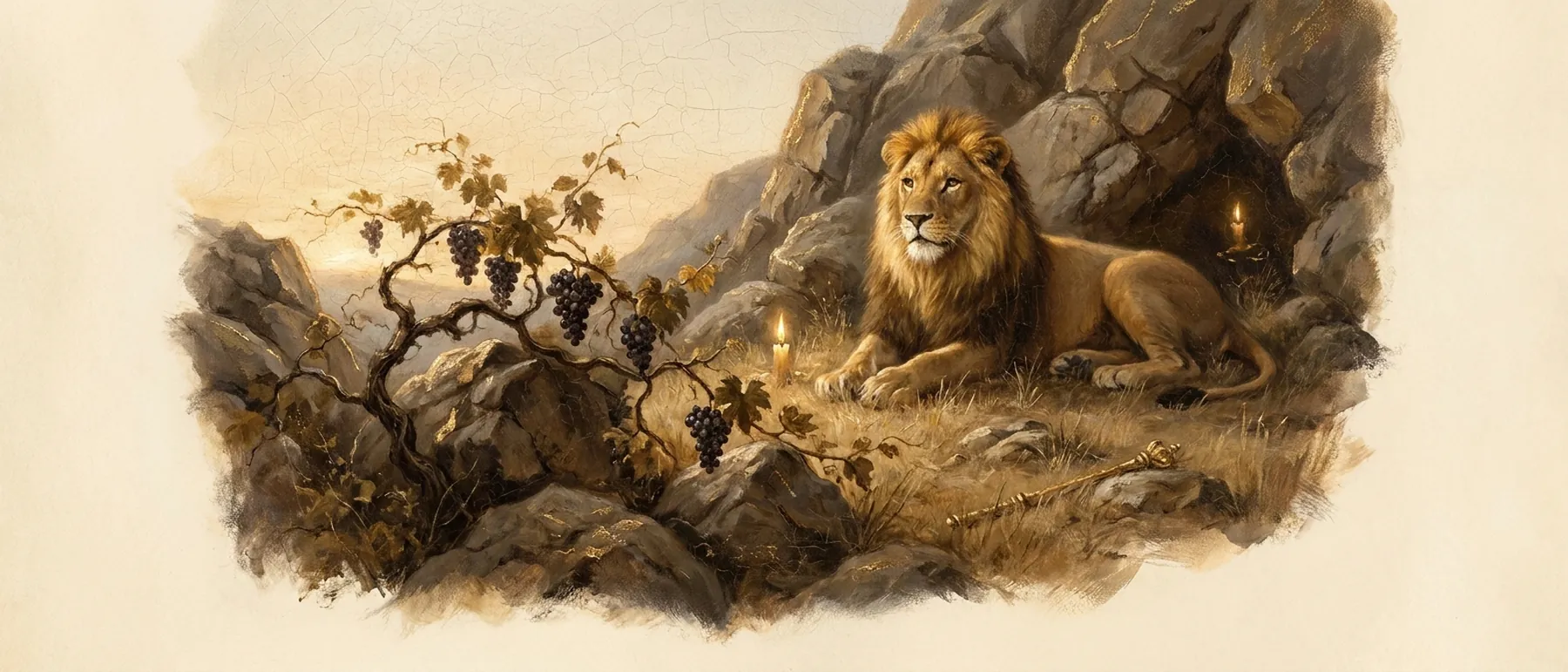
The Tribe of Judah — the lion, the kings, and the month of Nisan
The tribe of Judah descends from Judah (Yehudah), the fourth son of Jacob and Leah, whose name comes from Leah's words "This time I will praise GOD." The Midrash gives its banner a lion on a sky-colored field, and the later month tradition pairs Judah with Nisan.
Judah is also the tribe that gave its name to the Jewish people. The Hebrew yehudi, "Jew," first meant a member of the tribe of Judah.
The name and the birth
Leah's first three sons are named for her hope of winning Jacob's love. Reuben's name says "now my husband will love me," and Levi's "this time my husband will become attached to me." With her fourth son the wording changes: "This time I will praise GOD," and "therefore she named him Judah." The JPS notes connect the verb odeh, "I will praise," with the name Yehudah. After Judah, the verse adds, "Then she stopped bearing."
Genesis 35:23 lists Judah fourth among Leah's six sons, after Reuben, Simeon and Levi.
Two later scenes show Judah taking responsibility for his youngest brother, Benjamin. When the brothers must bring Benjamin to Egypt, Judah says, "I myself will be surety for him." When Joseph, still unrecognized, threatens to keep Benjamin as a slave, Judah steps forward and offers himself in the boy's place.
Jacob's blessing (Genesis 49)
Jacob's words to Judah are the source of the "lion of Judah":
The blessing opens with a second pun on the name: Yehudah, atah yoducha achecha, "Judah, your brothers shall praise you." The Hebrew for the lion image is gur aryeh Yehudah, "a lion's whelp is Judah." Verse 10 ends with a phrase whose meaning is uncertain. The JPS translation reads it as "so that tribute shall come to him" and notes that the literal sense is "until he comes to Shiloh." Verses 11–12 add vines, wine and milk, images of a fertile land.
Moses' blessing (Deuteronomy 33)
Moses' blessing for Judah is a short prayer rather than a portrait:
The lion is not Judah's alone in the Torah. Moses calls Dan "a lion's whelp" too, with the same Hebrew words gur aryeh (Deuteronomy 33:22), and compares Gad to a lion (33:20). Only Judah, though, has the lion on its banner in the Midrash.
Symbol, flag and stone
According to Midrash Bamidbar Rabbah 2:7, every tribe's banner had the color of its stone on the high priest's breastpiece. Judah's stone was the nofekh, its banner was "like the heavens," and "a lion was depicted on it." The flag is a rabbinic tradition. The Torah itself says only that each tribe camped under its own banner.
The nofekh is the first stone of the second row of the breastpiece (Exodus 28:18). Rashi says the stones followed the sons' birth order, which puts Judah, the fourth son, on the fourth stone, and Bamidbar Rabbah agrees. The JPS Tanakh and Sefaria's English Midrash Rabbah both translate nofekh as "turquoise," but what mineral the ancient word named is not certain.
In the wilderness and in the land
| Tribe of Judah | |
|---|---|
| First census (Numbers 1:27) | 74,600 |
| Second census (Numbers 26:22) | 76,500 |
| Camp | East side, at the head of the camp of Judah, with Issachar and Zebulun (Numbers 2:3–9) |
| Order of march | First (Numbers 2:9; 10:14) |
| Chieftain | Nahshon son of Amminadab (Numbers 1:7; 2:3) |
| Territory | The southernmost lot, down to the border of Edom (Joshua 15) |
Judah was the largest tribe in both censuses. When the chieftains brought their offerings for the dedication of the altar, one chieftain each day, Nahshon of Judah came "on the first day."
Judah's towns included Kiriath-arba, "that is, Hebron," given to Caleb. Joshua 15:63 notes that "the Judahites could not dispossess the Jebusites, the inhabitants of Jerusalem." The book of Joshua lists Jerusalem among the towns of Benjamin.
King David. Ruth 4:18–22 traces David to Perez, Judah's son, through Nahshon, the same tribal chieftain. First Samuel calls David's father Jesse "a certain Ephrathite of Bethlehem in Judah." First Chronicles sums up: "Judah became more powerful than his brothers and a leader came from him."
The kingdom of Judah. When the kingdom split after Solomon, "only the tribe of Judah remained loyal to the House of David," and Solomon's son Rehoboam mustered "all the House of Judah and the tribe of Benjamin." After Assyria exiled the northern tribes, Second Kings says "none was left but the tribe of Judah alone." That is how yehudi, "Judahite," came to mean "Jew."
The tribe and the Hebrew month
In the tradition that pairs tribes with months, Judah belongs to the month of Nisan, the first month, whose sign is Taleh, the Hebrew name for Aries.
The pairing follows the order in which the banners marched in Numbers 10:14–27, where Judah's division set out first. Bnei Yissaschar, the nineteenth-century Hasidic work by Rabbi Tzvi Elimelech of Dinov, states it directly: "according to the order of the banners, this month belongs to Judah, from whom comes the rod of kingship." Sefer Yetzirah, the source of the month and sign pairings, names no tribes. In its Gra version, Nisan's faculty is speech, and the commentary printed under the Ra'avad's name pairs speech with Judah, citing Leah's "This time I will praise," though it also records the view that speech belongs to Naphtali.
In 5787, Nisan runs from April 8 to May 7, 2027 (daytime dates), beginning at nightfall on April 7.
This is a symbolic reading of the calendar. It says nothing about who is actually descended from Judah.
Frequently asked questions
What does the name Judah mean?
Judah's mother Leah named him with the words "This time I will praise GOD" (Genesis 29:35). The Hebrew name Yehudah shares its letters with the verb odeh, "I will praise." Jacob repeats the pun in his blessing: "Judah, your brothers shall praise you" (Genesis 49:8).
What is the symbol of the tribe of Judah?
The lion. Jacob calls Judah "a lion's whelp" in Genesis 49:9, and the Midrash Bamidbar Rabbah 2:7 says the tribe's banner was sky-colored with a lion depicted on it. The banner's appearance comes from rabbinic tradition. The Torah says only that each tribe camped under its own banner.
What is the lion of Judah?
The phrase comes from Jacob's blessing, "Judah is a lion's whelp... he crouches, lies down like a lion" (Genesis 49:9). The image became the tribe's emblem in the Midrash. Moses also calls Dan "a lion's whelp" (Deuteronomy 33:22), but only Judah carries the lion on its banner.
What stone represents the tribe of Judah?
The nofekh, the first stone of the second row of the high priest's breastpiece (Exodus 28:18). Both Rashi's birth-order rule and Bamidbar Rabbah 2:7 assign it to Judah. It is usually translated "turquoise," but identifying the ancient stone is uncertain.
Where did the tribe of Judah live?
In the south of the land of Israel. Joshua 15 gives Judah the southernmost lot, reaching the border of Edom and the Wilderness of Zin, and its towns include Hebron. Joshua lists Jerusalem among Benjamin's towns, and Joshua 15:63 says Judah could not drive out its Jebusite inhabitants.
What month is the tribe of Judah?
Nisan, in the tradition that follows the marching order of the banners (Numbers 10:14–27), recorded in Bnei Yissaschar. Judah's division marched first, and Nisan is the first month. This pairing is a later interpretive tradition. Sefer Yetzirah, which links the months to the zodiac signs, does not mention the tribes.
Judah is one of the twelve tribes of Israel; the hub page compares all twelve. To see which Hebrew month you were born in and the tribe tradition pairs with it, you can request a free Jewish zodiac reading.
In the sources
Every text below was read in the linked edition while this page was written.
- Genesis 29:32-35 — sefaria.org
- Bamidbar Rabbah 2:7 — sefaria.org
- Bnei Yissaschar, Nisan 1:4 — sefaria.org
- Klein Dictionary, יְהוּדִי — sefaria.org
- Genesis 35:23 — sefaria.org
- Genesis 43:8-9; 44:18, 33 — sefaria.org
- Genesis 49:8-12 — sefaria.org
- Deuteronomy 33:7 — sefaria.org
- Deuteronomy 33:20, 22 — sefaria.org
- Numbers 2:2-9 — sefaria.org
- Exodus 28:18 (and 39:11) — sefaria.org
- Rashi on Exodus 28:21:1 — sefaria.org
- Numbers 1:27; 26:22 — sefaria.org
- Numbers 10:14-27 — sefaria.org
- Numbers 1:7; 2:3; 7:10-12 — sefaria.org
- Joshua 15:1, 13, 54, 63 — sefaria.org
- Joshua 18:28 — sefaria.org
- Ruth 4:18-22; Genesis 46:12; I Samuel 17:12 — sefaria.org
- I Chronicles 5:2 — sefaria.org
- I Kings 12:20-21; II Kings 17:18 — sefaria.org
- Sefer Yetzirah (Gra Version) 5:7; ch. 5 searched — sefaria.org
- Ra'avad on Sefer Yetzirah 5:1 — sefaria.org
- hebcal-5786-5788.json, year 5787, Nisan — hebcal.com
Names, mothers, emblems, stones and months in one table.
Name, blessings, emblem and month.
Name, blessings, emblem and month.