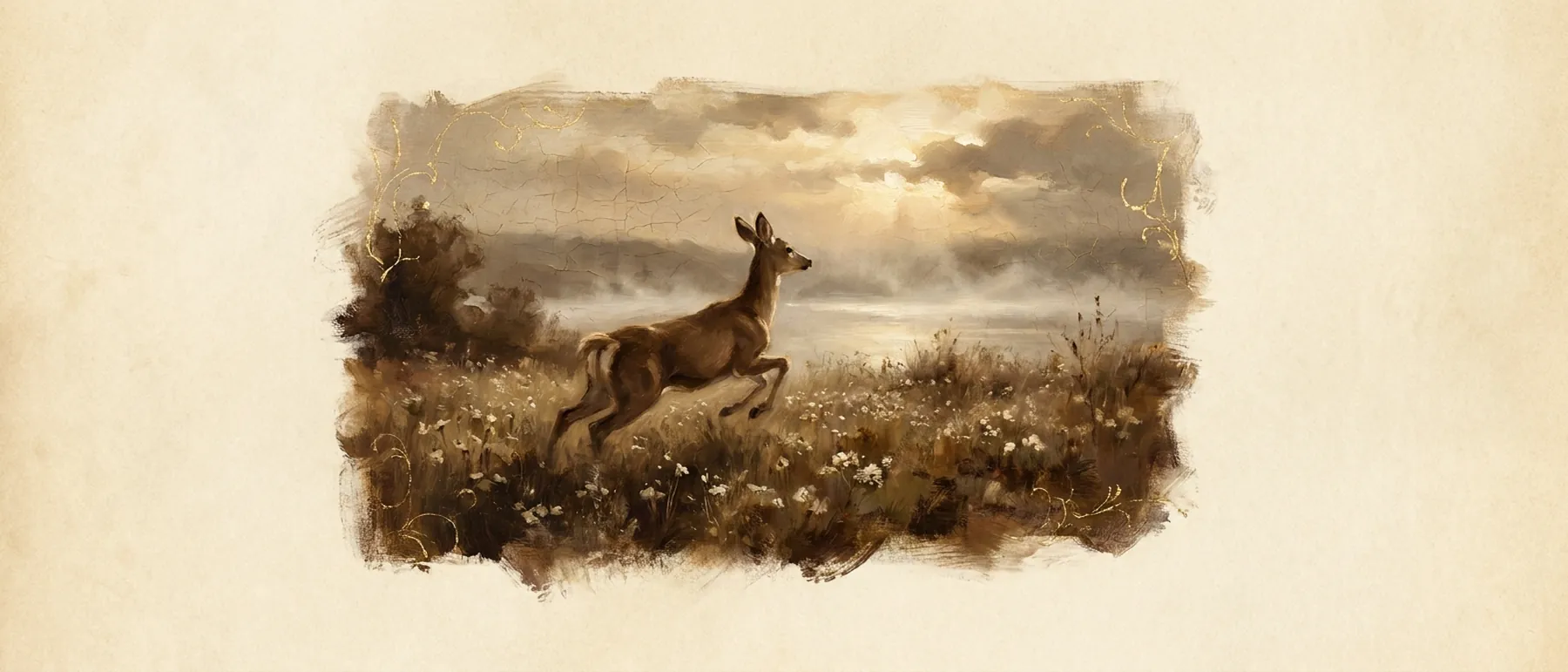
The Tribe of Naphtali — the hind let loose and the month of Adar
The tribe of Naphtali descends from Naphtali, Jacob's son by Bilhah, Rachel's maid; Rachel named him for her "contest" (naftulei) with her sister. Jacob called him "a hind let loose," and the Midrash puts a hind on the tribe's banner. In the later banner-order tradition its month is Adar.
Naphtali (Hebrew Naftali) camped on the north side of the wilderness camp. In the Book of Joshua its land reaches the Jordan and includes the towns of Chinnereth, Hazor and Kedesh, and its best-known son in the Bible is Barak, who fought Sisera with Deborah.
The name and the birth
Genesis 29:31 says Rachel was infertile while her sister Leah bore sons. Genesis 30:7–8 continues: "Rachel's maid Bilhah conceived again and bore Jacob a second son. And Rachel said, 'A fateful contest I waged with my sister; yes, and I have prevailed.' So she named him Naphtali" (JPS translation on Sefaria).
The Hebrew repeats one root: naftulei Elohim niftalti (נַפְתּוּלֵי אֱלֹהִים נִפְתַּלְתִּי). The JPS note connects naphtule… naphtalti with the name Naphtali (נַפְתָּלִי) and gives the literal sense as "a contest of God." Genesis 35:25 lists "the sons of Bilhah, Rachel's maid: Dan and Naphtali," which makes Dan his full brother.
Jacob's blessing (Genesis 49)
Jacob's words to Naphtali are a single line: "Naphtali is a hind let loose, which yields lovely fawns" (Genesis 49:21, JPS).
The Hebrew is Naftali ayalah sheluchah, ha-noten imrei shafer (נַפְתָּלִי אַיָּלָה שְׁלֻחָה הַנֹּתֵן אִמְרֵי־שָׁפֶר). The first half, the hind sent out to run, is clear. The second half is harder: imrei shafer is read by JPS as "lovely fawns," while Rashi reads it as "sayings of pleasantness," words of praise. Rashi offers several readings of it, starting with the Targum's. Translations differ, so treat any single English rendering of this half-verse with caution.
Rashi gives two explanations of the hind. One is the valley of Ginosar (בִּקְעַת גִּינוֹסַר), whose fruit ripens as fast as a hind runs. The other is the war against Sisera in Judges 4, where the men of Naphtali went up quickly; on that reading the "pleasant sayings" are the song Deborah and Barak sang because of them.
Moses' blessing (Deuteronomy 33)
Moses blesses Naphtali in Deuteronomy 33:23: "O Naphtali, sated with favor and full of GOD's blessing, take possession on the west and south" (JPS). The Hebrew for "west" is yam, literally "sea."
Read side by side, the two blessings describe a tribe that runs free and is satisfied with its share. Neither verse says anything about the personality of people born today, and this page does not read them that way.
Symbol, flag and stone
Numbers 2:2 tells each Israelite to camp "with its standard, under the banners of their ancestral house," but the Torah does not describe what the banners looked like. The description comes from Bamidbar Rabbah 2:7, a midrash on the word otot (insignias) in that verse. It says each prince's banner matched the color of his tribe's stone on the High Priest's breastplate.
For Naphtali it gives:
- Stone: achlamah (אַחְלָמָה)
- Banner color: like clear wine whose red is not deep
- Emblem: a hind, "based on: 'Naphtali is a hind let loose' (Genesis 49:21)"
Exodus 28:21 and 39:14 say the stones were engraved "each with its name, for the twelve tribes," but the verses do not say which name went on which stone. Rashi on Exodus 28:21 says the order followed the order of the brothers' births, and names only the first two (odem for Reuben, pitdah for Simeon). The Midrash's list above is a separate tradition, and the two do not have to agree for every tribe.
In the wilderness and in the land
| Naphtali | Source | |
|---|---|---|
| First census (men 20 and over able to bear arms) | 53,400 | Numbers 1:42–43 |
| Second census | 45,400 | Numbers 26:48–50 |
| Camp side | North, in the division of Dan, with Dan and Asher | Numbers 2:25–31 |
| Marching order | Last of the four divisions; Naphtali is the last troop named | Numbers 2:31; 10:25–27 |
| Prince (chieftain) | Ahira son of Enan | Numbers 1:15; 2:29 |
| Day of the Tabernacle offering | Twelfth day | Numbers 7:78 |
| Territory | The sixth lot: 19 fortified towns, including Chinnereth, Hazor and Kedesh | Joshua 19:32–39 |
Numbers 26:48–50 names four Naphtalite clans: the Jahzeelites, Gunites, Jezerites and Shillemites. Joshua 19:34 says Naphtali's border touched Zebulun on the south and Asher on the west.
Barak. In Judges 4:6 Deborah summons "Barak son of Abinoam, of Kedesh in Naphtali," and tells him to take ten thousand men "of Naphtali and Zebulun" to Mount Tabor against Sisera. Barak answers that he will go only if she goes with him, and she does.
In the Song of Deborah, Judges 5:18 names the same two tribes together: "Zebulun is a people that mocked at death, Naphtali—on the open heights." In both chapters Naphtali fights beside the tribe of Zebulun.
The tribe and the Hebrew month
A later Jewish tradition pairs the twelve Hebrew months with the twelve tribes by the order in which the tribal banners set out in Numbers 10:14–27. Bnei Yissaschar, a Hasidic work arranged by the months of the year, states the principle at the start of its Tishrei section: Tishrei "according to the order of the banners" is ascribed to Ephraim, seventh in the march.
Counting from Nisan, Naphtali is the twelfth and last troop named in Numbers 10:27, so it falls on the twelfth month, the month of Adar, whose sign is Dagim (Pisces). In a leap year such as 5787 there are two Adars, Adar I and Adar II; this page does not take a position on how the tradition handles the extra month.
This pairing is interpretation, not something the Torah states, and it says nothing about anyone's actual ancestry. Sefer Yetzirah 5:2, the older source that pairs Adar with Dagim, lists months, signs and parts of the body but names no tribes. For the signs themselves, see the Jewish zodiac signs.
Frequently asked questions
What does the name Naphtali mean?
Genesis 30:8 explains the name. Rachel said "A fateful contest I waged with my sister; yes, and I have prevailed," using the Hebrew naftulei and niftalti, from the same root as Naphtali. The JPS note gives the literal sense as "a contest of God." The name points to the rivalry between Rachel and Leah over children, not to a trait of the child himself.
What is the symbol of the tribe of Naphtali?
A hind, a female deer. Bamidbar Rabbah 2:7 says Naphtali's banner showed a hind, based on Jacob's blessing "Naphtali is a hind let loose" in Genesis 49:21. The same midrash gives the banner's color as like clear wine whose red is not deep. The Torah itself does not describe the tribal flags; this description is rabbinic.
What stone represents Naphtali?
Bamidbar Rabbah 2:7 assigns Naphtali the achlamah, a stone from the third row of the High Priest's breastplate in Exodus 28:19. Its identity is uncertain. The Sefaria translation of the midrash calls it amethyst; the JPS translation of Exodus calls it crystal and notes that several of the stones cannot be identified with confidence.
Who was Naphtali's mother?
Bilhah, Rachel's maid. Genesis 30:7–8 says Bilhah bore Jacob a second son and Rachel named him Naphtali, and Genesis 35:25 lists "the sons of Bilhah, Rachel's maid: Dan and Naphtali." Dan was therefore his full brother. Rachel, who gave him his name, was the mother of Joseph and Benjamin.
Where did the tribe of Naphtali live?
Joshua 19:32–39 gives Naphtali the sixth lot, with a boundary reaching the Jordan and 19 fortified towns, among them Chinnereth, Hazor and Kedesh. It touched Zebulun on the south and Asher on the west. Barak, the commander in Judges 4, came from Kedesh in Naphtali.
What month is the tribe of Naphtali?
Adar, in the tradition that pairs months with tribes by the order of the banners in Numbers 10:14–27. Naphtali is the last troop named there, and Adar is the twelfth month counting from Nisan. The pairing is later interpretation, found in works such as Bnei Yissaschar, not a statement of the Torah.
Naphtali is one of the twelve tribes of Israel. If you want to see which Hebrew month, sign and tribe tradition pairs with your own birthday, the free Jewish zodiac reading works it out from your Hebrew birth date; you can also look the date up first with the Hebrew birthday calculator.
In the sources
Every text below was read in the linked edition while this page was written.
- Genesis 30:7-8 — sefaria.org
- Genesis 35:24-25 — sefaria.org
- Genesis 49:21 — sefaria.org
- Rashi on Genesis 49:21:1-3 — sefaria.org
- Deuteronomy 33:23 — sefaria.org
- Bamidbar Rabbah 2:7 — sefaria.org
- Exodus 28:17-21 — sefaria.org
- Exodus 39:10-14 — sefaria.org
- Rashi on Exodus 28:21:1 — sefaria.org
- Numbers 1:42-43 — sefaria.org
- Numbers 26:48-50 — sefaria.org
- Numbers 2:25-31 — sefaria.org
- Numbers 1:15 — sefaria.org
- Numbers 7:78 — sefaria.org
- Joshua 19:32-39 — sefaria.org
- Judges 4:6-10 — sefaria.org
- Judges 5:18 — sefaria.org
- Numbers 10:14-27 — sefaria.org
- Bnei Yissaschar, Tishrei 1:1 — sefaria.org
- Genesis 29:31 — sefaria.org
- Sefer Yetzirah 5:2 — sefaria.org
- Numbers 2:2 — sefaria.org
- Klein Dictionary, s.v. אַחְלָמָה — sefaria.org
Names, mothers, emblems, stones and months in one table.
Name, blessings, emblem and month.
Name, blessings, emblem and month.