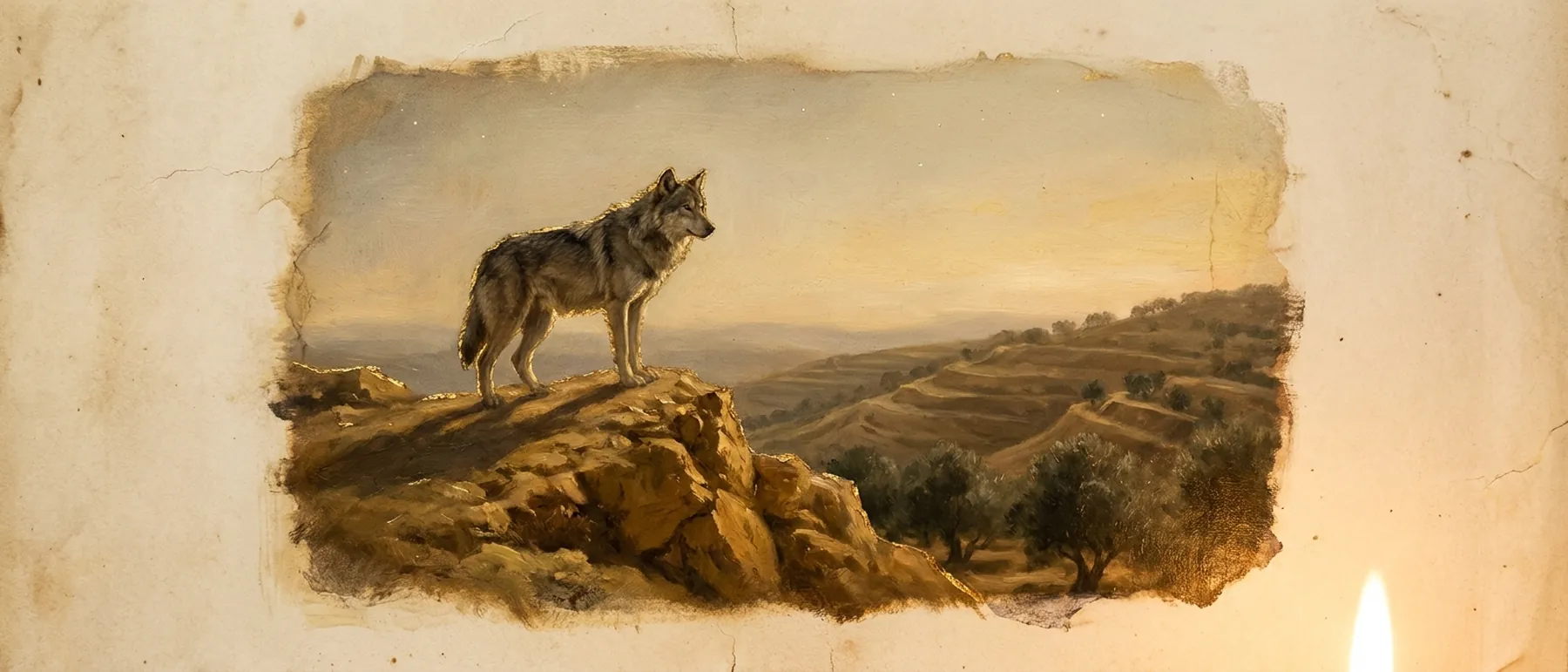
The Tribe of Benjamin — the wolf, the youngest son, and the month of Kislev
The tribe of Benjamin (Binyamin) descends from Benjamin, the youngest son of Jacob and the second son of Rachel, who died giving birth to him; she named him Ben-oni, and Jacob renamed him Benjamin. The Midrash gives the tribe a wolf on a banner of all twelve colors, and the month tradition pairs it with Kislev.
The tribe produced King Saul and Mordecai of the book of Esther.
The name and the birth
Benjamin is the only son of Jacob born in the land of Canaan; the others were born in Paddan-aram. The family had set out from Bethel and was "still some distance short of Ephrath" when Rachel went into hard labor. "As she breathed her last—for she was dying—she named him Ben-oni; but his father called him Benjamin." Rachel was buried on the road to Ephrath, "now Bethlehem," and Jacob set up a pillar over her grave.
Unlike his brothers, Benjamin receives a name with no explanation in the verse. Rashi fills the gap. Ben-oni means "son of my sorrow." Binyamin he reads as ben yamin, "son of the south," because Benjamin alone was born in the land of Canaan, which lies to the south for someone coming from Aram. Klein's dictionary gives yamin both meanings, "the right hand" and "the south," the south being on the right when one faces east.
The Bible itself sometimes spells the tribe's name as two words. In 1 Samuel 9:1 the written text has mi-ben yamin, "from Ben Yamin," read aloud as "from Benjamin," and a member of the tribe is called ish yemini, "a Benjaminite."
Genesis 35:24 lists him with his full brother: "The sons of Rachel: Joseph and Benjamin." Later, when Jacob hesitates to send Benjamin to Egypt, it is Judah who promises to bring him back.
Jacob's blessing (Genesis 49)
Jacob's last words to his sons end with the youngest:
In Hebrew the image is Binyamin ze'ev yitraf, "Benjamin, a wolf, tears." JPS notes that the word it translates "foe" ('ad) is uncertain, and that others render it "booty." The verse describes a fighter, active from morning to evening, rather than a peaceful settler.
Moses' blessing (Deuteronomy 33)
Moses' blessing is the opposite in tone:
Rashi explains why the blessing places Benjamin right after Levi: Levi's blessing concerns the Temple service, and Benjamin's concerns the Temple being built in his territory. On "between his shoulders," Rashi says the Temple stood in Benjamin's land a little below its highest point, as the shoulders sit below the head.
Symbol, flag and stone
According to Midrash Bamidbar Rabbah 2:7, each tribe's banner matched the color of its stone on the high priest's breastpiece. Benjamin's stone was the yashfeh, its banner was "like all the colors of the twelve colors," and "a wolf was depicted on it," based on Genesis 49:27. The banner is a rabbinic tradition. The Torah says only that each tribe camped under its own banner.
The yashfeh is the last stone of the fourth row (Exodus 28:20). Rashi's rule that the stones follow the sons' birth order puts Benjamin, the twelfth son, on the twelfth stone, and Bamidbar Rabbah agrees. The JPS Tanakh translates yashfeh as "jasper," while Sefaria's English Midrash Rabbah has "chalcedony." Which mineral the word named is not known for certain.
In the wilderness and in the land
| Tribe of Benjamin | |
|---|---|
| First census (Numbers 1:37) | 35,400 |
| Second census (Numbers 26:41) | 45,600 |
| Camp | West side, in the division of Ephraim, with Manasseh (Numbers 2:18–24) |
| Order of march | Third division, last tribe in it (Numbers 10:22–24) |
| Chieftain | Abidan son of Gideoni (Numbers 1:11; 2:22) |
| Territory | Between Judah and Joseph (Joshua 18:11–28) |
Benjamin camped beside the two tribes of his full brother Joseph, Ephraim and Manasseh. Its chieftain Abidan brought his dedication offering for the altar on the ninth day.
When the land was divided, Benjamin's lot "lay between the Judahites and the Josephites." Its towns included Jericho, Bethel, Gibeon, Ramah, Mizpeh, and "Jebus—that is, Jerusalem." Judges 1:21 says the Benjaminites did not drive out the Jebusites of Jerusalem.
Notable Benjaminites.
- Ehud son of Gera, the champion God raised up in the days of King Eglon of Moab, called in Judges 3:15 "the Benjaminite... a left-handed man."
- Saul, whose father Kish was "a man in Benjamin," described as "a head taller than any of the people."
- Mordecai, "a Jew by the name of Mordecai, son of Jair son of Shimei son of Kish, a Benjaminite," and his cousin Esther, "his uncle's daughter," whom he raised.
When the kingdom split after Solomon, Rehoboam mustered "all the House of Judah and the tribe of Benjamin," so Benjamin sided with Judah. Mordecai, a Benjaminite, is introduced as ish yehudi, "a Jew," a word that originally meant a member of the tribe of Judah.
The tribe and the Hebrew month
In the tradition that pairs tribes with months, Benjamin belongs to the month of Kislev, whose sign is Keshet, the Hebrew name for Sagittarius.
The pairing follows the marching order of the banners in Numbers 10:14–27, where Benjamin is ninth, and Kislev is the ninth month counting from Nisan. Bnei Yissaschar, the Hasidic work by Rabbi Tzvi Elimelech of Dinov, states it in a passage on the Hanukkah lights: "according to the order of the banners, Kislev to Benjamin and Tevet to Dan." The same passage reads the name as ben yamin, "son of the right."
Sefer Yetzirah names no tribes. In its Gra version, Kislev's faculty is sleep, and the commentary printed under the Ra'avad's name pairs sleep with Benjamin, citing "between his shoulders he dwells." The two sources reach Benjamin by different routes.
In 5787, Kislev runs from November 11 to December 10, 2026 (daytime dates), beginning at nightfall on November 10. In 5788 it runs from December 1 to December 30, 2027.
This is an interpretive tradition about the calendar, not a claim about anyone's descent.
Frequently asked questions
What does the name Benjamin mean?
The Torah does not explain it. Rachel, dying in childbirth, named him Ben-oni, which Rashi explains as "son of my sorrow," and Jacob renamed him Benjamin (Genesis 35:18). Rashi reads Binyamin as ben yamin, "son of the south," because he was the only son born in Canaan; yamin also means "right hand."
What is the symbol of the tribe of Benjamin?
The wolf. Jacob says "Benjamin is a ravenous wolf" in Genesis 49:27, and the Midrash Bamidbar Rabbah 2:7 says the tribe's banner showed a wolf on a field of all twelve colors. The banner's design is rabbinic tradition. The Torah says only that each tribe camped under its own banner.
What stone represents the tribe of Benjamin?
The yashfeh, the twelfth and last stone on the high priest's breastpiece (Exodus 28:20). Rashi's birth-order rule and Bamidbar Rabbah 2:7 both assign it to Benjamin, the youngest son. JPS translates it "jasper" and Sefaria's Midrash translation "chalcedony"; the ancient identification is uncertain.
Who was Benjamin's mother?
Rachel, Leah's sister and the mother of Joseph. She died giving birth to Benjamin on the road to Ephrath, now Bethlehem, and Jacob set a pillar over her grave (Genesis 35:16–20). Benjamin and Joseph were the only two sons of Rachel.
Where did the tribe of Benjamin live?
Between Judah and the tribes of Joseph (Joshua 18:11). Joshua 18 lists its towns, including Jericho, Bethel, Gibeon, Ramah, Mizpeh and Jebus, "that is, Jerusalem." Rashi on Deuteronomy 33:12 says the Temple was built in Benjamin's territory, which is how he reads Moses' words "between his shoulders."
What month is the tribe of Benjamin?
Kislev, in the tradition recorded in Bnei Yissaschar that follows the marching order of the banners in Numbers 10. Benjamin marched ninth, and Kislev is the ninth month from Nisan. The pairing is a later interpretation; Sefer Yetzirah, which links months to signs, names no tribes.
Benjamin is one of the twelve tribes of Israel; the hub page compares all twelve. To see which Hebrew month you were born in and the tribe tradition pairs with it, you can request a free Jewish zodiac reading.
In the sources
Every text below was read in the linked edition while this page was written.
- Genesis 35:16-20 — sefaria.org
- Genesis 35:24, 26 — sefaria.org
- Rashi on Genesis 35:18:1-3 — sefaria.org
- Klein Dictionary, יָמִין; I Samuel 9:1 — sefaria.org
- Bnei Yissaschar, Kislev and Tevet 3:38 — sefaria.org
- Genesis 49:27 — sefaria.org
- Deuteronomy 33:12; Rashi on Deuteronomy 33:12:1, 4 — sefaria.org
- Bamidbar Rabbah 2:7 — sefaria.org
- Exodus 28:20; Rashi on Exodus 28:21:1 — sefaria.org
- Numbers 1:37; 26:41 — sefaria.org
- Numbers 2:18-24 — sefaria.org
- Numbers 1:11; 2:22; 7:60 — sefaria.org
- Joshua 18:11, 21-28; Judges 1:21 — sefaria.org
- Judges 3:15 — sefaria.org
- I Samuel 9:1-2 — sefaria.org
- Esther 2:5, 7 — sefaria.org
- I Kings 12:21 — sefaria.org
- Genesis 43:8-9 — sefaria.org
- Sefer Yetzirah (Gra Version) 5:9; Ra'avad on Sefer Yetzirah 5:1 — sefaria.org
- hebcal-5786-5788.json, years 5787 and 5788, Kislev — hebcal.com
- Numbers 10:14-27 (Benjamin at 10:24) — sefaria.org
- Klein Dictionary, יְהוּדִי — sefaria.org
Names, mothers, emblems, stones and months in one table.
Name, blessings, emblem and month.
Name, blessings, emblem and month.